Headlines From Our Twitter Feed

Showing posts with label real deal guide to puerto rico. Show all posts

Friday, April 7, 2017

Puerto Rico Events For This Weekend


Friday, April 7

Noche En El Paraíso

Outdoor festival featuring music, gastronomy from various chefs and restaurants, alcoholic beverages and fashion. This Friday's theme is "Cuban Night"

Where: Plaza de Dorado, Dorado
When: 6:00 PM - 11:00 PM
Admission: Free

Mojo Culinary Fest

Local Salinas restaurants display their best dishes. Music, tapas, bar and refreshments available.

Where: Plaza de Recreo Las Delicias, Salinas
When: 5:30 PM - 11:00 PM
Admission: Free


Saturday, April 8

12th Sea Turtle Festival

Luquillo welcomes sea turtle nesting season and promotes natural conservation during this celebration featuring music, food vendors, artisans and childrens' activities.

Where: Luquillo Public Plaza, Jesus T Pineiro St., Luquillo
When: 10:00 AM - 10:00 PM
Admission: Free

Purina Snacks Woof Cinema Easter Edition 2017

Come watch "The Secret Life of Pets" with your dog. Free admission with packaging from a Purina Snack or a donation of any Purina or Purina Snacks food product for the Pet SOS foundation.

Where: Bahia Urbana, Pier 6, San Juan
When: 5:30 PM - 9:00 PM
Admission: Free (see above)


Sunday, April 9

Puerto Rico North Fashion Week 2017

Three-day festival features several designers showing off their latest styles. Runs Friday to Sunday. For tickets, email northfashionweek@gmail.com.

Where: Embassy Suites by Hilton (Dorado del Mar Beach Resort), Dorado
When: 7:00 PM- 11:00 PM
Admission: $30 per night

Condado In Concert 2017

Enjoy classical and local musical favorites, played by Iván Rijos with Francisco Cabán on violin.

Where: Antonia Quiñones Plaza, Luchetti Street, San Juan
When: 6:00PM - 8:00 PM
Admission: Free


The Puerto Rico Monitor cannot take responsibility for the accuracy of the 
above listings. They are based on the best information available at the time
of writing.


For more information on visiting Puerto Rico, read The Real Deal
Guide to Puerto Rico, only $3.59 in e-book format!

Tuesday, April 4, 2017

Visiting The El Yunque Rainforest

Feature


Bill Alvarez


The only honest-to-goodness tropical rainforest under the United States flag is located in eastern Puerto Rico, mostly in the town of Rio Grande. To get to it from San Juan, take Highway 26 east, and then exit onto PR Interstate Road 3, and head east/south (you can also take Toll Road 66 east, which is a faster way to get to Road 3, with a lot less traffic lights.) Off of Road 3, turn right onto PR-191 (you will see road signs directing you there, so it’s hard to miss). Once on PR-191, follow the signs for El Yunque. You will go through a small neighborhood and then you will notice you are driving increasingly uphill. Before long, you will see the forest’s welcome sign, and then the visitor’s center. The total drive from San Juan (if you take only Road 3, rather than Road 66 and Road 3) is about 30 miles, and will take about an hour.
The forest is officially open from 7:30AM to 6:00 PM daily. It doesn’t cost anything to get into the rainforest as such, and you can enjoy the many hiking trails, streams and waterfalls at no cost. The Visitor’s Center does charge $4 for adults and $2 for seniors, although children under 15 get in for free. They have a gift shop, cafeteria and some forest-related exhibits, as well as a movie about the rainforest narrated by Benicio del Toro. It is open daily from 9:00AM to 4:30 PM.
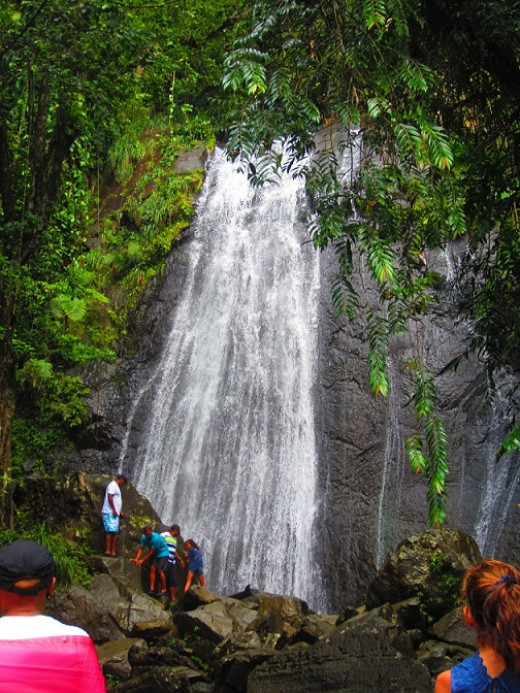
As you drive up through the rainforest, you will see several spots with limited parking where you can stop and go hiking or take some pictures. La Mina and La Coca waterfalls are both beautiful, and I recommend taking a dip in at least one of the pools at the bottom of the falls. The water is pretty cold, though! Rocks will also be slippery, so water shoes would be a handy thing to bring with you, along with an umbrella and/or poncho. As the name suggests, it rains all the time up there.
Stop at Yokahu Tower, climb up the stairs to the top and take some pictures of the stunning panorama. The hiking trails are pretty amazing, but they can be a bit narrow and steep. If you’re not in at least moderately good shape, you may only want to walk a portion of a trail, or skip them altogether. Wear some tennis shoes or hiking boots with good traction. La Coca Trail, La Mina Trail and the Big Tree Trail are some of the more popular ones (more trails here:http://www.fs.usda.gov/activity/elyunque/recreation/hiking/?recid=43377&actid=50).
The Mina Trail actually has a southern and a northern portion. The northern one follows the river more closely and seems to be the prettier one. Most trails have small picnic areas and gazebos along their trails.
DO NOT go exploring off-trail. El Yunque is a very large, deep jungle and you can most definitely get lost, perhaps for days. A few people who throughout the years have decided to venture into the forest without following trails did not make it out alive. I don’t want to scare you, all I’m saying is: follow the trails and you will have a great time.

Map data ©2016 Google
Map
Satellite
Source
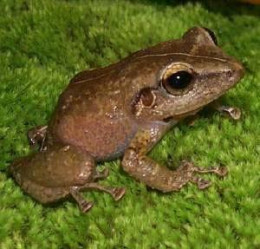
There are no indigenous peoples, cannibals, lions, elephants or other large animals in El Yunque. While the flora is very extensive and beautiful, the forest’s fauna is limited to lizards, insects, frogs and birds. If you’re lucky, you might catch a glimpse of the endangered Puerto Rican Parrot. You will almost certainly hear the call of Puerto Rico’s small native frog, the Coqui (its call sounds just like its name, a hypnotizing “co-kee, co-kee”). Please deposit all trash in marked receptacles, or take it with you.
Out of the hundreds of species of plants you will see at El Yunque, some are known to be poisonous. I would not recommend eating any wild fruits or berries during your visit. For more detailed information on
poisonous plants, go here:http://www.fs.usda.gov/detailfull/elyunque/learning/nature-science/?cid=fsbdev3_042885. Most of the vegetation is safe, though, and the forest is home to over two hundred different species of tree, as well as a dizzying array of flowers, among them different types of orchids.
If you’re more than a little adventurous, you can do some rain forest ziplining. YunKE Zipline Adventures offers a couple of different ‘adventures’ involving a few ziplines over a part of the forest, as well as some rappelling. As of summer 2013, their packages were priced at $99 per person. You can contact them directly at their website (http://yzapr.com). Rain Forest Zipline Corp (http://rainforestzipline.com/) also offers zip lining adventures, apparently at about the same price as YunKe ($99 + tax during day, $75 + tax at night), including a nighttime “Firefly Canopy Tour”.
For more detailed and current information on the rainforest, visit the US Park Service’s El Yunque website at: http://www.fs.usda.gov/elyunque


For more information on visiting Puerto Rico, check out The Real Deal Guide to Puerto Rico
available as an e-book

Tuesday, August 2, 2016

An Introduction To Puerto Rican Food


Feature

Bill Alvarez


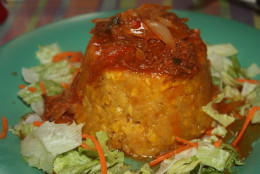
The food is probably the best thing about the island that most of the world at large doesn't know about. Puerto Rican food is largely a combination of Spanish and African elements, with some American characteristics blended in over the last century. Puerto Rico's best  known dish these days is probably Mofongo, which is a ball of fried, green plantain filled with meat (usually either chicken, fish or pork) and sometimes served sitting in a few ounces of fish broth. Green plantains look a lot like bananas, but aren't sweet. The closest common taste I could compare it to would be potato. When the plantain ripens, it becomes sweet, but dishes with green plantain always seem to taste best. Dishes like tostones and arañitas are also made from green plantain.

Rice and beans are everywhere, and have long been a staple of the Puerto Rican diet. The rice is usually white, and the beans most often red kidney beans, but different varieties of both are used. The island's diet is also heavy on pork, and is often found inside pasteles (which are a sort of turnover) on kabobs (orpinchos) and in sausages. Pork chops are also popular. Lechon asado (pork roasted over an open fire) is also popular, and the best lechon can be found outside of the San Juan metro area. If you like skirt steak ("churrasco") you're in luck, because it's everywhere.
You will also find some pretty incredible sandwiches in Puerto Rico. Pan de agua, or water bread, is like a french/italian bread, and is always sold in loaves (a sweeter variant is known as pan sobao). It is delicious and can really make a sandwich. The best sandwich you'll have in PR will probably be the tripleta, which -- as per its name -- has three different kinds of meat. A common combination would be steak, ham and roasted pork, with some mayo, potato sticks, lettuce and ketchup, served on pan de agua. After a night of drinking, nothing quite hits the spot like that 4:00 AM Tripleta.
Frituras are fried foods (or snacks, really) that are commonly sold in stalls or kiosks. These stands are almost always near the beach, and are very common on Road 187, as you go into Piñones from San Juan, and on the service road by Luquillo Beach. Alcapurrias are cigar-shaped masses of fried yautia (a locally grown tuber) and plantain, filled with either ground beef or crab. Bacalaitos are shaped like pancakes, and are made from a batter of flour and codfish. Both are delicious, although certainly not health food (frituras are often fried in lard over open fires). Don't be afraid and try some of the local food; even if it looks weird at first, your taste buds will thank you. The stuff from the beachside kiosks is usually tasty and safe to eat.
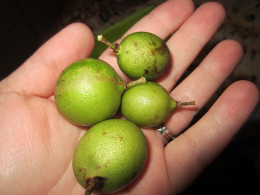
You'll also see plenty of fruits and vegetables that you have probably never seen before. Quenepas are a round fruit with a tough, green skin, inside of which a large pit is surrounded by a sweet paste. When they are in season, you will see people selling quenepas in bunches by the side of the road. Stop and try some. Don't get them on your clothes, though. You'll also come across mangoes, guava, bananas, oranges, along with several root vegetables (referred to collectively as "verduras" ) which for the most part have names that don't seem to have English translations: yucayautiañame and malanga, among others. Go the Plaza del Mercado in Santurce (what you would call a "farmer's market" in the rest of the U.S., except this one is not for yuppies) and check out the dizzying variety of local ingredients and foods.
As far as drinks go, Medalla is the main local beer, and is normally found for about a dollar a can. It is a light lager with not much body, but it is easy to drink and gets the job done. Rum is plentiful and relatively cheap; try some of the lesser-known local brands like Barrilito or Ron Llave. Piña Coladas were allegedly invented in Puerto Rico (at the restaurant Barrachina, in Old San Juan, specifically), and you haven't had a piña colada until you've had one in Puerto Rico. Want to try some coconut or pineapple soda? PR would be the place to do so. Malta is also big on the island. It is a carbonated, malted beverage, similar to beer, except that it is dark, sweet and non-alcoholic. If you visit near the holidays, try coquito, which is a coconut-heavy version of eggnog and is usually spiked with rum (ho-ho-HO!). Fruit juices are also a popular drink on the island. And yes, the water is okay to drink.

For more information on visiting Puerto Rico, check out The Real Deal Guide to 
Puerto Ricoavailable as an e-book.


Thursday, July 7, 2016

Visiting The El Yunque Rainforest

Feature

Bill Alvarez


The only honest-to-goodness tropical rainforest under the United States flag is located in eastern Puerto Rico, mostly in the town of Rio Grande. To get to it from San Juan, take Highway 26 east, and then exit onto PR Interstate Road 3, and head east/south (you can also take Toll Road 66 east, which is a faster way to get to Road 3, with a lot less traffic lights.) Off of Road 3, turn right onto PR-191 (you will see road signs directing you there, so it’s hard to miss). Once on PR-191, follow the signs for El Yunque. You will go through a small neighborhood and then you will notice you are driving increasingly uphill. Before long, you will see the forest’s welcome sign, and then the visitor’s center. The total drive from San Juan (if you take only Road 3, rather than Road 66 and Road 3) is about 30 miles, and will take about an hour.
The forest is officially open from 7:30AM to 6:00 PM daily. It doesn’t cost anything to get into the rainforest as such, and you can enjoy the many hiking trails, streams and waterfalls at no cost. The Visitor’s Center does charge $4 for adults and $2 for seniors, although children under 15 get in for free. They have a gift shop, cafeteria and some forest-related exhibits, as well as a movie about the rainforest narrated by Benicio del Toro. It is open daily from 9:00AM to 4:30 PM.
As you drive up through the rainforest, you will see several spots with limited parking where you can stop and go hiking or take some pictures. La Mina and La Coca waterfalls are both beautiful, and I recommend taking a dip in at least one of the pools at the bottom of the falls. The water is pretty cold, though! Rocks will also be slippery, so water shoes would be a handy thing to bring with you, along with an umbrella and/or poncho. As the name suggests, it rains all the time up there.
Stop at Yokahu Tower, climb up the stairs to the top and take some pictures of the stunning panorama. The hiking trails are pretty amazing, but they can be a bit narrow and steep. If you’re not in at least moderately good shape, you may only want to walk a portion of a trail, or skip them altogether. Wear some tennis shoes or hiking boots with good traction. La Coca Trail, La Mina Trail and the Big Tree Trail are some of the more popular ones (more trails here:http://www.fs.usda.gov/activity/elyunque/recreation/hiking/?recid=43377&actid=50).
The Mina Trail actually has a southern and a northern portion. The northern one follows the river more closely and seems to be the prettier one. Most trails have small picnic areas and gazebos along their trails.
DO NOT go exploring off-trail. El Yunque is a very large, deep jungle and you can most definitely get lost, perhaps for days. A few people who throughout the years have decided to venture into the forest without following trails did not make it out alive. I don’t want to scare you, all I’m saying is: follow the trails and you will have a great time.

Map data ©2016 Google
Map
Satellite
Source
There are no indigenous peoples, cannibals, lions, elephants or other large animals in El Yunque. While the flora is very extensive and beautiful, the forest’s fauna is limited to lizards, insects, frogs and birds. If you’re lucky, you might catch a glimpse of the endangered Puerto Rican Parrot. You will almost certainly hear the call of Puerto Rico’s small native frog, the Coqui (its call sounds just like its name, a hypnotizing “co-kee, co-kee”). Please deposit all trash in marked receptacles, or take it with you.
Out of the hundreds of species of plants you will see at El Yunque, some are known to be poisonous. I would not recommend eating any wild fruits or berries during your visit. For more detailed information on
poisonous plants, go here:http://www.fs.usda.gov/detailfull/elyunque/learning/nature-science/?cid=fsbdev3_042885. Most of the vegetation is safe, though, and the forest is home to over two hundred different species of tree, as well as a dizzying array of flowers, among them different types of orchids.
If you’re more than a little adventurous, you can do some rain forest ziplining. YunKE Zipline Adventures offers a couple of different ‘adventures’ involving a few ziplines over a part of the forest, as well as some rappelling. As of summer 2013, their packages were priced at $99 per person. You can contact them directly at their website (http://yzapr.com). Rain Forest Zipline Corp (http://rainforestzipline.com/) also offers zip lining adventures, apparently at about the same price as YunKe ($99 + tax during day, $75 + tax at night), including a nighttime “Firefly Canopy Tour”.
For more detailed and current information on the rainforest, visit the US Park Service’s El Yunque website at: http://www.fs.usda.gov/elyunque


For more information on visiting Puerto Rico, check out The Real Deal Guide to Puerto Rico
available as an e-book

Friday, May 6, 2016

An Introduction To Puerto Rican Food


Feature

Bill Alvarez


The food is probably the best thing about the island that most of the world at large doesn't know about. Puerto Rican food is largely a combination of Spanish and African elements, with some American characteristics blended in over the last century. Puerto Rico's best  known dish these days is probably Mofongo, which is a ball of fried, green plantain filled with meat (usually either chicken, fish or pork) and sometimes served sitting in a few ounces of fish broth. Green plantains look a lot like bananas, but aren't sweet. The closest common taste I could compare it to would be potato. When the plantain ripens, it becomes sweet, but dishes with green plantain always seem to taste best. Dishes like tostones and arañitas are also made from green plantain.

Rice and beans are everywhere, and have long been a staple of the Puerto Rican diet. The rice is usually white, and the beans most often red kidney beans, but different varieties of both are used. The island's diet is also heavy on pork, and is often found inside pasteles (which are a sort of turnover) on kabobs (orpinchos) and in sausages. Pork chops are also popular. Lechon asado (pork roasted over an open fire) is also popular, and the best lechon can be found outside of the San Juan metro area. If you like skirt steak ("churrasco") you're in luck, because it's everywhere.
You will also find some pretty incredible sandwiches in Puerto Rico. Pan de agua, or water bread, is like a french/italian bread, and is always sold in loaves (a sweeter variant is known as pan sobao). It is delicious and can really make a sandwich. The best sandwich you'll have in PR will probably be the tripleta, which -- as per its name -- has three different kinds of meat. A common combination would be steak, ham and roasted pork, with some mayo, potato sticks, lettuce and ketchup, served on pan de agua. After a night of drinking, nothing quite hits the spot like that 4:00 AM Tripleta.
Frituras are fried foods (or snacks, really) that are commonly sold in stalls or kiosks. These stands are almost always near the beach, and are very common on Road 187, as you go into Piñones from San Juan, and on the service road by Luquillo Beach. Alcapurrias are cigar-shaped masses of fried yautia (a locally grown tuber) and plantain, filled with either ground beef or crab. Bacalaitos are shaped like pancakes, and are made from a batter of flour and codfish. Both are delicious, although certainly not health food (frituras are often fried in lard over open fires). Don't be afraid and try some of the local food; even if it looks weird at first, your taste buds will thank you. The stuff from the beachside kiosks is usually tasty and safe to eat.
You'll also see plenty of fruits and vegetables that you have probably never seen before. Quenepas are a round fruit with a tough, green skin, inside of which a large pit is surrounded by a sweet paste. When they are in season, you will see people selling quenepas in bunches by the side of the road. Stop and try some. Don't get them on your clothes, though. You'll also come across mangoes, guava, bananas, oranges, along with several root vegetables (referred to collectively as "verduras" ) which for the most part have names that don't seem to have English translations: yucayautiañame and malanga, among others. Go the Plaza del Mercado in Santurce (what you would call a "farmer's market" in the rest of the U.S., except this one is not for yuppies) and check out the dizzying variety of local ingredients and foods.
As far as drinks go, Medalla is the main local beer, and is normally found for about a dollar a can. It is a light lager with not much body, but it is easy to drink and gets the job done. Rum is plentiful and relatively cheap; try some of the lesser-known local brands like Barrilito or Ron Llave. Piña Coladas were allegedly invented in Puerto Rico (at the restaurant Barrachina, in Old San Juan, specifically), and you haven't had a piña colada until you've had one in Puerto Rico. Want to try some coconut or pineapple soda? PR would be the place to do so. Malta is also big on the island. It is a carbonated, malted beverage, similar to beer, except that it is dark, sweet and non-alcoholic. If you visit near the holidays, try coquito, which is a coconut-heavy version of eggnog and is usually spiked with rum (ho-ho-HO!). Fruit juices are also a popular drink on the island. And yes, the water is okay to drink.

For more information on visiting Puerto Rico, check out The Real Deal Guide to 
Puerto Ricoavailable as an e-book.