Headlines From Our Twitter Feed

Showing posts with label travel guide. Show all posts

Tuesday, July 18, 2017

Visiting Culebra and Vieques, Puerto Rico

Feature

The islands of Vieques and Culebra lie off the east coast of Puerto Rico, and have some of the Caribbean's best beaches. Here are some of the basics you need to know before visiting these two islands.
Flamenco Beach, Culebra
Source: Wikimedia Commons
Casa Culebra.
Casa Culebra.
Source: TripAdvisor.Com
Source: Wikimedia Commons

Culebra

The island-municipality of Culebra lies about 17 miles east of the main island of Puerto Rico. It is sparsely inhabited, and hosts some of the best beaches on Puerto Rican territory, which is saying a lot. Flamenco Beach is the best-known one. Culebra was for a long time home to a US military bombing range, until its closing in 1975. An old, rusting army tank still sits on the beach and provides for good photo opportunities.
There are a few ways to get to Culebra. The simplest and cheapest one is to take the ferry from Fajardo. The terminal is located on Road 987, and the ferries run every day, although the cargo ferries run only during the workweek. The fare is $2.25 per person each way. If the ferry is not your style, you can rent a private boat to take you there. Or, if you are the kind of person that places a lot of faith in small, single-engine planes, you can take a flight to Culebra from Diego Jimenez Torres Airport in Fajardo, or from José Aponte de la Torre Airport in Ceiba, for little over $100 round-trip. I've gone to Culebra this way, and it was very fast, but I found the ferry more relaxing (and much cheaper, although also much slower).
Once at the Culebra ferry terminal or airport, you will probably see vans and/or taxis that can take you to Flamenco Beach or anywhere else on the island you need to go. Make sure you agree on the fare before hopping in, and be aware that many of these taxis will be shared. You can arrange with your driver to come pick you up at a particular time. If you're planning on going back to Fajardo the same day, make sure you're back at the ferry terminal by 4:30PM, if not earlier, as the last ferry leaves at 5:00PM. If you want to stay, there are several small hotels and inns on the island (a listing can be found at:http://www.islaculebra.com/puerto-rico/hotels-villas.html)
Culebra has been a pretty bare-bones place for a long time, but tourism infrastructure has been slowly developing over the last several years. It is one of the most charming, beautiful and picturesque places in Puerto Rico, and I highly recommend a visit.
Map data ©2015 Google
Map
Satellite
A beach in Vieques.
A beach in Vieques.
Source: Vieques Weekly
W Retreat & Spa in Vieques.

Vieques

Vieques is an island-municipality about 8 miles east of Puerto Rico's "big island". It bears the nickname "isla nena" or "daughter island", a reference to its size in relation to Puerto Rico. While Vieques was a US Navy bombing range for many decades, military activities ceased in 2003 after many years of heated protest both in Puerto Rico and the U.S. Since then, tourist facilities in Vieques have been greatly improving, although the island still retains its sleepy charm.
Vieques offers several attractions, besides its many pristine beaches, such as Esperanza Beach and Playa Caracas. You can visit the Fortin Conde de Mirasol, a Spanish-built fort from the 19th century which now serves as a museum. There are also two historical lighthouses, Faro Punta Mulas and Faro de Puerto Ferro. The main attraction in Vieques these days, though, is its bioluminiscent bay. Like similar bays in La Parguera and Fajardo, the water here is dramatically lit up by a multitude of glowing microorganisms, which only glow brighter when the water is agitated. The bay in Vieques (often referred to as "Mosquito Bay") is alleged to be the brightest one in Puerto Rico. Several companies offer tours, mainly by kayak. Some of these are Abe's Snorkeling (www.abessnorkeling.com) and Island Adventures (www.biobay.com). Make sure you book a trip when there isn't a full moon.
Vieques is still not nearly as urbanized as much of the rest of Puerto Rico, and seeing wild horses and chickens is not uncommon. American fast food outlets seem to be non-existent (which is great, in my opinion) and things generally move at a slower pace than in urban PR. If you're in the area in July, you can go check out Vieques' Patron Saint festivities, which are a real hoot. Make sure you put your drinking shoes on for that one, though.
Malecon Esperanza.
Malecon Esperanza.
Source: Vieques Weekly
You can get to Vieques by taking a ferry from the terminal on Road 987 in Fajardo, or by plane from the airports in San Juan, Ceiba or Isla Grande. You can also fly between Vieques and the US Virgin Islands, which are not far away. The ferry is about $4 round-trip per person, and runs daily. A cargo ferry is available during the workweek if you want to bring your car (I don't recommend it). For transportation, you can either rent a car in Vieques, or you can take a taxi or van at the ferry terminal or airport, or engage a taxi driver for the day. You can have a driver drop you off at the beach, for example, and arrange to be picked up by a certain time. The last ferry leaves Vieques at 6:00 PM, so be there an hour before that unless you're planning to spend the night. The best-known resort is the very pricey (and amazing) W Retreat and Spa, but less expensive accommodations, such as the Sea Gate Hotel, are available. For more information on Vieques tourism, visit:http://www.viequestourism.com/.
----
For more information on visiting Puerto Rico, try The Real Deal Guide To Puerto Rico.

Tuesday, April 4, 2017

Visiting The El Yunque Rainforest

Feature


Bill Alvarez


The only honest-to-goodness tropical rainforest under the United States flag is located in eastern Puerto Rico, mostly in the town of Rio Grande. To get to it from San Juan, take Highway 26 east, and then exit onto PR Interstate Road 3, and head east/south (you can also take Toll Road 66 east, which is a faster way to get to Road 3, with a lot less traffic lights.) Off of Road 3, turn right onto PR-191 (you will see road signs directing you there, so it’s hard to miss). Once on PR-191, follow the signs for El Yunque. You will go through a small neighborhood and then you will notice you are driving increasingly uphill. Before long, you will see the forest’s welcome sign, and then the visitor’s center. The total drive from San Juan (if you take only Road 3, rather than Road 66 and Road 3) is about 30 miles, and will take about an hour.
The forest is officially open from 7:30AM to 6:00 PM daily. It doesn’t cost anything to get into the rainforest as such, and you can enjoy the many hiking trails, streams and waterfalls at no cost. The Visitor’s Center does charge $4 for adults and $2 for seniors, although children under 15 get in for free. They have a gift shop, cafeteria and some forest-related exhibits, as well as a movie about the rainforest narrated by Benicio del Toro. It is open daily from 9:00AM to 4:30 PM.
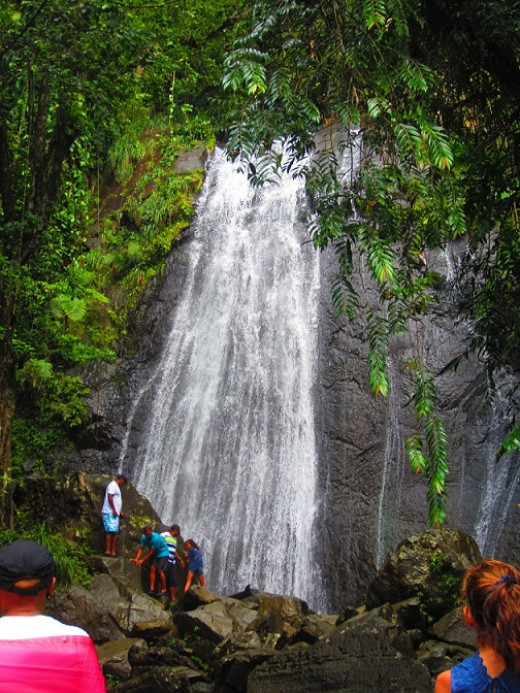
As you drive up through the rainforest, you will see several spots with limited parking where you can stop and go hiking or take some pictures. La Mina and La Coca waterfalls are both beautiful, and I recommend taking a dip in at least one of the pools at the bottom of the falls. The water is pretty cold, though! Rocks will also be slippery, so water shoes would be a handy thing to bring with you, along with an umbrella and/or poncho. As the name suggests, it rains all the time up there.
Stop at Yokahu Tower, climb up the stairs to the top and take some pictures of the stunning panorama. The hiking trails are pretty amazing, but they can be a bit narrow and steep. If you’re not in at least moderately good shape, you may only want to walk a portion of a trail, or skip them altogether. Wear some tennis shoes or hiking boots with good traction. La Coca Trail, La Mina Trail and the Big Tree Trail are some of the more popular ones (more trails here:http://www.fs.usda.gov/activity/elyunque/recreation/hiking/?recid=43377&actid=50).
The Mina Trail actually has a southern and a northern portion. The northern one follows the river more closely and seems to be the prettier one. Most trails have small picnic areas and gazebos along their trails.
DO NOT go exploring off-trail. El Yunque is a very large, deep jungle and you can most definitely get lost, perhaps for days. A few people who throughout the years have decided to venture into the forest without following trails did not make it out alive. I don’t want to scare you, all I’m saying is: follow the trails and you will have a great time.

Map data ©2016 Google
Map
Satellite
Source
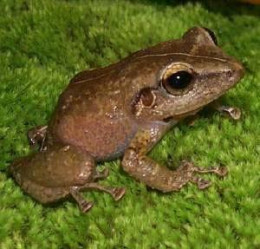
There are no indigenous peoples, cannibals, lions, elephants or other large animals in El Yunque. While the flora is very extensive and beautiful, the forest’s fauna is limited to lizards, insects, frogs and birds. If you’re lucky, you might catch a glimpse of the endangered Puerto Rican Parrot. You will almost certainly hear the call of Puerto Rico’s small native frog, the Coqui (its call sounds just like its name, a hypnotizing “co-kee, co-kee”). Please deposit all trash in marked receptacles, or take it with you.
Out of the hundreds of species of plants you will see at El Yunque, some are known to be poisonous. I would not recommend eating any wild fruits or berries during your visit. For more detailed information on
poisonous plants, go here:http://www.fs.usda.gov/detailfull/elyunque/learning/nature-science/?cid=fsbdev3_042885. Most of the vegetation is safe, though, and the forest is home to over two hundred different species of tree, as well as a dizzying array of flowers, among them different types of orchids.
If you’re more than a little adventurous, you can do some rain forest ziplining. YunKE Zipline Adventures offers a couple of different ‘adventures’ involving a few ziplines over a part of the forest, as well as some rappelling. As of summer 2013, their packages were priced at $99 per person. You can contact them directly at their website (http://yzapr.com). Rain Forest Zipline Corp (http://rainforestzipline.com/) also offers zip lining adventures, apparently at about the same price as YunKe ($99 + tax during day, $75 + tax at night), including a nighttime “Firefly Canopy Tour”.
For more detailed and current information on the rainforest, visit the US Park Service’s El Yunque website at: http://www.fs.usda.gov/elyunque


For more information on visiting Puerto Rico, check out The Real Deal Guide to Puerto Rico
available as an e-book

Thursday, January 14, 2016

Things to do in Old San Juan, Puerto Rico


by Bill Alvarez

Paseo de la Princesa
Source: Wikimedia Commons
What is now known as Old San Juan is now only a small portion of the city of San Juan, but was once a town in its own right. Founded in 1509, after the original “capital” of Caparra (founded by Ponce de Leon in what is now Guaynabo) was abandoned, the area was first known as ‘Puerto Rico”, until it was rechristened as “San Juan Bautista” in 1521. Old San Juan is about seven square blocks in size, and you can see most of it by foot, although this can be made difficult by the steep hills and the heat. OSJ is in reality an island itself, and rises from the area by the cruise ship piers and the Paseo de la Princesa up towards Calle San Sebastian and El Morro castle. An ancient city wall surrounds it, and its narrow cobblestone streets and Spanish colonial architecture give it a unique, charming look.
Map data ©2015 Google
Map
Satellite

Castles

Old San Juan boasts two major Spanish colonial forts: San Felipe del Morro, or just “El Morro” (built in the 16th century) and San Cristobal (built in the 18th century). Both are managed by the United States Park Service. El Morro has numerous rooms, staircases, guard posts (known locally as “garitas”) and a lighthouse. Admission to El Morro is $3.00 per adult (or you can pay $5 to visit both El Morro and San Cristobal). Children 15 and under get in for free. San Cristobal is smaller, and located along the northern edge of the old city, east of El Morro. Entrance fees are the same for both fortifications, and guided tours are available for both. El Morro has a huge, green lawn in front of the fort, which is a great place to walk, picnic or fly a kite. More information here:http://www.nps.gov/saju/index.htm

Museums

Old San Juan has various museums to meet different tastes (and most of them are air conditioned, which I’m sure you will appreciate). Several museums are located at Cuartel Ballaja, a former Spanish military headquarters, which has been turned into a cultural center. It is located across the street from the El Morro grounds. For example, Ballaja hosts the Museum of Coffee, Tobacco and Rum as well as theCasa del Libro (‘House of the Book’) on its first level. Both of these museums are free of charge. On Cuartel Ballaja’s second floor, you can find the Museum of the Americas (http://www.museolasamericas.org/), which deals mostly with the history and culture of the Americas (“from Alaska to Patagonia”). Admission to this museum is $3 each for adults and $2 for children and seniors.
Inside the Convento de los Dominicos at San Jose Plaza (uphill, on the way to El Morro), you can find the excellent Galeria Nacional, which highlights visual art (mostly paintings) from Puerto Rican artists from the 18th century onwards. The museum is divided into three separate rooms. No photography is allowed. Admission as of summer 2013 was $2 per adult.
You can also visit the Museo de San Juan, which showcases the city’s history, on 150 Norzagaray Street, not far from the Galeria Nacional. It is roughly located between El Morro and San Cristobal castles, facing the ocean. Admission is free.

Pigeon Park

As the name suggests, this is a small park inhabited by hundreds of pigeons, many of whom live in square holes along an ancient wall on the south side of the park. You can usually buy some corn or other type of feed from someone at the park for a dollar a bag which you can use to feed the birds. But watch out! These pigeons are not shy about not just going up to you to get their grub on, but they will get ON you as well. It’s a lot of fun to feed them, but I would recommend bringing a hat, some hand sanitizer and napkins. Maybe a spare shirt, too. The park is located at the very bottom of Calle del Cristo (next to the “Capilla del Cristo” or “Christ’s Chapel”) and admission is free.

Other Stuff

A free trolley which covers the great majority of Old San Juan is available. Stops are scattered throughout the old city. The Puerto Rico Governor’s mansion, La Fortaleza, is conveniently located on the street of the same name. Walk along thePaseo de la Princesa (located at the bottom of OSJ) and take a look at the ancient wall surrounding the city, right in front of the ocean. Very romantic.
Old San Juan has several bars for those wanting either a cold drink during a day of walking or a fun spot to hang out after dark. My favorite ones are El Batey on Calle del Cristo and Nono’s. As far as restaurants go, there are too many to list, but I personally recommend Mojito’s and Dragonfly.

San Juan, Puerto Rico Facts
Time Zone
Atlantic (UTC -4)
Area Code
787, 939
Population
395,326
Languages
Spanish (main), English
Founded
1509

More information


Want more information about visiting Puerto Rico? Check out The Real Deal Guide to Puerto Rico, available for the Amazon Kindle.