Showing posts with label article. Show all posts
Friday, May 20, 2016
Finalist Donald Trump vs Semifinalist Hillary Clinton: There is Something Missing Here
Feature
TIBERIU DIANU
After the Indiana primaries, on May 3, 2016, the Republican contender,
Donald Trump, has secured his “presumptive” party nomination for No-
vember general elections. However, not the same thing can be said about
Hillary Clinton. She, in spite of her ardent desire to compete with Trump
on the same national arena, could have not secured a similar position in
her Democratic party yet.
In other words, the Donald is already a general election finalist (from an
initial group of seventeen candidates), but Hillary is – still – a primary el-
ection semifinalist (from an initial group of… three). Trump has managed
to defeat 16 other Republicans, some of them with pedigree, and some of
them respected party rank-and-file members, like popular governors and
senators. While Hillary, in spite of her “inevitability” aura created by the
press, has managed to defeat only Martin O’Malley, who constantly sco-
red below 5% in all Democratic primaries. She, in her own words, could
not “close the deal” with Bernie Sanders. And still all we keep hearing is
about Trump vs. Clinton in the general elections. Is it just my reasoning or
am I missing something here?
Let us clarify some points. Hillary is not going to secure her party nomin-
ation anytime soon. First, Sanders keeps winning states (the last ones, West
Virginia on May 10, and Oregon on May 17), or breaks even (like in Ken-
tucky on the same May 17). He has already created a movement and, for su-
re, he wants to stick around for the July 25 Democratic Convention in Phila-
delphia. It will be interesting to see if this trend holds in the following – pre-
California (June 7) -- weeks, at the party elections in Washington (May 24),
Virgin Islands and Puerto Rico (June 4 and 5). Second, the ongoing FBI in-
vestigation of Clinton’s e-mails is still a powerful factor (some call it “a wild
card”). FBI recent interviews include Clinton’s long-time aide Huma Abedin,
and the Romanian notorious hacker Marcel Lazar, aka Guccifer, extradited in
April from Romania to the U.S.
Therefore, until there is a clear Democratic Party challenger, Trump’s disco-
urse should focus on his policies for the country and restrain from personal
attacks against Hillary. She is not even worth of such attention. She is just a
semifinalist. When she earns the honor of being a finalist, then she is entitled
to ‘personal attacks” against her challenger. I just cannot envision, like in any
sports or competition of any kind, why a loud-mouthed semifinalist like Hill-
ary is given the right to skip stages and, at least on the discourse level, offe-
red the free ride of “competing” for a tournament which she has not qualified
herself in yet.
Tiberiu Dianu is a legal scholar, book author, graduate of the American University Washington
College of Law in Washington, DC, the University of Manchester Faculty of Law in Manchester,
UK, and an exchange scholar of the Oxford University in Oxford, UK. He currently lives in Wa-
shington, DC and works for various government and private agencies. The opinions expressed in
the preceding article do not necessarily reflect those of The Puerto Rico Monitor, its editors or
advertisers.
Saturday, April 30, 2016
Nine of the Worst Cheap American Beers
Feature
Pedro Vega

As a dedicated middle class drunk, I have had ample opportunity to become acquainted with many less-than-expensive malted alcoholic beverages. In other words, I've gotten drunk on a lot of cheap beer and malt liquor. Sometimes I still do from time to time, although these days I can afford decent booze and don't need to slum too much. I still know what I know, though, so I thought I'd share my opinion on nice nauseating beverages which you may or may not be familiar with.
1. Natural Light
It wouldn't make any sense to start this list with
anything BUT Natural Light, the most high-profile
and most widely available of the cheap-ass beers
in the U.S. "Natty Light" is made by mega-corporation
Anheuser-Busch, providing us with yet another
example of the evils of corporate capitalism. Natty
Light's alcohol level is actually a bit below
the average of most mass-market pale lager beers
(the average is 5%; Natural Light is 4.4%). And yet,
this swill can pack a punch, especially if you haven't
developed a taste (or tolerance) for it. It can be
surprisingly smooth and it has only 95 calories per
serving, which is pretty decent. But it's still cheaply
brewed crap, so if you have more than 3 or 4 of these,
prepare for nasty headaches the next day. I used to
drink this fairly regularly in my poorer days, then
stopped for a while. The other day I bought a 12-pack
for old time's sake. After 2 cans, I felt like taking a
4-hour nap. At 32, I'm already too old to drink this
shit. If you're college-age, though, you probably
live on this garbage. Okay, if you're college age and
so poor you eat out of dumpsters.
2. Red Dog
Ugh. Jesus.
Red Dog is made by Plank Road Brewery (which is really
Miller, but they would rather not associate their main
brand with this liquid feces). It is around 5% alcohol,
and it is bitter and somewhat harsh. In my experience, the
hangovers from it are actually not all that bad. That's
probably because I never managed to drink more than one
or two. I'm not entirely sure that's it NOT made from
dog piss. No, that would be an improvement. If you have
to drink this, make sure it's very cold.
Miller, but they would rather not associate their main
brand with this liquid feces). It is around 5% alcohol,
and it is bitter and somewhat harsh. In my experience, the
hangovers from it are actually not all that bad. That's
probably because I never managed to drink more than one
or two. I'm not entirely sure that's it NOT made from
dog piss. No, that would be an improvement. If you have
to drink this, make sure it's very cold.
3. St. Ides
This is the first malt liquor on our list. And with good
reason, as it boasts 8% alcohol. I first became acquainted
with St. Ides about 15 years ago when I was living in New
York City. I was passing a convenience store on my way
home from work late one night and saw a poster advertising
a 40oz bottle of this sh*t for 99 cents. So I figured,
why not? Why not indeed. It tasted like someone dropped
a shot glass of beer into a bucket filled with kerosene.
I was so f****d up when I was done I passed out. The next
day, I woke up thinking that maybe I had leukemia or Lou
Gherig's Disease, or something. I was achy, irritable
and dehydrated. That's all you need to know about St.
Ides. Also, Ice Cube used to endorse it.

4. Pearl Light
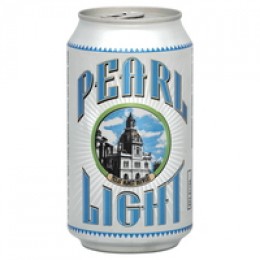
Pearl Light is unique among the beers on this list in that I could not get drunk on it. I bought a 12-pack of this stuff years ago and halfway through drinking it, I realized, much to my horror, that I didn't even have a buzz. Pearl Light used to be brewed by Pabst, but is now contracted out to Miller. Not much else I can say about this "beer". Apparently, it has a long history in Texas.
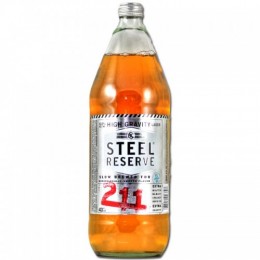
5. Steel Reserve High Gravity
I drank Steel Reserve only once, I believe. A lot of
people drank it once. I remember drinking a couple
of 16 ounce cans of this stuff a while back, and
felt dizzy and weird almost immediately. Usually
a beer buzz is pleasurable, but sometimes it's
uncomfortable and strange. And it's not just me.
A former co-worker, who is about 6 feet tall and
weighed close to 300 lbs, told me he once downed
a can of Steel Reserve while sitting, then stood
up and the room started spinning around. And he was
the kind of guy who had a good tolerance for
alcohol, too. It still ambushed him and kicked
his goddamn ass. Steel Reserve is labeled as 8%
alcohol (in most states) and is made by...wait for it!
...Miller. This is their third entry on this list.
Sadly, it won't be their last.
6. Milwaukee's Best Light
Milwaukee's...Best?? BEST?!? I would really hate to
have to sample Milwaukee's worst. I would get a couple
of 32oz cans at the store for a dollar each a few
years ago. I was obviously going through hard times
if I was drinking this sewage. It is thin, watery
and very carbonated. If you're a high schooler or
broke-ass college student, this beer probably seems
like a pretty good deal. And I suppose it is a good
deal for what it is. Which is trash. To its credit,
after downing 64 ounces of this at a time, I didn't
feel like I was going to die. I just felt like I'd
wasted my time. Oh, and by the way, know who makes
this? F****G MILLER.
7. Bud Ice
Made by Anheuser-Busch. 5.5% alcohol. Comes in a
40oz bottle. Tastes like anti-freeze. Bad hangovers.
Avoid.

8. Olde English
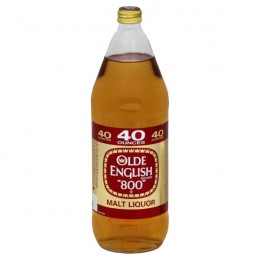
Ahh, Olde English. Just about everyone I know seems to have a story about Olde English, usually involving vandalism, fistfights, the police, sexual assault and/or vomiting. I haven't had this swill in years, and God willing, I will never again drink it. "Regular" Olde English is about 6% alcohol, although other varieties of it go as high as 8%. Out of all the malt liquors out there, this one seems to be the one that most white people will drink, if they drink any malt liquor at all. I'm not sure why that is. My memory of drinking it is that it started out smooth, then tasted a bit harsher and then...well, I can't remember. Oh, and guess who makes it? It starts with an M and ends in an R, and rhymes with "killer".
9. Busch
As the name suggests, this is brewed by the mother
f*****s at Anheuser-Busch. Think Budweiser is boring
and tasteless? Try this stuff. It'll make drinking Bud
Light feel like an orgy of flavor is going on in your
mouth. While it's certainly cheap, it's not the kind of
beer that will give you a decent buzz, even after 3
or 4 of them. The taste is not any worse than say,
Natural Light, but if you're going to be cheap anyway,
just buy f*****g Natural Light. Actually, if Natty
Light is a 19-year old frat boy, Busch could very
well be its balding, beer-bellied 47-year old dad.
Same genetics, just slower and lamer.
Thursday, April 9, 2015
Pedro Albizu Campos: At Least He Had Guts
By Bill Alvarez
A young Albizu Campos.
Source: Wikimedia Commons
(Note: this column was originally written in 2002)
I've found that, among Puerto Ricans, it is almost impossible to find an objective opinion of nationalist leader Pedro Albizu Campos. Those who hate him, hate him with a passion usually reserved for mass murderers or pedophiles. Those who love him often deify him, to the point of considering him some sort of demi-god (I've even seen a painting of Albizu crucified, looking very much like Jesus Christ; I'm not a Christian, and even I was appalled at the implication). While doing research for this column, I found it amazingly difficult to find clear, unbiased information about one of the best known Puerto Rican political leaders in history. In this column, I will actually attempt to look at Campos in something resembling a neutral, detached manner. I say attempt, because this was a man about which it seems to be very hard to be objective, so please forgive me if any bias seeps through my writing.
Pedro Albizu Campos was born in 1891 (although that date has been debated) in Ponce, Puerto Rico-- black and in poverty. He was given a scholarship to study engineering at the University of Vermont, and later went on to Harvard. He joined the U.S. military in 1917, apparently for reasons known only to him. In seven years, Campos became a chemist, a lawyer, an expert in history and politics and came to master seven languages. There was little doubt among those who knew him that he was practically a genius. What's more, he was a true leader of men; the kind of man that the island doesn't seem to produce much of anymore.
At the beginning of the 1930's, Albizu took over the leadership of the fledgling Puerto Rican Nationalist Party. His style was decidedly anti-American, and he made no reservations about the fact that he supported the use of violence in order to end the American administration in Puerto Rico. From the 1930's to the 1950's, Campos was accused by the government of orchestrating or supporting various violent actions against the U.S. government, among them the murder of insular Police Chief Riggs, the Nationalist Uprisings of 1950 and the assassination attempt against President Truman in that same year. The Federal Government kept him in jail, both in Puerto Rico and in the continent, during much of that period. He has, so far, been the only independentista leader to cause the United States some genuine trouble. During this time, his following was small (but committed) and the Nationalist Party did pathetically in electoral contests, when it chose to participate.
During Campo's last stint in prison, which ended shortly before he died in 1965, it is believed that the Federal Government regularly exposed him to radiation in his prison cell, which ultimately led to his death by cancer. This claim has credibility; the evidence and the photos of Albizu's horribly burnt and seemingly irradiated body are there for everyone to see, and stand as an example of a terrible crime which marked a shameful period in both Puerto Rican and American history. Surely the "crime" of sedition could have been punished in a more humane manner.
The legend of Pedro Albizu Campos continues to grow with the passage of time. He has even achieved a kind of legitimacy nobody could have dreamed of during his day; there are now streets and schools named after him, and not too long ago, the New York Puerto Rican Day Parade was dedicated to him. Every sector of the Puerto Rican independence movement wants to claim "El Maestro" (The Teacher, as they call him) as their own, be they left-wing or right-wing. But what really were Albizu's politics, aside from his nationalism? The left wing has laughably claimed he was sympathetic to socialism, and cite as an exaple his support of the 1934 sugarcane worker's strike, depsite the fact that his support smelled more of populism than socialism. Albizu was also a devoted Catholic and socially he seemed to be somewhat conservative, which may be why right-wing independence groups (like the Falange Boricua) also attempt to claim him as one of their own. This is all complicated by a lack of good documentation, or even reliable anecdotal evidence, that clearly outlines Albizu's political positions.
Some have said that Albizu was an out-and-out fascist; not an altogether unreasonable claim given the world political situation in the 1930s, when Albizu was the most active. The Nationalist Party's paramilitary wing, The Cadets of the Republic, marched through streets wearing black shirts and white pants, much like Mussolini's fascisti. He seemes to have viewed liberal American values as suspect at best and tools of oppression, at worst. However, I wouldn't qualify Pedro Albizu Campos as a fascist; his Catholicism perhaps would have put him ideologically closer to pseudo-fascists like Francisco Franco or Portugal's Antonio Salazar. I doubt he was very fond of Hitler. He was probably not a big fan of Stalin's, either.
When writing about a man as controversial as Albizu, it's important to remember that his actions and his ideological positions can't be looked at in black and white; there are things about "El Maestro" that both damn him and redeem him and his characteristics should all be looked at separately, taking into account the circumstances of his life and the times he lived in. Personally, I don't agree with his politics or his methods--although, I can't blame him for having been so radical; the U.S. Government of that time treated Puerto Rico with a frightening degree of scorn and brutality. I also think that an independent Puerto Rico with Albizu as its leader would probably not have been a very pleasant place to live in, not just for me, but for many others who value things like true liberty and progress, and whose thinking goes beyond crude collectivist notions of "La Patria".
However, there are things about the man that I genuinely admire; his passion for ideas and his willingness to put his life on the line for them. You don't see much of that anymore in Puerto Rico. He was a ridiculously intelligent and well-educated man; he could've had any career he wanted. He could have been a respected statesman or a multi-millionaire, or both. But he chose to follow his ideals. That's not to say he was completely selfless. It's reasonable to think that a lot of what drove him was a desire for some kind of power. Maybe he was just crazy; an average man he definitely wasn't. But, you still have to respect the fact that he was willing to risk, and eventually lose, his life fighting the enormous apparatus that was the United States government, and its servant insular government here in the island, all in a struggle which--and I'm sure many times he was tempted to think so--was hopeless.
Unlike many of his compatriots then and now, he had guts. And that's got to count for something.
Subscribe to:
Posts (Atom)