Headlines From Our Twitter Feed

Showing posts with label opinion. Show all posts

Tuesday, July 25, 2017

How Stupid Is The FBI? You Must Read This!


Commentary 

Richard Lawless


Unfortunately, my company along with tens of thousands of other individuals and corporations was caught off-guard by Puerto Rico’s financial collapse. To make sure that it doesn’t happen to us again, my company launched an investigation into the causes of this tragedy so we wouldn’t become a victim a second time, somewhere else.

Part of the findings uncovered information indicating the Puerto Rico Government theft of hundreds of millions of dollars in public funds each year.  I reported this to the San Juan FBI office and after many months and little cooperation, they determined the activities did not meet criminal standards and would better be handled as a personal civil case.

Shortly after that I received a call from a CIA Agent that said they have been tracking the massive wire transfers out of Puerto Rico for almost a decade. The Agent then went on to say that they have notified the FBI repeatedly and the FBI failed to act on it.  The agent also said that in tape recorded phone conversations it was clear that the San Juan FBI and U.S. District Attorney Offices were participating in this massive theft and their family members were receiving payoffs; Further explaining the lack of prosecution for so many years.  A short time after that, British Intelligence suggested they were aware of much of same.

Two newspaper editors were able to confirm the tip from the CIA and British Intelligence.

On April 6, 2016, the Caribbean News Now Agency printed the article “Personal conflicts obstruct FBI investigation into Puerto Rico fraud” and the New York Observer printed a similar article on 6 27-16. As of today, it is my understanding that the money continues to flow out of Puerto Rico and find its way back to critical DOJ employees.

Reporting this to the San Juan FBI and U.S. Attorney would be silly, since they were the DOJ employees allegedly accepting the payoffs. I forwarded this information to the Washington Headquarters of the FBI hoping they would do something.

After not hearing anything for almost a year, I filed a Freedom of Information Request.  I received the results today. The Washington FBI referred my complaint back to the San Juan FBI so they could investigate themselves!

As of today, it is my understanding that the money continues to flow out of Puerto Rico and find its way back to critical DOJ employees.

Puerto Rico Bond Fraud that set a new standard for Congressional Corruption? 60 Sec Commercial Summarizing some of the crimes

Press Conference recapping testimony to the SEC/FBI and Congressional Oversight Committee – It is mind bending


Richard Lawless is a former senior banker who has specialized in evaluating and granting debt for over 25 years. He has a Master’s Degree in Finance from the University of San Diego and Bachelor’s Degree from Pepperdine University. He sits on several Corporate Boards and actively writes for several finance publications. The opinions expressed in the preceding commetary are solely his and do not represent those of The Puerto Rico Monitor.


Thursday, July 13, 2017

Austerity Doesn't Work


Commentary

W.A. Delgado

Originally published March 16, 2017


When a nation or jurisdiction runs into problems with debt, the pres-
cription usually recommended by the banks, investors, hedge fund
managers and rich lender governments is usually the same: cut costs
by slashing social spending and raise taxes on the poor and middle
class. But these approaches, as has already been demonstrated -- in
Greece, for example -- usually end up tanking the target economy
even further. A society in economic recession or depression isn't go-
ing to get better by making the most vulnerable people suffer, and its
economy won't return to prosperity by leaving working class people
(who usually spend most of their income, putting the money back in-
to the economy) with less money to spend. Austerity doesn't create
employment or growth, and it certainly doesn't create better living
conditions for the bulk of the population. But for the masters of ca-
pital, how average people are doing is just an "externality".  Debts
must be paid, in full and on time, no matter what. The rich can never
suffer, even a bit.  Rather, the poor must always pay the price.

In a world where many governments are "democratic" only in appea-
rance, true democracy continues to erode. Institutions everywhere are
increasingly more beholden to the dictates of the very few and very
privileged, while the wishes of the masses continue to be drowned
out by lofty talk of the rules of the "free market". The orthodoxy of
the inscrutable market must always be obeyed, human beings be
damned. Who cares if people starve, as long as the numbers look
the way they're supposed to look, for the right people?

Recently, Puerto Rico's unelected fiscal control board warned about
the severityof the island's cash flow, and suggested "emergency mea-
sures" be taken. Measures like maybe taxing expensive real estate at
higher rates, or taxing foreign corporations and big box retailers mo-
re? No, of course not. What is needed is to reduce teachers' hours, cut
health services for the sick and slash pensions for the old. So how
will austerity make for a better society? It won't. But it will make
for better financial returns for the masters of capital.

What Puerto Rico really needs in the long term is not austerity, or en-
trepreneurs (another fabled cure for everything). We don't need more
rights and giveaways for the international and local investor classes
or platitudes about "innovation" or personal responsibility. What we
need is true democracy, where the people -- the ones who really keep
society running -- can have a direct say in how the government func-
tions, how its budget is spent, and how (and to whose benefit) the
economic resources of the nation are to be utilized.


W.A. Delgado is a staff writer for the Puerto Rico Monitor.

Monday, July 3, 2017

If Puerto Rico Thinks Bankruptcy is a Better Solution, They Have a Rude Awakening Coming!


   Commentary


   Richard Lawless


One should look no further than the Puerto Rico Electric Power Authority’s (PREPA) pending bankruptcy.

All credible financial analysts agree that PREPA only needs slightly more than a 10% reduction in debt service to continue paying its bills and operating as expected.  Over a three-year period, the utility negotiated with their bond holders for a 15% reduction in debt.  This consensual agreement gave the utility almost 50% more than it needed to get back on track. 

If the bankruptcy judges execute the hearings without personal or political bias, PREPA will get only what it needs to operate safely.  That number should reflect about a 10% reduction in debt, far less than was offered to the utility in their consensual negotiations with their bond holders.

For PREPA to receive a more favorable outcome in court they will have to shape an argument based on the following factors:

1.     PREPA has allegedly been over charging its customers every year for high quality crude oil while paying and taking delivery of sludge oil.  The difference in cost is hundreds of millions of dollars each year. That money is unaccounted for.   (Business wire 4-16-16, RICO Lawsuit)
2.     PREPA must pay unusually high accounting fees to KPMG to produce misleading financial statements each year. 
(KPMG lead auditor, Puerto Rico Senate Hearing 6-24-15)
3.     PREPA must pay unusually high bond rating fees each year to secure misleading bond ratings for their new bond offerings.  
(Puerto Rico Monitor 4-5-16, FINRA Settlements, on-going SEC Investigations)
4.     PREPA must pay unusually high sales fees to the major Wall Street Banks for them to knowingly market troubled bonds as safe investments.
(Reuters 6-28-17)
5.     PREPA budgets hundreds of millions of dollars each year for equipment maintenance and the money disappears while the repairs are rarely done. 
(SEC Whistleblower Financial Audit 1-18-16)
6.     The Puerto Rico Fiscal Control Board although mandated through legislation to approve consensual agreements with Puerto Rico’s Creditors, the Board has elected to ignore the legislation costing PREPA many millions in future litigation.
(Puerto Rico Fiscal Control Board 6-27-17)
7.     PREPA has numerous law suits, FBI and SEC investigations going on now, costing PREPA tens of millions in legal and consulting expenses.
(AlixPartners $28 million, etc.…)
8.     PREPA has massive unfunded pension obligations, although the pension contributions are budgeted every year they rarely contribute what was promised.

The PREPA attorneys and accountants will have to shape an argument that if they are to maintain their current level of mismanagement and malfeasance, more money must be taken from the innocent bondholders.

In an honest legal system, PREPA is unlikely to prevail.


Richard Lawless is a former senior banker who has specialized in evaluating and granting debt for over 25 years. He has a Master’s Degree in Finance from the University of San Diego and Bachelor’s Degree from Pepperdine University. He sits on several Corporate Boards and actively writes for several finance publications.


Wednesday, April 26, 2017

Puerto Rico Statehood In The Age of Trump


Commentary

Rosa Bravo

Originally published March 8, 2017

The cause of Puerto Rican statehood, already battered by the island's enormous economic crisis, has run into a new obstacle: the election of Donald Trump as President. While the President cannot change Puerto Rico's status on his own,his election -- and the tenor of the political discourse under which he was elected -- has made the Republican-majority Congress more implicitly hostile to Puerto Rico's statehood prospects. I believe Trump's rhetoric and actions have set the tone that Congress will follow for at least the  next four years.

It is not a secret that President Trump is a xenophobe who has little regard for Hispanics.That alone would prejudice him against supporting the admission of three-plus million Spanish speakers into the Union. But besides that, his goal of restoring America's economic might would steer him away from incorporating a territory with tens of billions of dollars in crippling debt that, in his view and of those like him, would contribute little to the federal treasury. But the biggest issue here may be Trump's almost total ignorance regarding Puerto Rico, its history and its issues. The President is a man famous for not reading and for losing his patience quickly. It is almost certain he has never taken an interest in the island, other than whatever he needed to know to build his now  defunct Rio Grande golf club. In his simple mind, Puerto Ricans are probably just welfare queens to be shoved aside; after all, they're not "real Americans". I think that Trump's election put PR ever closer to the unilateral granting of independence for the island, despite that option finding next to no support among Puerto Ricans. He can't do it himself, but he can certainly goad his Republican acolytes in Congress to do so.

The current government of Puerto Rico would do well do ask for very little from thecurrent federal government. And it should certainly not even bring up the issue of Puerto Rico's status or ask for Puerto Rican statehood. Because if they do, the answer from the USA may very well be: "No. But thanks for reminding us that you're still hanging around. Goodbye, you're free to go". This is why I think a status referendum in Puerto Rico right now is a ridiculous idea. As a supporter of statehood, I fear that no good would come from poking that hornet's nest. The best thing to do would be to keep our heads down, try to get our financial house in some kind of order and just wait out the Trump storm. A better climate will come.


Rosa Bravo is a staff writer for The Puerto Rico Monitor. The opinions expressed in the preceding
piece are strictly her own and do not necessarily represent those of The Puerto Rico Monitor, its
editors or advertisers.

Tuesday, April 11, 2017

Is Independence Imminent For Puerto Rico?


Commentary

Rosa Bravo

Originally published January 12, 2016


I am proud of my United States citizenship and I have long supported
the idea of statehood for Puerto Rico. But at this point, even I have to
admit that my home island becoming the 51st state seems like an in-
creasingly remote possibility. I'm not pessimistic about statehood be-
cause of the language difference, or the possibility of losing our "na-
tional" Olympic team, or because of Puerto Rican voters' long runn-
ing indecisiveness regarding the future of their island. I'm pessimis-
tic about statehood because the one entity that could grant such a thing,
the US Congress, will not let it happen. And with every day that passes,
Congress feels less and less willing to admit Puerto Rico as a state.

And who can blame them? Puerto Rico's financial woes have made
headlines regularly over the last several years. Holders of Puerto Rico
bonds are bracing themselves for the worst, will billions of dollars yet
to be lost. During the island's budget and debt debacles, some of Puerto
Rico's seemingly intractable institutional corruption has been brought to
light for the whole world to see. Puerto Ricans continue to leave the is-
land for the mainland in droves. Puerto Rico is still much poorer than the
poorest state in the union. Besides all of this, the US's incentives for hol-
ding on to this Caribbean territory have largely disappeared.

During the 20th century, Puerto Rico's location made it a key to protec-
ting the then US owned Panama Canal. After World War II, its strategic
value appreciated further, as Cuba went communist and the US needed to
pay close attention to the Caribbean and Central America. Puerto Rico was
also a hub for manufacturing, as tax incentives and cheap labor yielded bi-
llions in profits for American corporations. But those incentives are gone.
The Cold War is long over, and whatever geopolitical challenges the US
faces -- or expects to face in the near future -- are not present in the Ame-
ricas, but rather in the Middle East and Asia. American businesses found
labor cheaper than Puerto Rico's long ago, in Mexico, China, India...even
right next door in the Dominican Republic. Plus, Congress took away
many of the tax incentives.

The United States has taken plenty from Puerto Rico over the decades,
including scores of lives lost by Puerto Rican soldiers in American wars.
But now that they find they can't squeeze any more juice from their main
Caribbean possession, they are probably asking themselves what the point
is any longer. Sure, Puerto Ricans still pay plenty of taxes to Uncle Sam,
even if we don't pay Federal Income Tax (although many of us do have to
pay). American businesses still make billions in the island. But the old re-
turn on investment is no longer there. Many a right-wing blowhard in DC
will think "Why do we keep sending billions in federal funds into a black
hole? Why do we even still have this island of latino freeloaders any lon-
ger?". They look at Puerto Rico's super-corrupt elites and increasingly poor
population and wonder whether it might not be time to cut their losses. Ne-
vermind that that same corrupt elite grew initially under US auspices (Puer-
to Rico had no self-rule at all until 1952, and even then it was severely li-
mited) and that the US-favored colonial status is largely responsible for
keeping Puerto Ricans trapped in poverty. Historical memories are short
in Washington.

Will Congress suddenly be afflicted with an attack of conscience, and
grant Puerto Rico statehood (provided a majority of us finally and with-
out reservation ask for it)? Will they consider America's decades-long ill
treatment and neglect of Puerto Rico and do the morally right thing, and
say yes to admitting millions of US citizens into the union as equals? I
wouldn't bet any money on it. While the statehood conversation would be
taken a lot more seriously if at least 75% of Puerto Rican voters said yes
to statehood (nope, 51% doesn't cut it and never will), it would still be a
battle. Congress looks at the Puerto Rico of today and see millions of poor,
Spanish-speaking welfare recipients. With Cuba opening, Puerto Rico is
no longer the business-friendly Caribbean lab of the mid-century; it is a
washed-up has-been, in their eyes. But they are beginning to acknowledge
that the current colonial situation is no longer tenable. So what options are
left? A sovereign, "associated republic", a la Marshall Islands or Palau.
Or, of course, full independence. Either one would be seen in Washing-
ton as cheaper and easier than maintaining the current status, or burdening
itself with a "beggar" 51st state.

Congress may soon have the excuse that it wants to get rid of Puerto Ri-
co. Independence may be coming sooner than any of us expect, whether
we ask for it or not. The colonial master is getting anxious and is feeling
increasingly eager to get rid of what it helped create. If you don't want to
see that happen, it's time to start making some real noise for statehood.
And not in  Puerto Rico, where it won't matter what you say or who hears
you. It is people and politicians in the mainland who need to hear our voi-
ces. And do you have family or friends in the mainland  US? Of course you
do. Tell them to speak up and to always VOTE, and to let  everyone know
that they vote. We also need an organization that can promote statehood
other than the New Progressive Party, which for decades has accomplished
less than nothing in convincing Congress to seriously consider decoloniza-
tion.

If we don't take the fight for statehood to another level, get ready to make
some room for that Puerto Rico passport in your wallet. Because we're
going to be on our own.


The opinions expressed in the preceding commentary do no  necessarily reflect those 
of The Puerto Rico Monitor.

Thursday, March 16, 2017

Austerity Doesn't Work


Commentary

W.A. Delgado

When a nation or jurisdiction runs into problems with debt, the pres-
cription usually recommended by the banks, investors, hedge fund
managers and rich lender governments is usually the same: cut costs
by slashing social spending and raise taxes on the poor and middle
class. But these approaches, as has already been demonstrated -- in
Greece, for example -- usually end up tanking the target economy
even further. A society in economic recession or depression isn't go-
ing to get better by making the most vulnerable people suffer, and its
economy won't return to prosperity by leaving working class people
(who usually spend most of their income, putting the money back in-
to the economy) with less money to spend. Austerity doesn't create
employment or growth, and it certainly doesn't create better living
conditions for the bulk of the population. But for the masters of ca-
pital, how average people are doing is just an "externality".  Debts
must be paid, in full and on time, no matter what. The rich can never
suffer, even a bit.  Rather, the poor must always pay the price.

In a world where many governments are "democratic" only in appea-
rance, true democracy continues to erode. Institutions everywhere are
increasingly more beholden to the dictates of the very few and very
privileged, while the wishes of the masses continue to be drowned
out by lofty talk of the rules of the "free market". The orthodoxy of
the inscrutable market must always be obeyed, human beings be
damned. Who cares if people starve, as long as the numbers look
the way they're supposed to look, for the right people?

Recently, Puerto Rico's unelected fiscal control board warned about
the severityof the island's cash flow, and suggested "emergency mea-
sures" be taken. Measures like maybe taxing expensive real estate at
higher rates, or taxing foreign corporations and big box retailers mo-
re? No, of course not. What is needed is to reduce teachers' hours, cut
health services for the sick and slash pensions for the old. So how
will austerity make for a better society? It won't. But it will make
for better financial returns for the masters of capital.

What Puerto Rico really needs in the long term is not austerity, or en-
trepreneurs (another fabled cure for everything). We don't need more
rights and giveaways for the international and local investor classes
or platitudes about "innovation" or personal responsibility. What we
need is true democracy, where the people -- the ones who really keep
society running -- can have a direct say in how the government func-
tions, how its budget is spent, and how (and to whose benefit) the
economic resources of the nation are to be utilized.


W.A. Delgado is a staff writer for the Puerto Rico Monitor.


Tuesday, March 14, 2017

Enough Is Enough: Kill The Criminals


Commentary

by Pedro L. Vega


Puerto Rico's murder rate, after a dip in 2015, has been rising again since
last year, when it hit 20 homicides per 100,00 people. While this rate is st-
ill below that of insane hellholes like El Salvador, Honduras or Brazil, it is
much higher than the United State's national average of 5.3 per 100,000 in 
2016. As the economic situation in Puerto Rico worsens, I think it's safe to
assume that the violent crime situation will also worsen. You would think
that since Puerto Ricans are leaving the island in droves, that that would lo-
wer the crime numbers, but that never seems to happen. The numbers may
ebb and flow, but Boricuas have been fleeing to the mainland US for several
years now, and the murder rate remains stubbornly high. While measures like 
legalizing drugs would help drive crime down immensely, I doubt that that 
would be enough. We need a strong deterrent to make criminals think twice 
before carrying out a barbaric act. We need to bring back the death penalty.

Puerto Rico abolished capital punishment in 1929, starting a long period of
giving murderers and other scum the privilege of getting free housing, 
meals and healthcare for years or decades as a reward for being drains on so-
ciety. Since then, deadly violence in our land has become our daily bread. Ho-
rrific murders of men, women and children make the news almost every day, 
and while many are related to the drug trade, not all of them are. Some are so-
called crimes of passion, some happen as a result of arguments, some are the 
result of robberies. In some cases, people seem to be killed just for the hell 
of it. Regardless of the motive, Puerto Rico's law abiding majority deserves 
to feel safe, anywhere and at any time. Reinstituting the death penalty is 
not just a matter of removing dangerous maniacs from our society, but also 
of administering justice, of giving evildoers what they deserve. And they do
not deserve to live, even if  it's in prison.

For a long time now, it seems as if we worry more about the rights of crimi-
nals than about the rights of victims, to say nothing of the right all law-abi-
ding citizens have to walk the streets in safety. Why should criminals be
allowed to vote? And why shouldn't prison inmates be forced to work in
exchange for the generous support taxpayers give them? And more impor-
tantly, why should those who have taken the lives of others be allowed to
keep their own lives? They certainly shouldn't be allowed to roam the
streets ever again, at the very least. But in an island that is as broke as
Puerto Rico is, can we afford to support criminals for their whole lives?

While our justice system needs to do everything possible to avoid punishing 
innocent people, the guilty must be removed from our midst. Whether they 
had bad childhoods, or their spouse cheated on them or they have "mental pr-
oblems": too bad. Kill them. I don't care how it's done: shoot them, gas them, 
hang them, burn them, electrocute them, poison them. Just get rid of this sub-
human garbage.  We have had enough.


Pedro L. Vega is a freelance writer from Puerto Rico. The opinions expressed in the 
preceding commentary are solely those of the author and do not represent those of 
The Puerto Rico Monitor, its editors or advertisers.


Wednesday, March 8, 2017

Puerto Rico Statehood In The Age of Trump


Commentary

Rosa Bravo

The cause of Puerto Rican statehood, already battered by the island's enormous
economic crisis, has run into a new obstacle: the election of Donald Trump as
President. While the President cannot change Puerto Rico's status on his own,
his election -- and the tenor of the political discourse under which he was elec-
ted -- has made the Republican-majority Congress more implicitly hostile to
Puerto Rico's statehood prospects. I believe Trump's rhetoric and actions have
set the tone that Congress will follow for at least the  next four years.

It is not a secret that President Trump is a xenophobe who has little regard for
Hispanics.That alone would prejudice him against supporting the admission of
three-plus million Spanish speakers into the Union. But besides that, his goal of
restoring America's economic might would steer him away from incorporating a
territory with tens of billions of dollars in crippling debt that, in his view and of
those like him, would contribute little to the federal treasury. But the biggest issue
here may be Trump's almost total ignorance regarding Puerto Rico, its history and
its issues. The President is a man famous for not reading and for losing his patien-
ce quickly. It is almost certain he has never taken an interest in the island, other
than whatever he needed to know to build his now  defunct Rio Grande golf club.
In his simple mind, Puerto Ricans are probably just welfare queens to be shoved
aside; after all, they're not "real Americans". I think that Trump's election put PR
ever closer to the unilateral granting of independence for the island, despite that
option finding next to no support among Puerto Ricans. He can't do it himself,
but he can certainly goad his Republican acolytes in Congress to do so.

The current government of Puerto Rico would do well do ask for very little from
thecurrent federal government. And it should certainly not even bring up the issue
of Puerto Rico's status or ask for Puerto Rican statehood. Because if they do, the
answer from the USA may very well be: "No. But thanks for reminding us that
you're still hanging around. Goodbye, you're free to go". This is why I think a st-
atus referendum in Puerto Rico right now is a ridiculous idea. As a supporter of
statehood, I fear that no good would come from poking that hornet's nest. The
best thing to do would be to keep our heads down, try to get our financial house
in some kind of order and just wait out the Trump storm. A better climate will
come.


Rosa Bravo is a staff writer for The Puerto Rico Monitor. The opinions expressed in the preceding
piece are strictly her own and do not necessarily represent those of The Puerto Rico Monitor, its
editors or advertisers.


Thursday, September 8, 2016

The Real Cause of Puerto Rico’s Financial Collapse Wasn’t The Economy!


Commentary

Richard Lawless


On September 27, at the Waldorf Astoria Hotel in New York, Commercial Solar
Power, one of the many victims of the Puerto Rico financial collapse, will host
a press conference detailing its findings.

Sources close to the investigations suggest that there was rampant and repeated
massive government theft of public funds going on for over a decade. The theft
of public money, along with widespread Wall Street fraud associated with the is-
land’s bond issues, resulted in $39 billion in bondholder losses.

Although all the specifics may not be known until September 27, the following
has been shared with us.

The Puerto Rico Power Authority (PREPA), one of the world’s largest govern-
ment owned utilities, has been burning lowest grade No. 6 fuel oil for over a de-
cade.  The authority has been billing its citizens for the higher grade No. 2 oil.
The payments for this oil have been wired offshore and then kicked back to gov-
ernment officials’ family members. The difference in cost between No. 2 and No.
6 oil is approximately 58 percent.  In some years the overpayments exceeded $1.6
billion.

Our source also states that the ongoing EPA testing results could only occur with
the utility burning low grade sludge oil and that the equipment needed to burn No.
6 fuel oil is different than the equipment needed for the burning of higher grade No.
2 fuel.  A quick walk through of PREPA’s plants showed that PREPA was indeed
using equipment for fuel No. 6, which requires preheating.

[Note: Number 6 fuel oil is a high-viscosity residual oil requiring preheating to
220–260 °F (104–127 °C). Residual means the material remaining after the more
valuable cuts of crude oil have boiled off. The residue may contain various unde-
sirable impurities including two percent water and one-half percent mineral soil…
literally the bottom of the barrel.]

Additionally, a review of the agencies financial statements shows hundreds of mi-
llions of dollars in public funds missing from the equipment purchase and mainte-
nance accounts each year.

PREPA alone is responsible for almost $2 billion a year in missing or stolen public
funds.

An inter-agency review of Puerto Rico’s other agencies reflected similar activity.
It is estimated that as much as $3 billion a year in public funds are unaccounted
for in Puerto Rico.

Reviews of the various agencies’ financial statements indicate those agencies were
all technically bankrupt as early as 2007.  Normally, bankrupt entities would not be
able to secure any credit rating, let along investment grade ratings.  Without invest-
ment grade ratings the agencies could not issue bonds to raise more capital.

The typical fee for a credit rating is 1-2 percent but, by paying the rating agencies
as much as 9 percent, the Puerto Rico municipal agencies were able to secure good
credit ratings.

These fraudulent credit ratings allowed Puerto Rico to issue new debt ultimately
resulting in the financial collapse and a loss to the original bondholders of $39 bi-
llion.

I have been told that all members of both the Congress and the Senate knew this
when they voted to revoke all legal rights for the victims, the bondholders.

It is reasonable to expect, when a full disclosure is finally made, that Wall Street
and Washington will have some explaining to do.


Mr. Lawless is a career Banker and CEO of Commercial Solar Power, Inc.  Mr. Lawless has been 
working with the SEC, the FBI, The U.S. Attorney’s Office and the Treasury Department to un-
cover the reasons for Puerto Rico’s $70-billion-dollar bond default.  Mr. Lawless has held Senior 
and Executive positions with Wells Fargo Bank, Home Savings and Washington Mutual Bank 
specializing in the issuance of debt instruments.  Mr. Lawless holds a BA from Pepperdine Uni-
versity and a Master’s Degree from the University of San Diego.


The opinions expressed in the preceding commentary are exclusively those of the author and
do not necessarily reflect those of The Puerto Rico Monitor, its contributors or advertisers.


Wednesday, September 7, 2016

The Sign Of The Lord


Opinion

Tiberiu Dianu


The Divine Sign

One of the most popular festival events in Puerto Rico takes place every year
on August 15 in the municipality of Cayey, about 30 miles south of the capital
city of San Juan: the Matron Festivities of Nuestra Señora de Asunción. The
festivities are celebrated during 10 consecutive days, bringing singers and ba-
nds from around the island. Cayey is relatively close to the southern shores of
Puerto Rico, the southernmost part of the United States.

This year, on the same day, in one of the northernmost largest cities of the Uni-
ted States, the popular Christian feast was observed being accompanied by a
special event. Almighty God has chosen the skies of Chicago to cast his vote for
President.

A “yuge” heavenly Donald Trump - displayed on the Lord’s ceiling - has dem-
onstrated to us that neither the place, nor the day have been chosen randomly.

The Place

Thus, for the Chicago place: God is reminding us of his displeasure for the un-
healthy policies of the former Illinois senator, now president of the United Sta-
tes, Barack Hussein Obama. These policies have targeted constantly the most
blessed country on earth, which the Almighty – still – loves and protects. It is
also a reminder to the (lefty) Chicagoans of their ugly manners and despicable
reception they had prepared in their Windy City for the Republican presidential
candidate. On March 11, they brutally infringed Trump’s constitutional right to
free speech by blocking his rally in the city.

This did not prevent Trump from easily winning the Illinois primary on the fo-
llowing Tuesday, March 15, exactly five months before the Divine Sign. Indeed,
God sees and takes care.

The Time

As for the date, rare are the days of the year loaded with so much religious sig-
nificance and variety of human events as August 15. Let us review some of them.
A few are related to the acute problems that concern the American society of to-
day...

-  the Assumption of Mary,  one of the most important Christian feast days and
holidays; according to some sources,  Mary’s death occurred 11 years after the
death – in 30 A.D. - of her son, Jesus (in 41 A.D.);

- the beginning of the Arab-Byzantine wars (in 636);

- the Second Arab Siege of Constantinople (in 718);

- the foundation stone of Cologne Cathedral, built to house the relics of the
Three Wise Men, is laid (in 1248);

- the end of the Byzantine Empire, as a result of the Ottoman victory in Tre-
bizond (in 1461);

- the Sistine Chapel is consecrated by Pope Sixtus IV (in 1480);

- Paraguay's capital city of Asunción (the Assumption) is founded (in 1537);

- The Battle of Fort Dearborn (now Chicago) is fought between the U.S. troops
and Potawatomi, during the Anglo-American War (in 1812);

- the oldest Roman Catholic cathedral (Our Lady of Peace) in continuous use
in the United States is dedicated in Honolulu, Hawaii (in 1843);

- the Panama Canal opens to traffic (in 1914);

- coincidentally or not, my maternal grandmother, called Maria, is born on the
Assumption Day, also known (in her native Romania) as the Falling Asleep of
the Blessed Virgin Mary (in 1915);

- The Wizard of Oz premieres in Los Angeles (in 1939);

- effective surrender of Japan in World War II (in 1945);

- the birth of stadium rock, with The Beatles playing to 60,000 fans at Shea
Stadium in New York City (in 1965);

- The Woodstock Music & Art Fair opens in upstate New York (in 1969);

- a radio telescope operated by Ohio University, The Big Ear, receives a radio
signal from deep space, named “Wow! Signal” from the notations made on the
project (in 1977).

The Identity

In case anybody still doubts the significance of the Divine Sign, take another
look at the profiles of Earthly Donald and Heavenly Donald. They are…
I-DEN-TI-CAL!


TIBERIU DIANU is a scholar and author of several books and articles in law and post-
communist societies. He studied law, human rights, and criminal justice at the univer-
sities of Bucharest (Romania), Strasbourg (France), Oxford and Manchester (U.K.), Am-
erican University (Washington, DC),  and University of Maryland at College Park (Ma-
ryland). He currently lives in Washington, DC, where he works for various government 
and private agencies.


The opinions expressed in the preceding article are those of those of the author alone and do not 
necessarily represent the views of The Puerto Rico Monitor, its contributors, editors or advertisers.


Tuesday, June 14, 2016

The Lesson We Refuse To Learn: The Case of Orlando, Florida 2016


Commentary

Tiberiu Dianu


So, it happened again. On June 12, 2016, another Muslim militant, this time 
Omar Mateen, an American citizen of an Afghan origin, a self-declared ISIS-
inspired fighter, and a registered Democrat (a detail the press does not want 
to emphasize), opened fire in a gay club in the city of Orlando, Florida, kill-
ing 50 people and injuring other 53 (to date) in what is now being called “the 
deadliest mass shooting in the United States and the nation’s worst terror 
attack since 9/11,” according to authorities. 

In the period 2008-2016, overlapping comfortably the Obama’s two presi-
dential mandates, several mass shootings took place in the United States, 
with casualties ranging from 12 to 50 dead and 1 to 58 wounded. Let us re-
cap the most notable ones:  Binghamton, New York and Fort Hood, Texas 
(both in 2009), Aurora, Colorado and Newton, Connecticut (both in 2012), 
Washington, DC (2013), Fairfax, Virginia (2014), Charleston, South Caro-
lina and San Bernardino, California (2015), and finally, Orlando, Florida 
(2016).

Some of them were committed by people unsatisfied with their own life, 
but others were cold-blooded executions in the name of Jihad.

And again, the same sickening mass-media’s post-fact scenario repeats 
itself. The (fill in the blank with ABC, NBC, MSNBC, CNN or FOX) network 
anchor asks the field reporter: “So, tell me about the reactions of the people 
over there” and the reporter goes: “Well, everybody is in a state of shock!” 
After which the network anchor concludes: “Our prayers go to the victims of
...(fill in the blank with the name of the city where the massacre took place).”

I am beginning, for one, to become sick and tired of this crêpe (pardon my
French!). The same thing has been happening over and over again during the
last eight years, with us being “in the state of shock” and sending “prayers to
the victims.” Until when, if I may ask? I am not shocked any more, I am extre-
mely angry. And, no, in my outgrowing cynicism, I do not want to send prayers
to the victims anymore, but instead I want their terrorist attackers to be punished 
according to the military law. And more importantly, I want to see the leaders 
of this country admitting for once the cause of these mass killings, with no po-
liticking spins.

We are living in a perpetual state of denial, where the president of the Republic 
(the lame-duck Barack Obama) keeps on preaching us about “workplace viol-
ence” or “acts of hate,” but refuses to call the shootings for what they are, that 
is “Islamic terrorist acts” when the case applies.

When I was little, my grandmother told me a story about a donkey (not the De-
mocrat one, although it was possible) who, once lost in a dark forest, saw at a 
certain distance behind him what appeared to be the eyes of a wolf, but he refu-
sed to think it might actually be one. When the creature got closer, the donkey
saw his open jaws and rabid fangs but he reassured himself: “No, it’s not the wo-
lf, it cannot be the wolf!” And then, when the wolf planted his teeth into the poor 
donkey’s leg, the donkey yelled: “No, I don’t think it’s the wolf, it cannot be!”
But, finally, when the wolf stuck his fangs into the donkey’s neck, the donkey 
began to roar: “It’s the wooolf! Help! It’s the wooolf!” Sadly for the donkey,
there was no one around to help him anymore.

This coming November we will have to make up our minds and decide if we 
want to play donkeys or not, and who the wolf is.


Tiberiu Dianu is a legal scholar, book author, graduate of the American University Washington 
College of Law in Washington, DC, the University of Manchester Faculty of Law in Manchester, 
UK, and an exchange scholar of the Oxford University in Oxford, UK. He currently lives in Wa-
shington, DC and works for various government and private agencies. The opinions expressed
in the preceding article are those of those of the author alone and do not necessarilly represent
 the views of The Puerto Rico Monitor, its editors or advertisers.

Tuesday, May 17, 2016

Statehood for U.S. Territories: A Historical Chance to Make America Great(er) Again. Literally.


Feature

TIBERIU DIANU


The current political discourse in the heated 2016 electoral year gravita-
tes around some simple, common-sense, yet grandiose ideas like making
America great again through reviving trade, by recapturing overseas jobs
(lost in favor of other nations beneficiaries of globalization), and streng-
thening the military (weakened by the political demagogues’ lack of visi-
on). As a result, many American manufactured products are not being com-
petitive anymore on international markets, the same as American military
which, it is said, is not being capable to fight anymore on two fronts at the
same time. [1]

In the meantime, on the international arena, America’s traditional foes ha-
ve been already coagulated their territorial expansion policies. Russia is
extending its sphere of influence in both the Arctic and the Pacific Rim.
China is pushing its boundaries in the disputed South China Sea. While
North Korea does not make any secret of the fact that is ready to attack the
coast of Alaska. In addition to those aggressive actors, a series of lower le-
vel rogue nations (among them: Iran, Venezuela) already have been displa-
ying bombastic discourses about regional dominance. To all that, interna-
tional terrorism is added.

Given the circumstances, it is imperiously necessary for the United States
to solidify their narrative about a new era of American greatness and excep-
tionalism. We are not talking about “the world’s policeman”, nor about “na-
tion building”. Instead, we are talking about a new period when America
should recapture its greatness again for itself, and not so much for the
others.

But before that, we need to remind ourselves the past periods when Ameri-
ca used to be great(er). Let us briefly recap some revealing moments in  re-
cent U.S. history:

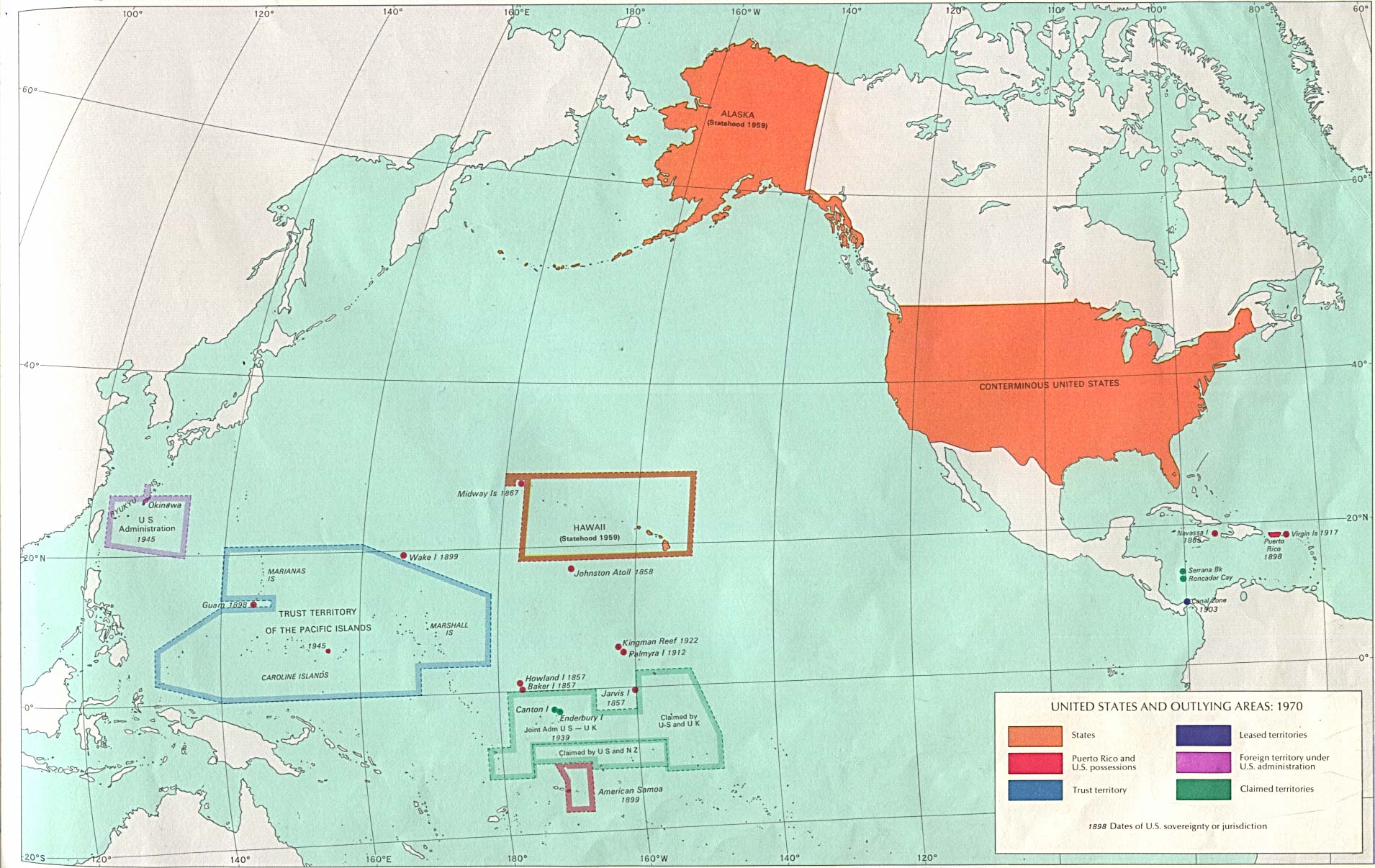
1. The Spanish-American War of 1898: the U.S. win sovereignty over
Cuba, Puerto Rico (in the Atlantic/the Caribbean Sea), Guam and the
Philippines (in the Pacific), and soon after that over the Panama
Canal (in 1903).

2. During the years of the World War 1 (U.S. entered the war in 1917):
U.S. administration of Haiti (1915), Dominican Republic (1916), Virgin
Islands (purchased from Denmark in 1917), and Rhineland/Germany
(1918).

3. During and after the World War 2: U.S. occupation of Iceland and Gr-
eenland (1941), parts of Austria and Germany, including West Berlin
(1945), Japan and South Korea (1945), Trieste/Italy (1947), and the ad-
ministration of the Trust Territory of the Pacific Islands/West Pacific
Micronesia (1947). [2]

On the other hand, the United States have a long lasting tradition of turning
its territories and possessions into states when imperatives of the times have
required them to do so. To begin with, most U.S. states, except the original
thirteen, were territories before they became states. The last U.S. statehood-
granted territories were: Oklahoma (in 1907), New Mexico and Arizona
(both in 1912), Hawaii and Alaska (both in 1959).

Currently, there are sixteen U.S. territories, five of which are permanently in-
habited: American Samoa (AS), Guam (GU), Northern Mariana Islands (MP),
Puerto Rico (PR), and U.S. Virgin Islands (VI). The rest of the eleven territo-
ries are small islands, atolls, and reefs spread across the Pacific Ocean and the
Caribbean Sea, with no permanent population. Also, there are certain constitu-
tional and administrative differences between these territories. Some territories
are or are not incorporated (as part of the United States proper), and do or do
not have an organizedgovernment (that is, through an organic act passed by the
U.S. Congress).

Thus, there were incorporated organized territories of the U.S. (such as Alaska
and Hawaii until 1959). Currently, there are only U.S. territories that are incor-
porated unorganized (Palmyra Atoll), unincorporated organized (Guam and U.S.
Virgin Islands), unincorporated unorganized (American Samoa and other islands,
atolls and reefs in the Pacific Ocean and the Caribbean Sea), and commonweal-
ths (Northern Mariana Islands and Puerto Rico). Other former U.S. territories
have become independent countries (such as: the Philippines, Micronesia, Mar-
shall Islands and Palau). It should be mentioned the fact that, with the excepti-
on of the Philippines, the other three former U.S. territories gained their inde-
pendence under the Compact of Free Association (COFA), which allows the
United States to have full authority over aid, defense, health care, and other go-
vernment services (such as federal communications and postal service), plus
the right to work in the U.S. and vice versa. [3]

In spite of the various local organizational differences among these entities,
the common denominator is that they all are (or, in case of few others, used
to be) U.S. territories and, for the obvious aforementioned strategic, military,
and economic reasons, there should start a serious and uninhibited approach
toward granting - at least for five of them: AS, GU, MP, PR, and VI – the U.S.
statehood. A step forward would be to attract the current COFA entities into
the new federal construction. An inspiring movement, which we call STATE-
HOOD FOR U.S. TERRITORIES, coming from the top executive level (the
 President), in conjunction with its top legislative counterpart (the Congress),
is expected in order to gather and channel the grassroots energies and resour-
ces toward this noble and visionary ideal. If properly implemented and accom-
plished, this country project or national plan is able to assure a perennial place
in history for its initiators. And, indeed, Statehood For U.S. Territories can
find its natural inception within the already popular trend of “making Ameri-
ca great(er) again”. Literally. [4]


[1]
[2]
[3]
[4]

------------------------------------------------------------------------------------------------

Tiberiu Dianu is a legal scholar, book author, graduate of the American  University Washington 
College of Law in Washington, DC, the University of Manchester Faculty of Law in Manchester, 
UK, and an exchange scholar of the Oxford University in Oxford, UK. He currently lives in Wa-
shington, DC and works for various government and private agencies. The opinions expressed in 
the preceding article do not necessarily reflect those of The Puerto Rico Monitor, its editors or 
advertisers.