Headlines From Our Twitter Feed

Showing posts with label statehood. Show all posts

Wednesday, January 9, 2019

Puerto Rico News Digest For January 9, 2019


PR FBI CHIEF: ISLAND FACES "CRISIS OF VIOLENCE"


From CBS News:

"The top FBI official in Puerto Rico said the island is facing a "crisis of violence" and has asked the agency for more personnel and resources from the U.S. mainland. In an interview with local radio station NotiUno630 Wednesday morning, Special Agent in Charge Douglas Leff said no other agency field office in the country is facing what his San Juan office is facing in terms of crime..."


GONZALEZ TO INTRODUCE NEW STATEHOOD BILL


From El Nuevo Dia:

"Resident Commissioner in Washington Jenniffer González plans to introduce a new pro-statehood bill in the House. However, for the legislation to be addressed during this Congress, the government of Puerto Rico would have to hold a "statehood: yes-or-no" referendum this year..."


AGRITEK GETS POT LICENSE


From News Is My Business:

"Agritek Holdings Inc., a real estate investor for the cannabis sector in the United States and Canada, announced that its licensee and partner, 1919 Clinic, has received its final approval from the Puerto Rico Department of Health to begin operations under the medicinal cannabis program..."


NY TIMES NAMES PR TOP TOURIST DESTINATION


From Caribbean Business:

"Puerto Rico Gov. Ricardo Rosselló Nevares was pleased Wednesday with the New York Times(NYT) having selected the island as its top recommended travel destination this year. “Once again, we see rewarded the effort we have made to present Puerto Rico to the world as a world-class destination, to present the attractions of our beautiful Island, as well as highlighting the resilient nature of Puerto Ricans..."


TEACHER SHORTAGE ON HORIZON AS MANY RETIRE


From The San Juan Daily Star:

"About 65 percent of local public school teachers are near the average age for retirement, yet there are not enough qualified candidates in the island to replace them, Teachers Association President Ada Diaz said Tuesday..."


Monday, July 24, 2017

Puerto Rico News Digest For July 24, 2017


JARDINES DE COUNTRY KILL

Carolina neighborhood reports murder for 2nd weekend in a row


A man believed to be in his early 20s, who is so far unidentified, was shot to death at around 4:30 on Sunday morning in the Jardines de Country Club neighborhood of Carolina. The victim parked his car on 30th Street, between a basketball court and baseball field in the suburban neighborhood, and was apparently shot at several times as he sat in the vehicle. It is unknown whether he was pursued there before being killed. After shooting, the perpetrators presumably drove away in their own vehicle, while the victim left his bullet-riddled car and stumbled for a few feet before falling to the ground, where he died. A 911 call alerted police to the sound of gunfire, and they found the lifeless body soon afterward. This is the second murder reported in Jardines de Country Club inside of a week, and was one of eight violent deaths registered over the weekend across Puerto Rico.


TREASURY NET INCOME UP 1.7% FOR LAST FISCAL YEAR

From The San Juan Daily Star:

"Puerto Rico Treasury Secretary Raúl Maldonado Gautier reported that the net income to the General Fund from the newly concluded fiscal year 2016-17 (July-June) amounted to $9.334 billion, which represents $159.6 million, or 1.7 percent  more than the previous fiscal year 2015-16..."


ROSSELLO SIGNS PATIENTS' RIGHTS LAW 

From Caribbean Business:

"...Puerto Rico Gov. Ricardo Rosselló on Sunday enacted Senate Bill 27, giving patients more say before health insurers and providing greater power to the Patients Advocate Office (OPP by its Spanish initials) when defending those who are  not covered by the government’s medical plan, Mi Salud..."


MORE PR DOCTORS GOING BANKRUPT 

From News Is My Business:

"During the first six months of the year, 17 medical doctors filed for bankruptcy protection, reporting more than $23.5 million in combined debt to the court, a report by research firm Boletín de Puerto Rico confirmed..."


ROSSELLO TRIES TO PUT PR IN CONGRESSIONAL AGENDA

From The Washington Examiner:

"Puerto Rico is throwing a wrench into the mainland's politics. The Caribbean island's government held a referendum on June 11 to gauge public support in what was the territory's fifth-ever plebiscite on statehood, and the vast majority  of voters said yes..."


Wednesday, April 26, 2017

Puerto Rico Statehood In The Age of Trump


Commentary

Rosa Bravo

Originally published March 8, 2017

The cause of Puerto Rican statehood, already battered by the island's enormous economic crisis, has run into a new obstacle: the election of Donald Trump as President. While the President cannot change Puerto Rico's status on his own,his election -- and the tenor of the political discourse under which he was elected -- has made the Republican-majority Congress more implicitly hostile to Puerto Rico's statehood prospects. I believe Trump's rhetoric and actions have set the tone that Congress will follow for at least the  next four years.

It is not a secret that President Trump is a xenophobe who has little regard for Hispanics.That alone would prejudice him against supporting the admission of three-plus million Spanish speakers into the Union. But besides that, his goal of restoring America's economic might would steer him away from incorporating a territory with tens of billions of dollars in crippling debt that, in his view and of those like him, would contribute little to the federal treasury. But the biggest issue here may be Trump's almost total ignorance regarding Puerto Rico, its history and its issues. The President is a man famous for not reading and for losing his patience quickly. It is almost certain he has never taken an interest in the island, other than whatever he needed to know to build his now  defunct Rio Grande golf club. In his simple mind, Puerto Ricans are probably just welfare queens to be shoved aside; after all, they're not "real Americans". I think that Trump's election put PR ever closer to the unilateral granting of independence for the island, despite that option finding next to no support among Puerto Ricans. He can't do it himself, but he can certainly goad his Republican acolytes in Congress to do so.

The current government of Puerto Rico would do well do ask for very little from thecurrent federal government. And it should certainly not even bring up the issue of Puerto Rico's status or ask for Puerto Rican statehood. Because if they do, the answer from the USA may very well be: "No. But thanks for reminding us that you're still hanging around. Goodbye, you're free to go". This is why I think a status referendum in Puerto Rico right now is a ridiculous idea. As a supporter of statehood, I fear that no good would come from poking that hornet's nest. The best thing to do would be to keep our heads down, try to get our financial house in some kind of order and just wait out the Trump storm. A better climate will come.


Rosa Bravo is a staff writer for The Puerto Rico Monitor. The opinions expressed in the preceding
piece are strictly her own and do not necessarily represent those of The Puerto Rico Monitor, its
editors or advertisers.

Tuesday, April 11, 2017

Is Independence Imminent For Puerto Rico?


Commentary

Rosa Bravo

Originally published January 12, 2016


I am proud of my United States citizenship and I have long supported
the idea of statehood for Puerto Rico. But at this point, even I have to
admit that my home island becoming the 51st state seems like an in-
creasingly remote possibility. I'm not pessimistic about statehood be-
cause of the language difference, or the possibility of losing our "na-
tional" Olympic team, or because of Puerto Rican voters' long runn-
ing indecisiveness regarding the future of their island. I'm pessimis-
tic about statehood because the one entity that could grant such a thing,
the US Congress, will not let it happen. And with every day that passes,
Congress feels less and less willing to admit Puerto Rico as a state.

And who can blame them? Puerto Rico's financial woes have made
headlines regularly over the last several years. Holders of Puerto Rico
bonds are bracing themselves for the worst, will billions of dollars yet
to be lost. During the island's budget and debt debacles, some of Puerto
Rico's seemingly intractable institutional corruption has been brought to
light for the whole world to see. Puerto Ricans continue to leave the is-
land for the mainland in droves. Puerto Rico is still much poorer than the
poorest state in the union. Besides all of this, the US's incentives for hol-
ding on to this Caribbean territory have largely disappeared.

During the 20th century, Puerto Rico's location made it a key to protec-
ting the then US owned Panama Canal. After World War II, its strategic
value appreciated further, as Cuba went communist and the US needed to
pay close attention to the Caribbean and Central America. Puerto Rico was
also a hub for manufacturing, as tax incentives and cheap labor yielded bi-
llions in profits for American corporations. But those incentives are gone.
The Cold War is long over, and whatever geopolitical challenges the US
faces -- or expects to face in the near future -- are not present in the Ame-
ricas, but rather in the Middle East and Asia. American businesses found
labor cheaper than Puerto Rico's long ago, in Mexico, China, India...even
right next door in the Dominican Republic. Plus, Congress took away
many of the tax incentives.

The United States has taken plenty from Puerto Rico over the decades,
including scores of lives lost by Puerto Rican soldiers in American wars.
But now that they find they can't squeeze any more juice from their main
Caribbean possession, they are probably asking themselves what the point
is any longer. Sure, Puerto Ricans still pay plenty of taxes to Uncle Sam,
even if we don't pay Federal Income Tax (although many of us do have to
pay). American businesses still make billions in the island. But the old re-
turn on investment is no longer there. Many a right-wing blowhard in DC
will think "Why do we keep sending billions in federal funds into a black
hole? Why do we even still have this island of latino freeloaders any lon-
ger?". They look at Puerto Rico's super-corrupt elites and increasingly poor
population and wonder whether it might not be time to cut their losses. Ne-
vermind that that same corrupt elite grew initially under US auspices (Puer-
to Rico had no self-rule at all until 1952, and even then it was severely li-
mited) and that the US-favored colonial status is largely responsible for
keeping Puerto Ricans trapped in poverty. Historical memories are short
in Washington.

Will Congress suddenly be afflicted with an attack of conscience, and
grant Puerto Rico statehood (provided a majority of us finally and with-
out reservation ask for it)? Will they consider America's decades-long ill
treatment and neglect of Puerto Rico and do the morally right thing, and
say yes to admitting millions of US citizens into the union as equals? I
wouldn't bet any money on it. While the statehood conversation would be
taken a lot more seriously if at least 75% of Puerto Rican voters said yes
to statehood (nope, 51% doesn't cut it and never will), it would still be a
battle. Congress looks at the Puerto Rico of today and see millions of poor,
Spanish-speaking welfare recipients. With Cuba opening, Puerto Rico is
no longer the business-friendly Caribbean lab of the mid-century; it is a
washed-up has-been, in their eyes. But they are beginning to acknowledge
that the current colonial situation is no longer tenable. So what options are
left? A sovereign, "associated republic", a la Marshall Islands or Palau.
Or, of course, full independence. Either one would be seen in Washing-
ton as cheaper and easier than maintaining the current status, or burdening
itself with a "beggar" 51st state.

Congress may soon have the excuse that it wants to get rid of Puerto Ri-
co. Independence may be coming sooner than any of us expect, whether
we ask for it or not. The colonial master is getting anxious and is feeling
increasingly eager to get rid of what it helped create. If you don't want to
see that happen, it's time to start making some real noise for statehood.
And not in  Puerto Rico, where it won't matter what you say or who hears
you. It is people and politicians in the mainland who need to hear our voi-
ces. And do you have family or friends in the mainland  US? Of course you
do. Tell them to speak up and to always VOTE, and to let  everyone know
that they vote. We also need an organization that can promote statehood
other than the New Progressive Party, which for decades has accomplished
less than nothing in convincing Congress to seriously consider decoloniza-
tion.

If we don't take the fight for statehood to another level, get ready to make
some room for that Puerto Rico passport in your wallet. Because we're
going to be on our own.


The opinions expressed in the preceding commentary do no  necessarily reflect those 
of The Puerto Rico Monitor.

Wednesday, March 8, 2017

Puerto Rico Statehood In The Age of Trump


Commentary

Rosa Bravo

The cause of Puerto Rican statehood, already battered by the island's enormous
economic crisis, has run into a new obstacle: the election of Donald Trump as
President. While the President cannot change Puerto Rico's status on his own,
his election -- and the tenor of the political discourse under which he was elec-
ted -- has made the Republican-majority Congress more implicitly hostile to
Puerto Rico's statehood prospects. I believe Trump's rhetoric and actions have
set the tone that Congress will follow for at least the  next four years.

It is not a secret that President Trump is a xenophobe who has little regard for
Hispanics.That alone would prejudice him against supporting the admission of
three-plus million Spanish speakers into the Union. But besides that, his goal of
restoring America's economic might would steer him away from incorporating a
territory with tens of billions of dollars in crippling debt that, in his view and of
those like him, would contribute little to the federal treasury. But the biggest issue
here may be Trump's almost total ignorance regarding Puerto Rico, its history and
its issues. The President is a man famous for not reading and for losing his patien-
ce quickly. It is almost certain he has never taken an interest in the island, other
than whatever he needed to know to build his now  defunct Rio Grande golf club.
In his simple mind, Puerto Ricans are probably just welfare queens to be shoved
aside; after all, they're not "real Americans". I think that Trump's election put PR
ever closer to the unilateral granting of independence for the island, despite that
option finding next to no support among Puerto Ricans. He can't do it himself,
but he can certainly goad his Republican acolytes in Congress to do so.

The current government of Puerto Rico would do well do ask for very little from
thecurrent federal government. And it should certainly not even bring up the issue
of Puerto Rico's status or ask for Puerto Rican statehood. Because if they do, the
answer from the USA may very well be: "No. But thanks for reminding us that
you're still hanging around. Goodbye, you're free to go". This is why I think a st-
atus referendum in Puerto Rico right now is a ridiculous idea. As a supporter of
statehood, I fear that no good would come from poking that hornet's nest. The
best thing to do would be to keep our heads down, try to get our financial house
in some kind of order and just wait out the Trump storm. A better climate will
come.


Rosa Bravo is a staff writer for The Puerto Rico Monitor. The opinions expressed in the preceding
piece are strictly her own and do not necessarily represent those of The Puerto Rico Monitor, its
editors or advertisers.


Tuesday, September 20, 2016

Is Independence Imminent For Puerto Rico?


Commentary

Rosa Bravo

Originally published January 12, 2016


I am proud of my United States citizenship and I have long supported
the idea of statehood for Puerto Rico. But at this point, even I have to
admit that my home island becoming the 51st state seems like an in-
creasingly remote possibility. I'm not pessimistic about statehood be-
cause of the language difference, or the possibility of losing our "na-
tional" Olympic team, or because of Puerto Rican voters' long runn-
ing indecisiveness regarding the future of their island. I'm pessimis-
tic about statehood because the one entity that could grant such a thing,
the US Congress, will not let it happen. And with every day that passes,
Congress feels less and less willing to admit Puerto Rico as a state.

And who can blame them? Puerto Rico's financial woes have made
headlines regularly over the last several years. Holders of Puerto Rico
bonds are bracing themselves for the worst, will billions of dollars yet
to be lost. During the island's budget and debt debacles, some of Puerto
Rico's seemingly intractable institutional corruption has been brought to
light for the whole world to see. Puerto Ricans continue to leave the is-
land for the mainland in droves. Puerto Rico is still much poorer than the
poorest state in the union. Besides all of this, the US's incentives for hol-
ding on to this Caribbean territory have largely disappeared.

During the 20th century, Puerto Rico's location made it a key to protec-
ting the then US owned Panama Canal. After World War II, its strategic
value appreciated further, as Cuba went communist and the US needed to
pay close attention to the Caribbean and Central America. Puerto Rico was
also a hub for manufacturing, as tax incentives and cheap labor yielded bi-
llions in profits for American corporations. But those incentives are gone.
The Cold War is long over, and whatever geopolitical challenges the US
faces -- or expects to face in the near future -- are not present in the Ame-
ricas, but rather in the Middle East and Asia. American businesses found
labor cheaper than Puerto Rico's long ago, in Mexico, China, India...even
right next door in the Dominican Republic. Plus, Congress took away
many of the tax incentives.

The United States has taken plenty from Puerto Rico over the decades,
including scores of lives lost by Puerto Rican soldiers in American wars.
But now that they find they can't squeeze any more juice from their main
Caribbean possession, they are probably asking themselves what the point
is any longer. Sure, Puerto Ricans still pay plenty of taxes to Uncle Sam,
even if we don't pay Federal Income Tax (although many of us do have to
pay). American businesses still make billions in the island. But the old re-
turn on investment is no longer there. Many a right-wing blowhard in DC
will think "Why do we keep sending billions in federal funds into a black
hole? Why do we even still have this island of latino freeloaders any lon-
ger?". They look at Puerto Rico's super-corrupt elites and increasingly poor
population and wonder whether it might not be time to cut their losses. Ne-
vermind that that same corrupt elite grew initially under US auspices (Puer-
to Rico had no self-rule at all until 1952, and even then it was severely li-
mited) and that the US-favored colonial status is largely responsible for
keeping Puerto Ricans trapped in poverty. Historical memories are short
in Washington.

Will Congress suddenly be afflicted with an attack of conscience, and
grant Puerto Rico statehood (provided a majority of us finally and with-
out reservation ask for it)? Will they consider America's decades-long ill
treatment and neglect of Puerto Rico and do the morally right thing, and
say yes to admitting millions of US citizens into the union as equals? I
wouldn't bet any money on it. While the statehood conversation would be
taken a lot more seriously if at least 75% of Puerto Rican voters said yes
to statehood (nope, 51% doesn't cut it and never will), it would still be a
battle. Congress looks at the Puerto Rico of today and see millions of poor,
Spanish-speaking welfare recipients. With Cuba opening, Puerto Rico is
no longer the business-friendly Caribbean lab of the mid-century; it is a
washed-up has-been, in their eyes. But they are beginning to acknowledge
that the current colonial situation is no longer tenable. So what options are
left? A sovereign, "associated republic", a la Marshall Islands or Palau.
Or, of course, full independence. Either one would be seen in Washing-
ton as cheaper and easier than maintaining the current status, or burdening
itself with a "beggar" 51st state.

Congress may soon have the excuse that it wants to get rid of Puerto Ri-
co. Independence may be coming sooner than any of us expect, whether
we ask for it or not. The colonial master is getting anxious and is feeling
increasingly eager to get rid of what it helped create. If you don't want to
see that happen, it's time to start making some real noise for statehood.
And not in  Puerto Rico, where it won't matter what you say or who hears
you. It is people and politicians in the mainland who need to hear our voi-
ces. And do you have family or friends in the mainland  US? Of course you
do. Tell them to speak up and to always VOTE, and to let  everyone know
that they vote. We also need an organization that can promote statehood
other than the New Progressive Party, which for decades has accomplished
less than nothing in convincing Congress to seriously consider decoloniza-
tion.

If we don't take the fight for statehood to another level, get ready to make
some room for that Puerto Rico passport in your wallet. Because we're
going to be on our own.


The opinions expressed in the preceding commentary do no  necessarily reflect those 
of The Puerto Rico Monitor.


Tuesday, July 5, 2016

Puerto Rico News Digest For July 5, 2016


GOVT MAKES PARTIAL INTEREST PAYMENT


From The San Juan Daily Star:

"The government of Puerto Rico said it would pay at least part of the interest
on bonds that came due at midnight on Friday, but in any case foresaw the grea-
test default on the debt to date. The different bonds that came due July 1 totaled
nearly $2 billion, of which some $700 million were general obligation (GO) bo-
nds, according to a CyberNews report. This type of bond is guaranteed by the
Puerto Rico Constitution, which assures that their payment has priority over any
other public expenditure that the commonwealth administration has incurred..."


PR UNVEILS FIRST LGBT MONUMENT


From The Advocate:

"Puerto Rico has unveiled its first LGBT monument, which also serves as a me-
morial to the 49 victims of the June 12 massacre at Orlando’s Pulse nightclub.
Most of the people killed were LGBT and Latino, and a majority of the victims
were of Puerto Rican descent. The monument, located in San Juan’s Third Mill-
ennium Park, is comprised of seven rectangular columns in rainbow colors, and
sits at the entrance to the Escobar the Sixth Stadium...At the base of the monum-
ent is a plaque highlighting the names of the 23 Puerto Rican victims killed in the
massacre, with the additional 26 victims listed below..."


BANKRUPTCIES REMAIN FLAT IN JUNE


From News Is My Business:

"Puerto Rico’s bankruptcy levels remained flat last month, when the total number
of companies and individuals who turned to the U.S. Bankruptcy Court for help
was up by two cases when compared to the same month in 2015. So far this year,
there are 5,291 bankruptcy cases on file, representing a 5.06 percent increase from
the same six-month period last year..."


NPP HOISTS 51-STAR US FLAG


From Caribbean Business:

"The secretary-general of the New Progressive Party (NPP), William Villafañe,
on Monday, July 4, removed the U.S. flag from on its pole at party headquarters
and hoisted a new flag, with 51 stars. The event comes about as part of an initia-
tive calling for the U.S. government to “respect the will of the people and give
way to a decolonization process in which statehood is attained,” Villafañe said
...Villafañe added that during the NPP’s monthly directors’ meeting, to be held
Tuesday, a resolution will be presented so all of the party’s municipal committe-
es hoist the 51-star flag “to deliver the message of equality and statehood,” he
said...'


Friday, July 1, 2016

Is Independence Imminent For Puerto Rico?


Commentary

Rosa Bravo


Originally published January 12, 2016


I am proud of my United States citizenship and I have long supported
the idea of statehood for Puerto Rico. But at this point, even I have to
admit that my home island becoming the 51st state seems like an in-
creasingly remote possibility. I'm not pessimistic about statehood be-
cause of the language difference, or the possibility of losing our "na-
tional" Olympic team, or because of Puerto Rican voters' long runn-
ing indecisiveness regarding the future of their island. I'm pessimis-
tic about statehood because the one entity that could grant such a thing,
the US Congress, will not let it happen. And with every day that passes,
Congress feels less and less willing to admit Puerto Rico as a state.

And who can blame them? Puerto Rico's financial woes have made
headlines regularly over the last several years. Holders of Puerto Rico
bonds are bracing themselves for the worst, will billions of dollars yet
to be lost. During the island's budget and debt debacles, some of Puerto
Rico's seemingly intractable institutional corruption has been brought to
light for the whole world to see. Puerto Ricans continue to leave the is-
land for the mainland in droves. Puerto Rico is still much poorer than the
poorest state in the union. Besides all of this, the US's incentives for hol-
ding on to this Caribbean territory have largely disappeared.

During the 20th century, Puerto Rico's location made it a key to protec-
ting the then US owned Panama Canal. After World War II, its strategic
value appreciated further, as Cuba went communist and the US needed to
pay close attention to the Caribbean and Central America. Puerto Rico was
also a hub for manufacturing, as tax incentives and cheap labor yielded bi-
llions in profits for American corporations. But those incentives are gone.
The Cold War is long over, and whatever geopolitical challenges the US
faces -- or expects to face in the near future -- are not present in the Ame-
ricas, but rather in the Middle East and Asia. American businesses found
labor cheaper than Puerto Rico's long ago, in Mexico, China, India...even
right next door in the Dominican Republic. Plus, Congress took away
many of the tax incentives.

The United States has taken plenty from Puerto Rico over the decades,
including scores of lives lost by Puerto Rican soldiers in American wars.
But now that they find they can't squeeze any more juice from their main
Caribbean possession, they are probably asking themselves what the point
is any longer. Sure, Puerto Ricans still pay plenty of taxes to Uncle Sam,
even if we don't pay Federal Income Tax (although many of us do have to
pay). American businesses still make billions in the island. But the old re-
turn on investment is no longer there. Many a right-wing blowhard in DC
will think "Why do we keep sending billions in federal funds into a black
hole? Why do we even still have this island of latino freeloaders any lon-
ger?". They look at Puerto Rico's super-corrupt elites and increasingly poor
population and wonder whether it might not be time to cut their losses. Ne-
vermind that that same corrupt elite grew initially under US auspices (Puer-
to Rico had no self-rule at all until 1952, and even then it was severely li-
mited) and that the US-favored colonial status is largely responsible for
keeping Puerto Ricans trapped in poverty. Historical memories are short
in Washington.

Will Congress suddenly be afflicted with an attack of conscience, and
grant Puerto Rico statehood (provided a majority of us finally and with-
out reservation ask for it)? Will they consider America's decades-long ill
treatment and neglect of Puerto Rico and do the morally right thing, and
say yes to admitting millions of US citizens into the union as equals? I
wouldn't bet any money on it. While the statehood conversation would be
taken a lot more seriously if at least 75% of Puerto Rican voters said yes
to statehood (nope, 51% doesn't cut it and never will), it would still be a
battle. Congress looks at the Puerto Rico of today and see millions of poor,
Spanish-speaking welfare recipients. With Cuba opening, Puerto Rico is
no longer the business-friendly Caribbean lab of the mid-century; it is a
washed-up has-been, in their eyes. But they are beginning to acknowledge
that the current colonial situation is no longer tenable. So what options are
left? A sovereign, "associated republic", a la Marshall Islands or Palau.
And of course, full independence. Either one would be seen in Washing-
ton as cheaper and easier than maintaining the current status, or burdening
itself with a "beggar" 51st state.

Congress may soon have the excuse that it wants to get rid of Puerto Ri-
co. Independence may be coming sooner than any of us expect, whether
we ask for it or not. The colonial master is getting anxious and is feeling
increasingly eager to get rid of what it helped create. If you don't want to
see that happen, it's time to start making some real noise for statehood.
And not in  Puerto Rico, where it won't matter what you say or who hears
you. It is people and politicians in the mainland who need to hear our voi-
ces. And do you have family or friends in the mainland  US? Of course you
do. Tell them to speak up and to always VOTE, and to let  everyone know
that they vote. We also need an organization that can promote statehood
other than the New Progressive Party, which for decades has accomplished
less than nothing in convincing Congress to seriously consider decoloniza-
tion.

If we don't take the fight for statehood to another level, get ready to make
some room for that Puerto Rico passport in your wallet. Because we're
going to be on our own.


The opinions expressed in the preceding commentary do no  necessarily reflect those 
of The Puerto Rico Monitor.

Monday, June 20, 2016

Puerto Rico News Digest For June 20, 2016


ROSSELLO TO ASK FOR DECOLONIZATION


"The president of the New Progressive Party (NPP), Ricardo Rosselló, will 
return Monday to the United Nations to deliver his message in favor of deco-
lonization. “Following the results of the 2012 plebiscite, this forum acquires
more relevance due to Puerto Ricans’ interest in solving the colonial problem.
It is now even more important because the Supreme Court of the United Sta-
tes confirmed the commonwealth has no sovereignty, which has been a decep-
tion, as we have been saying,” the party president said Sunday. In 2013, Rosse-
lló testified before the UN, after delivering to the entity in November 2012 the
results of the referendum in which the statehood option won a majority of votes..."


GROUP BUSINESS UP DESPITE ZIKA


"Puerto Rico’s group business closed off what has come to be known as the
initial Zika period (March to May), “very much open for business,” with 57 
new booked pieces of business including events, conferences, annual meet-
ings and sports activities from now through 2017, Meet Puerto Rico offici-
als said Thursday. This represents a total direct spend of potentially $20.4 
million into the local economy, Milton Segarra, president of Meet Puerto Ri-
co, the Destination Marketing Organization responsible for attracting meeti-
ngs, conventions, trade shows, sporting events and incentive groups to Puer-
to Rico..."


ZIKA CONTRACEPTIVES FAIL TO REACH WOMEN


From Fox News:

"Only a small fraction of contraceptives donated in Puerto Rico to prevent 
Zika-related birth defects are expected to get to the women who need them 
this month, public health officials told Reuters. The donations - tens of thou-
sands of intrauterine devices and birth control pill packs - came from major 
healthcare companies as the virus spreads rapidly through the island. The de-
livery delays illustrate the struggles of Puerto Rico's healthcare system, which 
is faltering amid the commonwealth's financial crisis...


CAR RENTAL TAX GOES FORWARD


From The San Juan Daily Star:

"The island House of Representatives on Thursday approved with a voice
vote the bill to impose a tax of $3.50 per day for the rental of motor vehicles
in Puerto Rico. House Bill 2867, authored by Popular Democratic Party Rep.
Ángel Matos, establishes that the surcharge would be for the first 30 days of
rental and for those who do not have a driver’s license issued by the common-
wealth..."

Wednesday, June 8, 2016

The District of Columbia Statehood Issue: Why The National Capital Cannot Be a State Nor a Territory


Washington Post


Commentary

Tiberiu Dianu


Recently, there have been several attempts to assimilate the District of Co-
lumbia status to the one of a US territory. In the midst of a presidential elec-
tion year, the DC Mayor Muriel Bowser, a Democrat, intends to prepare a 
statehood package for the District of Columbia when the new administrati-
on takes office, irrespective of who wins in November. Supposedly, this is 
“a new front in the District’s long-running fight for equal rights.” [1]

When asked about this, the former Republican presidential hopeful John Ka-
sich opined that this would be “just more votes in the Democratic Party.” [2]
 This approach was seen by some as precarious vis-à-vis the almighty “Taxa-
tion without Representation” slogan. On the contrary, Hillary Clinton grabbed 
the opportunity, and promised to be "a vocal champion" for DC statehood just 
weeks before the city's presidential primary. [3]

Let’s try to figure out if there is any elephant in the room. On the face value, 
sure, why would the DC residents not have their own representatives in the 
Congress, since they – don’t we all know? – pay (federal) taxes, go to war 
and fulfill other citizenship duties. As a twenty-plus-year resident in the Dis-
trict, I say: it’s not going to happen. Not anytime soon.

Here are several reasons.

-The absence of political will at the top: Washington, DC has been a city 
dominated by Democrats and a Republican-dominated Congress will never 
allow several Democratic congress people showing out of the blue. In addi-
tion, Maryland and Virginia Democrat representatives (let alone their Repu-
blican colleagues) do not want a DC commuter tax imposed on their own re-
sidents;

-The lack of viability as a state: DC does not have the means nor resources 
to sustain a viable territory or economy in order to protect its residents within 
its borders; that aside, if the new state would exclude a small federal enclave 
(as proposed, in an attempt to avoid a constitutional amendment), this would 
reduce its territory to a new minimum;

-The inexistence of an independent budget: according to the Article I of the 
Constitution, the Congress has the power to Exercise exclusive Legislation in
all Cases whatsoever” over the District. Although the DC representatives (in-
cluding the current mayor) have threatened to pass budget autonomy laws, fe-
deral judges have constantly stricken down such initiatives over the years (see
 in 2014, for that matter), ruling that only Congress can act;

-The absence of such an express provision in the US Constitution: according to 
the Article IV, Section 3, Clause 1, the Constitution empowers the Congress to 
grant statehood, while Clause 2 stipulates that “The Congress shall have Power
to dispose of and make all needful Rules and Regulations respecting the Terri-
tory or other Property belonging to the United States; and nothing in this Cons-
titution shall be so construed as to Prejudice any Claims of the United States, 
or of any particular State.” (our emphasis, TD).

First, the legislator uses the word “territory” but not the word “district.” Seco-
nd, even if one claims that DC is “other Property belonging to the United States” 
no state can be prejudiced. Originally, the DC land was part of Virginia and Ma-
ryland. Virginia land has been already returned to this state, and Maryland can 
soon have the same claim if DC pushes for statehood.

Historically, the US Congress has followed a standard procedure for granting 
statehood to territories. The territory holds a referendum to determine the local
population’s desire for or against statehood. If the majority vote is for statehood, 
the territory addresses a statehood petition to the Congress. Then, the two Congr-
ess chambers, House and Senate, pass a joint resolution, by a simple majority vo-
te, accepting the territory as a state. Finally, the US President signs the joint reso-
lution, and the territory is acknowledged as a US state.

For this reason, the five US territories – American Samoa, Guam, Northern Ma-
riana Islands, Puerto Rico, and US Virgin Islands – have all a clear constitutio-
nal path toward statehood, provided by the aforementioned Article IV, Section 3. 
The Federal District of Columbia does not have one.

In turn, what the DC mayor tries to do is to organize a “DC referendum”  in No-
vember – not supported by the US Constitution – and to force the Congress to
acknowledge it. If this attempt succeeds, it will be quickly challenged in court.

The DC administration has tried in the past to promote lawsuits seeking to gr-
ant DC residents congressional voting rights (in 1998) or seeking permission to 
levy a commuter tax on non-District residents (in 2003), but they were all equa-
lly unsuccessful.

More recently, the DC authorities’ enthusiasm has been curbed on May 26,
2016, when the US Congress House of Representatives voted 240 to 179 to nu-
llify a DC ballot measure that allowed the city to spend local tax dollars without 
congressional approval. It is worth mentioning that several Democrat representa-
tives sided with their Republican colleagues to pass the bill. [4]

There is a good reason the District is not a state. The US Constitution provided 
for a federal district under the exclusive jurisdiction of the Congress, and the Dis-
trict is therefore not a part of any US state. Which means that DC should remain
a politically neutral entity. And, since it’s not, being forever dominated by Demo-
crats, there is no ground to become a state.

The future DC (state) Constitution that the Democrats envision in the future will 
certainly be a biased organic law, with provisions overtly against the current US 
Constitution (like, banning The Second Amendment legal gun carrying or ban-
ning discrimination over employees’ reproductive decision and targeting the an-
tiabortion groups[5], and other standard progressive issues regarding legalization
of drugs and “equal marriage act,” to name just a few). [6]

Now the elephant  (not the Republican, but the Democrat one!) is more visible in 
the room. What reason might some Democrats have to reignite the discussion ab-
out the DC statehood now? That is, to press the issue of DC having 2 senators and 
1 representative for the new administration, no matter who wins in November?! 
Or maybe because of that. Or maybe because there is a perceived danger that the
Republicans (as disunited as they seem to be right now) may actually have a cha-
nce to conquer back the White House. In such a context, 2 senators and 1 represen-
tative, all (perpetual) Democrats, will be a major victory for the progressive Don-
key fans.

However, for those residents who still feel disenfranchised (myself included),
there are several alternative solutions.

-Territory relocation: to reincorporate the DC territory (except a small federal 
enclave) to Maryland and/or Virginia (as it was before), and increase to 1 (one) 
the number of U.S. representatives for these states; people would be represented 
in the Congress House of the Representatives, but not in the Senate. Demographi-
cally, this is a fair solution.

-Federal tax exemption: to declare the DC territory federal-tax free, like the U.S.
territories; this will give satisfaction for the residents non-represented in Congress, 
plus it will create a boom in the number of new residents and businesses. Some may 
object that since Washington is a “federal district”, it should continue to pay fede-
ral tax, but in arguing so, we are back to square number one “taxation without re-
presentation” dilemma; and for those still interested to recover retroactively the 
back federal taxes imposed “unconstitutionally,”  they can challenge the issue in 
court. Fiscally, this is a fair solution.

-Granting more electoral votes: according to the 23rd Amendment to the US Con-
stitution (ratified in 1961), the District receives three electoral votes in presidential 
election, which makes the District having an intermediate position (by having elec-
toral votes both for party primaries and general elections, and a non-voting Congr-
ess member), between the US territories (with electoral votes in party primaries,
but not in general elections, and no voting Congress members) and US states (with 
both electoral votes in primary and general elections, and voting Congress mem-
bers). Congress could grant DC three more electoral votes in presidential elections 
(corresponding, so to speak, to the required voting 1 representative and 2 senators), 
doubling the current number, from three to six. Electorally, this may be considered 
by many as a fair solution.


Links:
 

Tiberiu Dianu is a legal scholar, book author, graduate of the American University Washington 
College of Law in Washington, DC, the University of Manchester Faculty of Law in Manchester, 
UK, and an exchange scholar of the Oxford University in Oxford, UK. He currently lives in Wa-
shington, DC and works for various government and private agencies. The opinions expressed
in the preceding article are those of those of the author alone and do not necessarilly represent
 the views of The Puerto Rico Monitor, its editors or advertisers.


Tuesday, May 17, 2016

Statehood for U.S. Territories: A Historical Chance to Make America Great(er) Again. Literally.


Feature

TIBERIU DIANU


The current political discourse in the heated 2016 electoral year gravita-
tes around some simple, common-sense, yet grandiose ideas like making
America great again through reviving trade, by recapturing overseas jobs
(lost in favor of other nations beneficiaries of globalization), and streng-
thening the military (weakened by the political demagogues’ lack of visi-
on). As a result, many American manufactured products are not being com-
petitive anymore on international markets, the same as American military
which, it is said, is not being capable to fight anymore on two fronts at the
same time. [1]

In the meantime, on the international arena, America’s traditional foes ha-
ve been already coagulated their territorial expansion policies. Russia is
extending its sphere of influence in both the Arctic and the Pacific Rim.
China is pushing its boundaries in the disputed South China Sea. While
North Korea does not make any secret of the fact that is ready to attack the
coast of Alaska. In addition to those aggressive actors, a series of lower le-
vel rogue nations (among them: Iran, Venezuela) already have been displa-
ying bombastic discourses about regional dominance. To all that, interna-
tional terrorism is added.

Given the circumstances, it is imperiously necessary for the United States
to solidify their narrative about a new era of American greatness and excep-
tionalism. We are not talking about “the world’s policeman”, nor about “na-
tion building”. Instead, we are talking about a new period when America
should recapture its greatness again for itself, and not so much for the
others.

But before that, we need to remind ourselves the past periods when Ameri-
ca used to be great(er). Let us briefly recap some revealing moments in  re-
cent U.S. history:

1. The Spanish-American War of 1898: the U.S. win sovereignty over
Cuba, Puerto Rico (in the Atlantic/the Caribbean Sea), Guam and the
Philippines (in the Pacific), and soon after that over the Panama
Canal (in 1903).

2. During the years of the World War 1 (U.S. entered the war in 1917):
U.S. administration of Haiti (1915), Dominican Republic (1916), Virgin
Islands (purchased from Denmark in 1917), and Rhineland/Germany
(1918).

3. During and after the World War 2: U.S. occupation of Iceland and Gr-
eenland (1941), parts of Austria and Germany, including West Berlin
(1945), Japan and South Korea (1945), Trieste/Italy (1947), and the ad-
ministration of the Trust Territory of the Pacific Islands/West Pacific
Micronesia (1947). [2]

On the other hand, the United States have a long lasting tradition of turning
its territories and possessions into states when imperatives of the times have
required them to do so. To begin with, most U.S. states, except the original
thirteen, were territories before they became states. The last U.S. statehood-
granted territories were: Oklahoma (in 1907), New Mexico and Arizona
(both in 1912), Hawaii and Alaska (both in 1959).

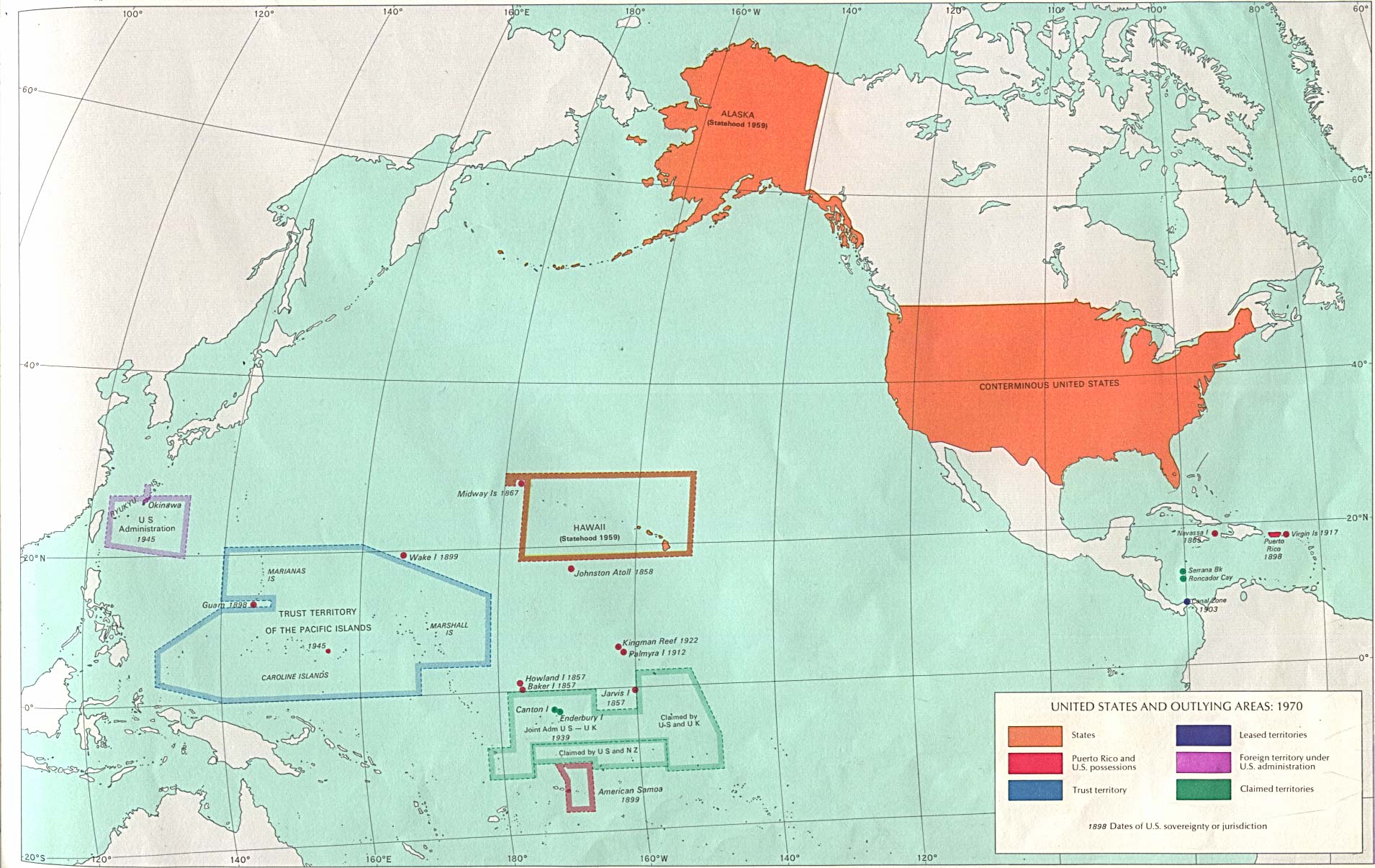
Currently, there are sixteen U.S. territories, five of which are permanently in-
habited: American Samoa (AS), Guam (GU), Northern Mariana Islands (MP),
Puerto Rico (PR), and U.S. Virgin Islands (VI). The rest of the eleven territo-
ries are small islands, atolls, and reefs spread across the Pacific Ocean and the
Caribbean Sea, with no permanent population. Also, there are certain constitu-
tional and administrative differences between these territories. Some territories
are or are not incorporated (as part of the United States proper), and do or do
not have an organizedgovernment (that is, through an organic act passed by the
U.S. Congress).

Thus, there were incorporated organized territories of the U.S. (such as Alaska
and Hawaii until 1959). Currently, there are only U.S. territories that are incor-
porated unorganized (Palmyra Atoll), unincorporated organized (Guam and U.S.
Virgin Islands), unincorporated unorganized (American Samoa and other islands,
atolls and reefs in the Pacific Ocean and the Caribbean Sea), and commonweal-
ths (Northern Mariana Islands and Puerto Rico). Other former U.S. territories
have become independent countries (such as: the Philippines, Micronesia, Mar-
shall Islands and Palau). It should be mentioned the fact that, with the excepti-
on of the Philippines, the other three former U.S. territories gained their inde-
pendence under the Compact of Free Association (COFA), which allows the
United States to have full authority over aid, defense, health care, and other go-
vernment services (such as federal communications and postal service), plus
the right to work in the U.S. and vice versa. [3]

In spite of the various local organizational differences among these entities,
the common denominator is that they all are (or, in case of few others, used
to be) U.S. territories and, for the obvious aforementioned strategic, military,
and economic reasons, there should start a serious and uninhibited approach
toward granting - at least for five of them: AS, GU, MP, PR, and VI – the U.S.
statehood. A step forward would be to attract the current COFA entities into
the new federal construction. An inspiring movement, which we call STATE-
HOOD FOR U.S. TERRITORIES, coming from the top executive level (the
 President), in conjunction with its top legislative counterpart (the Congress),
is expected in order to gather and channel the grassroots energies and resour-
ces toward this noble and visionary ideal. If properly implemented and accom-
plished, this country project or national plan is able to assure a perennial place
in history for its initiators. And, indeed, Statehood For U.S. Territories can
find its natural inception within the already popular trend of “making Ameri-
ca great(er) again”. Literally. [4]


[1]
[2]
[3]
[4]

------------------------------------------------------------------------------------------------

Tiberiu Dianu is a legal scholar, book author, graduate of the American  University Washington 
College of Law in Washington, DC, the University of Manchester Faculty of Law in Manchester, 
UK, and an exchange scholar of the Oxford University in Oxford, UK. He currently lives in Wa-
shington, DC and works for various government and private agencies. The opinions expressed in 
the preceding article do not necessarily reflect those of The Puerto Rico Monitor, its editors or 
advertisers.


Friday, April 1, 2016

Puerto Rico News Digest For April 1, 2016


ZIKA KILLS HUNDREDS IN PUERTO RICO


The zika virus, until now thought to only be dangerous to pregnant women,
but mild or even symptomless for most people, has suddenly taken a turn for
the worse, as up to 500 people have seemingly died due to complications from
the virus over the last week. Large numbers of unusual deaths were reported
starting about eight days ago, all across Puerto Rico. The only common thread
among the  otherwise unexplained deaths was that all of the victims had recently
tested positive for the Zika virus, which indicates that the virus may have recent-
ly mutated. "This is definitely a game-changer", said PR Health Secretary Ana
Rius. "Experts from the CDC [Centers for Disease Control] are on their way to
the island right now to investigate. We encourage all residents not to panic, but
to please stay indoors 24 hours a day, without exception. We have also discove-
red that certain invididuals with Zika who rubbed their bellies while simultane-
ously drinking an Old Colony pineapple soda were able to avoid being killed
by the virus." After concluding her remarks, Rius promptly ran outside and
threw herself onto highway traffic, being struck by several cars. She was de-
clared dead at the scene.


GARCIA PADILLA ENDORSES TRUMP FOR PRESIDENT


In a surprise announcement this morning, Puerto Rico Governor Alejandro
Garcia Padilla endorsed controversial Republican Presidential candidate Do-
nald Trump. During a press conference at La Fortaleza, Garcia Padilla stated
to shocked members of the press that he believes a Donald Trump presidency
would be best for the United states, and therefore for Puerto Rico. "Este queee,
ay zink that Mister Tromp is best deelmaiker in da werld and he can help os ne-
gochiate da debt. Plos, he has lots of moni and can meybee help os out wif a
loan or somsink", declared the governor to the bewildered reporters. "Plos,
dose steaks of hiz are pritti delichous."


PEDRO PIERLUISI: 'FUCK STATEHOOD'


Puerto Rico's sole non-voting congressional representative, Resident Commi-
ssioner and NPP gubernatorial candidate Pedro Pierluisi, expressed disillusi-
onment towards his long-held ideal of Puerto Rican statehood today during
remarks to The Puerto Rico Monitor. "Look, let's just be honest here, okay?",
said the tired-looking Pierluisi, immediately before taking a long drag from
a cigarrette and then slowly exhaling the smoke upward, a bitter look on his
face. "This statehood shit's not going to happen. It's just not. It never will. I
work in Congress, remember? They're the ones who can make it happen. And
they don't give a shit. You think they care what I think? I can't vote. Most of
the time these people mistake me for the janitor, or the guy delivering lunch."
Pierluisi went on, looking as if he were on the verge of tears, "We're broke,
why would they make us a state now? You know what? Fuck statehood. Jesus.
I've wasted my goddamn life." Having said that, the Resident Commissioner
spat on the ground, turned around and walked away.


April Fool's!

Tuesday, March 15, 2016

Is Independence Imminent For Puerto Rico?


Commentary

Rosa Bravo


I am proud of my United States citizenship and I have long supported
the idea of statehood for Puerto Rico. But at this point, even I have to
admit that my home island becoming the 51st state seems like an in-
creasingly remote possibility. I'm not pessimistic about statehood be-
cause of the language difference, or the possibility of losing our "na-
tional" Olympic team, or because of Puerto Rican voters' long runn-
ing indecisiveness regarding the future of their island. I'm pessimis-
tic about statehood because the one entity that could grant such a thing,
the US Congress, will not let it happen. And with every day that passes,
Congress feels less and less willing to admit Puerto Rico as a state.

And who can blame them? Puerto Rico's financial woes have made
headlines regularly over the last several years. Holders of Puerto Rico
bonds are bracing themselves for the worst, will billions of dollars yet
to be lost. During the island's budget and debt debacles, some of Puerto
Rico's seemingly intractable institutional corruption has been brought to
light for the whole world to see. Puerto Ricans continue to leave the is-
land for the mainland in droves. Puerto Rico is still much poorer than the
poorest state in the union. Besides all of this, the US's incentives for hol-
ding on to this Caribbean territory have largely disappeared.

During the 20th century, Puerto Rico's location made it a key to protec-
ting the then US owned Panama Canal. After World War II, its strategic
value appreciated further, as Cuba went communist and the US needed to
pay close attention to the Caribbean and Central America. Puerto Rico was
also a hub for manufacturing, as tax incentives and cheap labor yielded bi-
llions in profits for American corporations. But those incentives are gone.
The Cold War is long over, and whatever geopolitical challenges the US
faces -- or expects to face in the near future -- are not present in the Ame-
ricas, but rather in the Middle East and Asia. American businesses found
labor cheaper than Puerto Rico's long ago, in Mexico, China, India...even
right next door in the Dominican Republic. Plus, Congress took away
many of the tax incentives.

The United States has taken plenty from Puerto Rico over the decades,
including scores of lives lost by Puerto Rican soldiers in American wars.
But now that they find they can't squeeze any more juice from their main
Caribbean possession, they are probably asking themselves what the point
is any longer. Sure, Puerto Ricans still pay plenty of taxes to Uncle Sam,
even if we don't pay Federal Income Tax (although many of us do have to 
pay). American businesses still make billions in the island. But the old re-
turn on investment is no longer there. Many a right-wing blowhard in DC
will think "Why do we keep sending billions in federal funds into a black
hole? Why do we even still have this island of latino freeloaders any lon-
ger?". They look at Puerto Rico's super-corrupt elites and increasingly poor
population and wonder whether it might not be time to cut their losses. Ne-
vermind that that same corrupt elite grew initially under US auspices (Puer-
to Rico had no self-rule at all until 1952, and even then it was severely li-
mited) and that the US-favored colonial status is largely responsible for
keeping Puerto Ricans trapped in poverty. Historical memories are short
in Washington.

Will Congress suddenly be afflicted with an attack of conscience, and
grant Puerto Rico statehood (provided a majority of us finally and with-
out reservation ask for it)? Will they consider America's decades-long ill
treatment and neglect of Puerto Rico and do the morally right thing, and
say yes to admitting millions of US citizens into the union as equals? I
wouldn't bet any money on it. While the statehood conversation would be
taken a lot more seriously if at least 75% of Puerto Rican voters said yes
to statehood (nope, 51% doesn't cut it and never will), it would still be a
battle. Congress looks at the Puerto Rico of today and see millions of poor,
Spanish-speaking welfare recipients. With Cuba opening, Puerto Rico is
no longer the business-friendly Caribbean lab of the mid-century; it is a
washed-up has-been, in their eyes. But they are beginning to acknowledge
that the current colonial situation is no longer tenable. So what options are
left? A sovereign, "associated republic", a la Marshall Islands or Palau.
And of course, full independence. Either one would be seen in Washing-
ton as cheaper and easier than maintaining the current status, or burdening
itself with a "beggar" 51st state.

Congress may soon have the excuse that it wants to get rid of Puerto Ri-
co. Independence may be coming sooner than any of us expect, whether
we ask for it or not. The colonial master is getting anxious and is feeling
increasingly eager to get rid of what it helped create. If you don't want to
see that happen, it's time to start making some real noise for statehood.
And not in  Puerto Rico, where it won't matter what you say or who hears
you. It is people and politicians in the mainland who need to hear our voi-
ces. And do you have family or friends in the mainland  US? Of course you
do. Tell them to speak up and to always VOTE, and to let  everyone know
that they vote. We also need an organization that can promote statehood
other than the New Progressive Party, which for decades has accomplished
less than nothing in convincing Congress to seriously consider decoloniza-
tion.

If we don't take the fight for statehood to another level, get ready to make
some room for that Puerto Rico passport in your wallet. Because we're
going to be on our own.


The opinions expressed in the preceding commentary do no  necessarily reflect those of 
The Puerto Rico Monitor.