Headlines From Our Twitter Feed

Showing posts with label decolonization. Show all posts

Tuesday, September 20, 2016

Is Independence Imminent For Puerto Rico?


Commentary

Rosa Bravo

Originally published January 12, 2016


I am proud of my United States citizenship and I have long supported
the idea of statehood for Puerto Rico. But at this point, even I have to
admit that my home island becoming the 51st state seems like an in-
creasingly remote possibility. I'm not pessimistic about statehood be-
cause of the language difference, or the possibility of losing our "na-
tional" Olympic team, or because of Puerto Rican voters' long runn-
ing indecisiveness regarding the future of their island. I'm pessimis-
tic about statehood because the one entity that could grant such a thing,
the US Congress, will not let it happen. And with every day that passes,
Congress feels less and less willing to admit Puerto Rico as a state.

And who can blame them? Puerto Rico's financial woes have made
headlines regularly over the last several years. Holders of Puerto Rico
bonds are bracing themselves for the worst, will billions of dollars yet
to be lost. During the island's budget and debt debacles, some of Puerto
Rico's seemingly intractable institutional corruption has been brought to
light for the whole world to see. Puerto Ricans continue to leave the is-
land for the mainland in droves. Puerto Rico is still much poorer than the
poorest state in the union. Besides all of this, the US's incentives for hol-
ding on to this Caribbean territory have largely disappeared.

During the 20th century, Puerto Rico's location made it a key to protec-
ting the then US owned Panama Canal. After World War II, its strategic
value appreciated further, as Cuba went communist and the US needed to
pay close attention to the Caribbean and Central America. Puerto Rico was
also a hub for manufacturing, as tax incentives and cheap labor yielded bi-
llions in profits for American corporations. But those incentives are gone.
The Cold War is long over, and whatever geopolitical challenges the US
faces -- or expects to face in the near future -- are not present in the Ame-
ricas, but rather in the Middle East and Asia. American businesses found
labor cheaper than Puerto Rico's long ago, in Mexico, China, India...even
right next door in the Dominican Republic. Plus, Congress took away
many of the tax incentives.

The United States has taken plenty from Puerto Rico over the decades,
including scores of lives lost by Puerto Rican soldiers in American wars.
But now that they find they can't squeeze any more juice from their main
Caribbean possession, they are probably asking themselves what the point
is any longer. Sure, Puerto Ricans still pay plenty of taxes to Uncle Sam,
even if we don't pay Federal Income Tax (although many of us do have to
pay). American businesses still make billions in the island. But the old re-
turn on investment is no longer there. Many a right-wing blowhard in DC
will think "Why do we keep sending billions in federal funds into a black
hole? Why do we even still have this island of latino freeloaders any lon-
ger?". They look at Puerto Rico's super-corrupt elites and increasingly poor
population and wonder whether it might not be time to cut their losses. Ne-
vermind that that same corrupt elite grew initially under US auspices (Puer-
to Rico had no self-rule at all until 1952, and even then it was severely li-
mited) and that the US-favored colonial status is largely responsible for
keeping Puerto Ricans trapped in poverty. Historical memories are short
in Washington.

Will Congress suddenly be afflicted with an attack of conscience, and
grant Puerto Rico statehood (provided a majority of us finally and with-
out reservation ask for it)? Will they consider America's decades-long ill
treatment and neglect of Puerto Rico and do the morally right thing, and
say yes to admitting millions of US citizens into the union as equals? I
wouldn't bet any money on it. While the statehood conversation would be
taken a lot more seriously if at least 75% of Puerto Rican voters said yes
to statehood (nope, 51% doesn't cut it and never will), it would still be a
battle. Congress looks at the Puerto Rico of today and see millions of poor,
Spanish-speaking welfare recipients. With Cuba opening, Puerto Rico is
no longer the business-friendly Caribbean lab of the mid-century; it is a
washed-up has-been, in their eyes. But they are beginning to acknowledge
that the current colonial situation is no longer tenable. So what options are
left? A sovereign, "associated republic", a la Marshall Islands or Palau.
Or, of course, full independence. Either one would be seen in Washing-
ton as cheaper and easier than maintaining the current status, or burdening
itself with a "beggar" 51st state.

Congress may soon have the excuse that it wants to get rid of Puerto Ri-
co. Independence may be coming sooner than any of us expect, whether
we ask for it or not. The colonial master is getting anxious and is feeling
increasingly eager to get rid of what it helped create. If you don't want to
see that happen, it's time to start making some real noise for statehood.
And not in  Puerto Rico, where it won't matter what you say or who hears
you. It is people and politicians in the mainland who need to hear our voi-
ces. And do you have family or friends in the mainland  US? Of course you
do. Tell them to speak up and to always VOTE, and to let  everyone know
that they vote. We also need an organization that can promote statehood
other than the New Progressive Party, which for decades has accomplished
less than nothing in convincing Congress to seriously consider decoloniza-
tion.

If we don't take the fight for statehood to another level, get ready to make
some room for that Puerto Rico passport in your wallet. Because we're
going to be on our own.


The opinions expressed in the preceding commentary do no  necessarily reflect those 
of The Puerto Rico Monitor.


Friday, July 1, 2016

Is Independence Imminent For Puerto Rico?


Commentary

Rosa Bravo


Originally published January 12, 2016


I am proud of my United States citizenship and I have long supported
the idea of statehood for Puerto Rico. But at this point, even I have to
admit that my home island becoming the 51st state seems like an in-
creasingly remote possibility. I'm not pessimistic about statehood be-
cause of the language difference, or the possibility of losing our "na-
tional" Olympic team, or because of Puerto Rican voters' long runn-
ing indecisiveness regarding the future of their island. I'm pessimis-
tic about statehood because the one entity that could grant such a thing,
the US Congress, will not let it happen. And with every day that passes,
Congress feels less and less willing to admit Puerto Rico as a state.

And who can blame them? Puerto Rico's financial woes have made
headlines regularly over the last several years. Holders of Puerto Rico
bonds are bracing themselves for the worst, will billions of dollars yet
to be lost. During the island's budget and debt debacles, some of Puerto
Rico's seemingly intractable institutional corruption has been brought to
light for the whole world to see. Puerto Ricans continue to leave the is-
land for the mainland in droves. Puerto Rico is still much poorer than the
poorest state in the union. Besides all of this, the US's incentives for hol-
ding on to this Caribbean territory have largely disappeared.

During the 20th century, Puerto Rico's location made it a key to protec-
ting the then US owned Panama Canal. After World War II, its strategic
value appreciated further, as Cuba went communist and the US needed to
pay close attention to the Caribbean and Central America. Puerto Rico was
also a hub for manufacturing, as tax incentives and cheap labor yielded bi-
llions in profits for American corporations. But those incentives are gone.
The Cold War is long over, and whatever geopolitical challenges the US
faces -- or expects to face in the near future -- are not present in the Ame-
ricas, but rather in the Middle East and Asia. American businesses found
labor cheaper than Puerto Rico's long ago, in Mexico, China, India...even
right next door in the Dominican Republic. Plus, Congress took away
many of the tax incentives.

The United States has taken plenty from Puerto Rico over the decades,
including scores of lives lost by Puerto Rican soldiers in American wars.
But now that they find they can't squeeze any more juice from their main
Caribbean possession, they are probably asking themselves what the point
is any longer. Sure, Puerto Ricans still pay plenty of taxes to Uncle Sam,
even if we don't pay Federal Income Tax (although many of us do have to
pay). American businesses still make billions in the island. But the old re-
turn on investment is no longer there. Many a right-wing blowhard in DC
will think "Why do we keep sending billions in federal funds into a black
hole? Why do we even still have this island of latino freeloaders any lon-
ger?". They look at Puerto Rico's super-corrupt elites and increasingly poor
population and wonder whether it might not be time to cut their losses. Ne-
vermind that that same corrupt elite grew initially under US auspices (Puer-
to Rico had no self-rule at all until 1952, and even then it was severely li-
mited) and that the US-favored colonial status is largely responsible for
keeping Puerto Ricans trapped in poverty. Historical memories are short
in Washington.

Will Congress suddenly be afflicted with an attack of conscience, and
grant Puerto Rico statehood (provided a majority of us finally and with-
out reservation ask for it)? Will they consider America's decades-long ill
treatment and neglect of Puerto Rico and do the morally right thing, and
say yes to admitting millions of US citizens into the union as equals? I
wouldn't bet any money on it. While the statehood conversation would be
taken a lot more seriously if at least 75% of Puerto Rican voters said yes
to statehood (nope, 51% doesn't cut it and never will), it would still be a
battle. Congress looks at the Puerto Rico of today and see millions of poor,
Spanish-speaking welfare recipients. With Cuba opening, Puerto Rico is
no longer the business-friendly Caribbean lab of the mid-century; it is a
washed-up has-been, in their eyes. But they are beginning to acknowledge
that the current colonial situation is no longer tenable. So what options are
left? A sovereign, "associated republic", a la Marshall Islands or Palau.
And of course, full independence. Either one would be seen in Washing-
ton as cheaper and easier than maintaining the current status, or burdening
itself with a "beggar" 51st state.

Congress may soon have the excuse that it wants to get rid of Puerto Ri-
co. Independence may be coming sooner than any of us expect, whether
we ask for it or not. The colonial master is getting anxious and is feeling
increasingly eager to get rid of what it helped create. If you don't want to
see that happen, it's time to start making some real noise for statehood.
And not in  Puerto Rico, where it won't matter what you say or who hears
you. It is people and politicians in the mainland who need to hear our voi-
ces. And do you have family or friends in the mainland  US? Of course you
do. Tell them to speak up and to always VOTE, and to let  everyone know
that they vote. We also need an organization that can promote statehood
other than the New Progressive Party, which for decades has accomplished
less than nothing in convincing Congress to seriously consider decoloniza-
tion.

If we don't take the fight for statehood to another level, get ready to make
some room for that Puerto Rico passport in your wallet. Because we're
going to be on our own.


The opinions expressed in the preceding commentary do no  necessarily reflect those 
of The Puerto Rico Monitor.

Monday, June 20, 2016

Puerto Rico News Digest For June 20, 2016


ROSSELLO TO ASK FOR DECOLONIZATION


"The president of the New Progressive Party (NPP), Ricardo Rosselló, will 
return Monday to the United Nations to deliver his message in favor of deco-
lonization. “Following the results of the 2012 plebiscite, this forum acquires
more relevance due to Puerto Ricans’ interest in solving the colonial problem.
It is now even more important because the Supreme Court of the United Sta-
tes confirmed the commonwealth has no sovereignty, which has been a decep-
tion, as we have been saying,” the party president said Sunday. In 2013, Rosse-
lló testified before the UN, after delivering to the entity in November 2012 the
results of the referendum in which the statehood option won a majority of votes..."


GROUP BUSINESS UP DESPITE ZIKA


"Puerto Rico’s group business closed off what has come to be known as the
initial Zika period (March to May), “very much open for business,” with 57 
new booked pieces of business including events, conferences, annual meet-
ings and sports activities from now through 2017, Meet Puerto Rico offici-
als said Thursday. This represents a total direct spend of potentially $20.4 
million into the local economy, Milton Segarra, president of Meet Puerto Ri-
co, the Destination Marketing Organization responsible for attracting meeti-
ngs, conventions, trade shows, sporting events and incentive groups to Puer-
to Rico..."


ZIKA CONTRACEPTIVES FAIL TO REACH WOMEN


From Fox News:

"Only a small fraction of contraceptives donated in Puerto Rico to prevent 
Zika-related birth defects are expected to get to the women who need them 
this month, public health officials told Reuters. The donations - tens of thou-
sands of intrauterine devices and birth control pill packs - came from major 
healthcare companies as the virus spreads rapidly through the island. The de-
livery delays illustrate the struggles of Puerto Rico's healthcare system, which 
is faltering amid the commonwealth's financial crisis...


CAR RENTAL TAX GOES FORWARD


From The San Juan Daily Star:

"The island House of Representatives on Thursday approved with a voice
vote the bill to impose a tax of $3.50 per day for the rental of motor vehicles
in Puerto Rico. House Bill 2867, authored by Popular Democratic Party Rep.
Ángel Matos, establishes that the surcharge would be for the first 30 days of
rental and for those who do not have a driver’s license issued by the common-
wealth..."

Tuesday, March 15, 2016

Is Independence Imminent For Puerto Rico?


Commentary

Rosa Bravo


I am proud of my United States citizenship and I have long supported
the idea of statehood for Puerto Rico. But at this point, even I have to
admit that my home island becoming the 51st state seems like an in-
creasingly remote possibility. I'm not pessimistic about statehood be-
cause of the language difference, or the possibility of losing our "na-
tional" Olympic team, or because of Puerto Rican voters' long runn-
ing indecisiveness regarding the future of their island. I'm pessimis-
tic about statehood because the one entity that could grant such a thing,
the US Congress, will not let it happen. And with every day that passes,
Congress feels less and less willing to admit Puerto Rico as a state.

And who can blame them? Puerto Rico's financial woes have made
headlines regularly over the last several years. Holders of Puerto Rico
bonds are bracing themselves for the worst, will billions of dollars yet
to be lost. During the island's budget and debt debacles, some of Puerto
Rico's seemingly intractable institutional corruption has been brought to
light for the whole world to see. Puerto Ricans continue to leave the is-
land for the mainland in droves. Puerto Rico is still much poorer than the
poorest state in the union. Besides all of this, the US's incentives for hol-
ding on to this Caribbean territory have largely disappeared.

During the 20th century, Puerto Rico's location made it a key to protec-
ting the then US owned Panama Canal. After World War II, its strategic
value appreciated further, as Cuba went communist and the US needed to
pay close attention to the Caribbean and Central America. Puerto Rico was
also a hub for manufacturing, as tax incentives and cheap labor yielded bi-
llions in profits for American corporations. But those incentives are gone.
The Cold War is long over, and whatever geopolitical challenges the US
faces -- or expects to face in the near future -- are not present in the Ame-
ricas, but rather in the Middle East and Asia. American businesses found
labor cheaper than Puerto Rico's long ago, in Mexico, China, India...even
right next door in the Dominican Republic. Plus, Congress took away
many of the tax incentives.

The United States has taken plenty from Puerto Rico over the decades,
including scores of lives lost by Puerto Rican soldiers in American wars.
But now that they find they can't squeeze any more juice from their main
Caribbean possession, they are probably asking themselves what the point
is any longer. Sure, Puerto Ricans still pay plenty of taxes to Uncle Sam,
even if we don't pay Federal Income Tax (although many of us do have to 
pay). American businesses still make billions in the island. But the old re-
turn on investment is no longer there. Many a right-wing blowhard in DC
will think "Why do we keep sending billions in federal funds into a black
hole? Why do we even still have this island of latino freeloaders any lon-
ger?". They look at Puerto Rico's super-corrupt elites and increasingly poor
population and wonder whether it might not be time to cut their losses. Ne-
vermind that that same corrupt elite grew initially under US auspices (Puer-
to Rico had no self-rule at all until 1952, and even then it was severely li-
mited) and that the US-favored colonial status is largely responsible for
keeping Puerto Ricans trapped in poverty. Historical memories are short
in Washington.

Will Congress suddenly be afflicted with an attack of conscience, and
grant Puerto Rico statehood (provided a majority of us finally and with-
out reservation ask for it)? Will they consider America's decades-long ill
treatment and neglect of Puerto Rico and do the morally right thing, and
say yes to admitting millions of US citizens into the union as equals? I
wouldn't bet any money on it. While the statehood conversation would be
taken a lot more seriously if at least 75% of Puerto Rican voters said yes
to statehood (nope, 51% doesn't cut it and never will), it would still be a
battle. Congress looks at the Puerto Rico of today and see millions of poor,
Spanish-speaking welfare recipients. With Cuba opening, Puerto Rico is
no longer the business-friendly Caribbean lab of the mid-century; it is a
washed-up has-been, in their eyes. But they are beginning to acknowledge
that the current colonial situation is no longer tenable. So what options are
left? A sovereign, "associated republic", a la Marshall Islands or Palau.
And of course, full independence. Either one would be seen in Washing-
ton as cheaper and easier than maintaining the current status, or burdening
itself with a "beggar" 51st state.

Congress may soon have the excuse that it wants to get rid of Puerto Ri-
co. Independence may be coming sooner than any of us expect, whether
we ask for it or not. The colonial master is getting anxious and is feeling
increasingly eager to get rid of what it helped create. If you don't want to
see that happen, it's time to start making some real noise for statehood.
And not in  Puerto Rico, where it won't matter what you say or who hears
you. It is people and politicians in the mainland who need to hear our voi-
ces. And do you have family or friends in the mainland  US? Of course you
do. Tell them to speak up and to always VOTE, and to let  everyone know
that they vote. We also need an organization that can promote statehood
other than the New Progressive Party, which for decades has accomplished
less than nothing in convincing Congress to seriously consider decoloniza-
tion.

If we don't take the fight for statehood to another level, get ready to make
some room for that Puerto Rico passport in your wallet. Because we're
going to be on our own.


The opinions expressed in the preceding commentary do no  necessarily reflect those of 
The Puerto Rico Monitor.


Tuesday, January 12, 2016

Is Independence Imminent For Puerto Rico?


Commentary

Rosa Bravo


I am proud of my United States citizenship and I have long supported
the idea of statehood for Puerto Rico. But at this point, even I have to
admit that my home island becoming the 51st state seems like an in-
creasingly remote possibility. I'm not pessimistic about statehood be-
cause of the language difference, or the possibility of losing our "na-
tional" Olympic team, or because of Puerto Rican voters' long runn-
ing indecisiveness regarding the future of their island. I'm pessimis-
tic about statehood because the one entity that could grant such a thing,
the US Congress, will not let it happen. And with every day that passes,
Congress feels less and less willing to admit Puerto Rico as a state.

And who can blame them? Puerto Rico's financial woes have made
headlines regularly over the last several years. Holders of Puerto Rico
bonds are bracing themselves for the worst, will billions of dollars yet
to be lost. During the island's budget and debt debacles, some of Puerto
Rico's seemingly intractable institutional corruption has been brought to
light for the whole world to see. Puerto Ricans continue to leave the is-
land for the mainland in droves. Puerto Rico is still much poorer than the
poorest state in the union. Besides all of this, the US's incentives for hol-
ding on to this Caribbean territory have largely disappeared.

During the 20th century, Puerto Rico's location made it a key to protec-
ting the then US owned Panama Canal. After World War II, its strategic
value appreciated further, as Cuba went communist and the US needed to
pay close attention to the Caribbean and Central America. Puerto Rico was
also a hub for manufacturing, as tax incentives and cheap labor yielded bi-
llions in profits for American corporations. But those incentives are gone.
The Cold War is long over, and whatever geopolitical challenges the US
faces -- or expects to face in the near future -- are not present in the Ame-
ricas, but rather in the Middle East and Asia. American businesses found
labor cheaper than Puerto Rico's long ago, in Mexico, China, India...even
right next door in the Dominican Republic. Plus, Congress took away
many of the tax incentives.

The United States has taken plenty from Puerto Rico over the decades,
including scores of lives lost by Puerto Rican soldiers in American wars.
But now that they find they can't squeeze any more juice from their main
Caribbean possession, they are probably asking themselves what the point
is any longer. Sure, Puerto Ricans still pay plenty of taxes to Uncle Sam,
even if we don't pay Federal Income Tax (although many of us do have to 
pay). American businesses still make billions in the island. But the old re-
turn on investment is no longer there. Many a right-wing blowhard in DC
will think "Why do we keep sending billions in federal funds into a black
hole? Why do we even still have this island of latino freeloaders any lon-
ger?". They look at Puerto Rico's super-corrupt elites and increasingly poor
population and wonder whether it might not be time to cut their losses. Ne-
vermind that that same corrupt elite grew initially under US auspices (Puer-
to Rico had no self-rule at all until 1952, and even then it was severely li-
mited) and that the US-favored colonial status is largely responsible for
keeping Puerto Ricans trapped in poverty. Historical memories are short
in Washington.

Will Congress suddenly be afflicted with an attack of conscience, and
grant Puerto Rico statehood (provided a majority of us finally and with-
out reservation ask for it)? Will they consider America's decades-long ill
treatment and neglect of Puerto Rico and do the morally right thing, and
say yes to admitting millions of US citizens into the union as equals? I
wouldn't bet any money on it. While the statehood conversation would be
taken a lot more seriously if at least 75% of Puerto Rican voters said yes
to statehood (nope, 51% doesn't cut it and never will), it would still be a
battle. Congress looks at the Puerto Rico of today and see millions of poor,
Spanish-speaking welfare recipients. With Cuba opening, Puerto Rico is
no longer the business-friendly Caribbean lab of the mid-century; it is a
washed-up has-been, in their eyes. But they are beginning to acknowledge
that the current colonial situation is no longer tenable. So what options are
left? A sovereign, "associated republic", a la Marshall Islands or Palau.
And of course, full independence. Either one would be seen in Washing-
ton as cheaper and easier than maintaining the current status, or burdening
itself with a "beggar" 51st state.

Congress may soon have the excuse that it wants to get rid of Puerto Ri-
co. Independence may be coming sooner than any of us expect, whether
we ask for it or not. The colonial master is getting anxious and is feeling
increasingly eager to get rid of what it helped create. If you don't want to
see that happen, it's time to start making some real noise for statehood.
And not in  Puerto Rico, where it won't matter what you say or who hears
you. It is people and politicians in the mainland who need to hear our voi-
ces. And do you have family or friends in the mainland  US? Of course you
do. Tell them to speak up and to always VOTE, and to let  everyone know
that they vote. We also need an organization that can promote statehood
other than the New Progressive Party, which for decades has accomplished
less than nothing in convincing Congress to seriously consider decoloniza-
tion.

If we don't take the fight for statehood to another level, get ready to make
some room for that Puerto Rico passport in your wallet. Because we're
going to be on our own.


The opinions expressed in the preceding commentary do no  necessarily 
reflect those of The Puerto Rico Monitor.

Monday, January 4, 2016

The Last Colony...Free For Three King's Day?


Filmmaker Juan Agustín Márquez has stated that if the trailer for his pro-
decolonization documentary The Last Colony reaches 50,000 views, that
he will make the entire film available for free on January 6th, 2016 (Three
King's Day). Click below to watch the trailer and add at least one more

Thursday, June 18, 2015

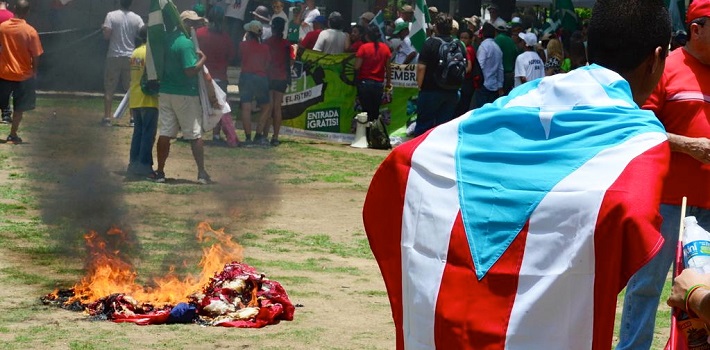
Push for Puerto Rican Independence Gathering Steam


El Nuevo Dia


PanAm Post

Belen Marty

Independence from the United States. That’s what almost 2,000 Puerto Ricans
in the island’s capital of San Juan demanded on Sunday, June 14. Protesters
also called for the release of Oscar López Rivera, an independence activist and
former member of the Armed Forces of National Liberation (FALN), who has
been locked up in a US federal prison on conspiracy charges since 1981.

The march comes just days ahead of a meeting of the UN Special Committee
on Decolonization scheduled for June 22, where nation members are expected
to discuss the commonwealth’s case, officially an unincorporated US territory.
The groups involved in organizing Sunday’s protest included the Nationalist
Party, the Workers’ Socialist Movement (MST), New School, Caribbean and
Latin American Coordinator, the Resistance Collective, and the Revolutionary
Workers’ Party-Macheteros...[CONTINUE READING]

Wednesday, June 17, 2015

Puerto Rico News Digest For June 17, 2015


ACTIVISTS READY FOR UN DECOLONIZATION HEARINGS 


From The San Juan Daily Star:

As a prelude to next week’s hearings of the United Nations Decolonization
Committee in New York to discuss Puerto Rico’s status, a demonstration to
free nationalist Oscar López Rivera was held for the second year in a row in
Condado. Some 2,000 independence supporters from several organizations
spoke out for the freedom of López Rivera and the independence of Puerto
Rico, significantly increasing attendance from the first such demonstration
last year. The annual discussion about the future statusof Puerto Rico will be
held Monday for the 33rd time. Another local action to call attention to the
June 22 deliberations was a letter written to UN Secretary General Ban Ki-
moon urging him to have the hearings broadcast throughout the world. The
letter was signed by José M. López Sierra of the organization Todos Unidos
Descolonizar, which has also printed T-shirts in English and Spanish to pu-
blicize the annual event.


SAN JUAN HOT DESTINATION FOR JULY 4


From Caribbean Business:

A travel agency that can be used online but can also be called to speak with
its agents, CheapOair, announced Wednesday the top 10 destinations  U.S.
mainland travelers are booking for the Independence Day holiday. The agen-
cy’s data show that airfare to these destinations is significantly lower than
the average airfare for all booked flights for the same weekend. Key findings
include that consumers are traveling mostly within the continental U.S.; San
Juan, Puerto Rico and Cancun, Mexico, were the only overseas spots making
it into the top 10.


GDB LIQUIDITY DOWN 24% IN MAY


From News Is My Business:

The Puerto Rico Government Development Bank released Monday its latest
liquidity report showing the agency had $777.8 million left as of May 31, re-
presenting a 24 percent drop from the $1.02 billion it had in April. The agency
attributed the decrease in net liquidity to the disbursement of $120 million thr-
ough the Puerto Rico Treasury Department, $250 million for the repayment of
Tax Revenue Anticipation Notes, and $95 million to pay debt service owed by
the Puerto Rico Electric Power Authority.


Thursday, June 11, 2015

Puerto Rico, The Colony, Part 2: Puerto Ricans Resist

Feature

Worker's World

Berta Joubert-Ceci


Puerto Rico has been selling itself off since the 1990s, when the telephone
company was privatized under Gov. Pedro Rosello. Since then, all Puerto
Rico’s governments have been privatizing all public property, including the
airports, health services, roads, the valuable pineapple industry, etc. The slo-
gan of the progressive independence movement since then has been, “Puerto
Rico is not for sale.”

The “reconfiguration” of schools is actually another attempt to privatize edu-
cation. The few agencies that remain under public control do so thanks to the
ceaseless struggle of their workers. The class-conscious union UTIER, for
example, has defended the nationalized Electric Power Authority tooth and
nail.

Apart from the sell-off, the government wanted to pay the debt by applying
tax measures that the working class would have to pay. While transnational
giants and megastores like Walmart take in billions in profits while paying
minimal taxes, if any, the government loaded a tax on sales and services of
11.5 percent — the IVU — with the possibility of imposing a Value Added
Tax later. In fact, the 16 percent VAT that García Padilla wanted to impose
was rejected by the legislature in mid-May due to the population’s massive
rejection of this tax...[CONTINUE READING]

Friday, May 29, 2015

Puerto Rico, The Colony, Part 1: The ‘Miracle’ of Indebtedness


Feature

Worker's World


In the late 1940s, the United States baptized Puerto Rico the “Showcase of
the Caribbean.” It was to be a role model for countries in the Caribbean and
Latin America. This would supposedly be the outcome of the miracle of in-
dustrialization that the giant capitalist benefactor from the North carried out
in a poor, colonized, underdeveloped small island.

It was a false miracle.

Colonial economy

After destroying Puerto Rico’s agriculture, Washington encouraged foreign
investment — that is, U.S. investment — which initiated a model that first
set up light industries such as textiles, then imposed pharmaceutical and pe-
trochemical companies, and later biotechnology and electronic firms.

Beside causing enormous environmental destruction, this process contrib-
uted nothing at all to the real development of the island. It did generate in-
creased revenue for one sector of the working class — those in industries
based on foreign capital that are export-oriented. They don’t produce what
is needed on the island nor do the products of their labor benefit the econo-
my of Puerto Rico — only Wall Street....[CONTINUE READING]


Friday, April 24, 2015

Filmmaker Juan Agustín Márquez Talks About 'The Last Colony'


Puerto Rican filmmaker Juan Agustín Márquez's Emmy Award-winning 2010
documentary, 100,000, dealt with his home island's deplorable dog overpopulation
problem.The director is now turning his attention to Puerto Rico once again in
another English-language documentary. But  this time he's dealing with a more
macro, and in many ways, more sensitive issue: Puerto Rico's political status.
Márquez's new film, The Last Colony, takes a hard, unflinching  look at the
island's 117-year-long status as a territory of the United States, and what it
would take to achieve decolonization.

The limbo that Puerto Rico has long  been in -- neither a state nor a country --
has fueled a decades-long identity crisis among Boricuas, but it's an issue that
is seldom talked about outside of the island. It is clear that The Last Colony is
seeking to broaden the dialogue regarding Puerto Rico's situation, especially
in the mainland United States, where the issue is puzzingly obscure. This
looks to be the main reason why the film was made in English.  The docu-
mentary also features opinions from numerous political figures on all sides
of the status debate, providing for a more complete and balanced view of the
subject matter. The Puerto Rico Monitor recently caught up with the director
to talk about his latest film:


Why a documentary on Puerto Rico's status?

I'm Puerto Rican but I went to high school in Massachusetts. Since age of 16
I've had to answer many, many times the question about Puerto Rico's status.
It has been very clear to me for a very long time that we needed to expose the
status debate to the rest of the world.

How long did it take to produce the film?

We started in 2012 with the general election and the plebiscite. We also
went to Washington DC to see the aftermath of the plebiscite in DC. Overall,
production took about 4 weeks total spread out in different moments. What
took a long time was post production. Editing, putting all these thoughts
together was the real challenge.


Do you favor any particular status option?

I favor the decolonization of Puerto Rico, in whichever form that may be. 

Do you feel optimistic regarding PR's status being resolved any time 
soon? 

I have to be optimistic.

Why is that?

I have seen how other documentaries (including my Emmy winning film,
100,000)  have had a deep impact in different social issues. The Cove is a
great example of a film solving a big issue. Blackfish has done wonders to
shut down Sea World. My film, 100,000 has helped reduce the overpopulation
problem of dogs in Puerto Rico. I think films can be very powerful. I think
if we get The Last Colony to the right audience, we might be able to force
the conversation about Puerto Rico. I want the US to also have a say in
our status.


What has been the main obstacle in decolonizing Puerto Rico?

I think fear plays a big role. I think there is fear of rejection from the US
and fear of independence. But these fears have their roots. We present
them in the film. But I think fear of change is the biggest obstacle.


When will the film be released and how can people see it?

In Puerto Rico, it will come out on April 30th at Fine Arts [Cinemas]. We
are working  with a distributor to take the film to the USA market. 


(The Last Colony will also premiere on April 30 at Cinema Bar 1950 in
Ballajá.)

----

You can visit Mr. Márquez's website at http://juan.mixform.com/.


Thursday, April 9, 2015

Pedro Albizu Campos: At Least He Had Guts


A young Albizu Campos.
Source: Wikimedia Commons

(Note: this column was originally written in 2002)

I've found that, among Puerto Ricans, it is almost impossible to find an objective opinion of nationalist leader Pedro Albizu Campos. Those who hate him, hate him with a passion usually reserved for mass murderers or pedophiles. Those who love him often deify him, to the point of considering him some sort of demi-god (I've even seen a painting of Albizu crucified, looking very much like Jesus Christ; I'm not a Christian, and even I was appalled at the implication). While doing research for this column, I found it amazingly difficult to find clear, unbiased information about one of the best known Puerto Rican political leaders in history. In this column, I will actually attempt to look at Campos in something resembling a neutral, detached manner. I say attempt, because this was a man about which it seems to be very hard to be objective, so please forgive me if any bias seeps through my writing.
Pedro Albizu Campos was born in 1891 (although that date has been debated) in Ponce, Puerto Rico-- black and in poverty. He was given a scholarship to study engineering at the University of Vermont, and later went on to Harvard. He joined the U.S. military in 1917, apparently for reasons known only to him. In seven years, Campos became a chemist, a lawyer, an expert in history and politics and came to master seven languages. There was little doubt among those who knew him that he was practically a genius. What's more, he was a true leader of men; the kind of man that the island doesn't seem to produce much of anymore.
At the beginning of the 1930's, Albizu took over the leadership of the fledgling Puerto Rican Nationalist Party. His style was decidedly anti-American, and he made no reservations about the fact that he supported the use of violence in order to end the American administration in Puerto Rico. From the 1930's to the 1950's, Campos was accused by the government of orchestrating or supporting various violent actions against the U.S. government, among them the murder of insular Police Chief Riggs, the Nationalist Uprisings of 1950 and the assassination attempt against President Truman in that same year. The Federal Government kept him in jail, both in Puerto Rico and in the continent, during much of that period. He has, so far, been the only independentista leader to cause the United States some genuine trouble. During this time, his following was small (but committed) and the Nationalist Party did pathetically in electoral contests, when it chose to participate.
During Campo's last stint in prison, which ended shortly before he died in 1965, it is believed that the Federal Government regularly exposed him to radiation in his prison cell, which ultimately led to his death by cancer. This claim has credibility; the evidence and the photos of Albizu's horribly burnt and seemingly irradiated body are there for everyone to see, and stand as an example of a terrible crime which marked a shameful period in both Puerto Rican and American history. Surely the "crime" of sedition could have been punished in a more humane manner.
The legend of Pedro Albizu Campos continues to grow with the passage of time. He has even achieved a kind of legitimacy nobody could have dreamed of during his day; there are now streets and schools named after him, and not too long ago, the New York Puerto Rican Day Parade was dedicated to him. Every sector of the Puerto Rican independence movement wants to claim "El Maestro" (The Teacher, as they call him) as their own, be they left-wing or right-wing. But what really were Albizu's politics, aside from his nationalism? The left wing has laughably claimed he was sympathetic to socialism, and cite as an exaple his support of the 1934 sugarcane worker's strike, depsite the fact that his support smelled more of populism than socialism. Albizu was also a devoted Catholic and socially he seemed to be somewhat conservative, which may be why right-wing independence groups (like the Falange Boricua) also attempt to claim him as one of their own. This is all complicated by a lack of good documentation, or even reliable anecdotal evidence, that clearly outlines Albizu's political positions.
Some have said that Albizu was an out-and-out fascist; not an altogether unreasonable claim given the world political situation in the 1930s, when Albizu was the most active. The Nationalist Party's paramilitary wing, The Cadets of the Republic, marched through streets wearing black shirts and white pants, much like Mussolini's fascisti. He seemes to have viewed liberal American values as suspect at best and tools of oppression, at worst. However, I wouldn't qualify Pedro Albizu Campos as a fascist; his Catholicism perhaps would have put him ideologically closer to pseudo-fascists like Francisco Franco or Portugal's Antonio Salazar. I doubt he was very fond of Hitler. He was probably not a big fan of Stalin's, either.
When writing about a man as controversial as Albizu, it's important to remember that his actions and his ideological positions can't be looked at in black and white; there are things about "El Maestro" that both damn him and redeem him and his characteristics should all be looked at separately, taking into account the circumstances of his life and the times he lived in. Personally, I don't agree with his politics or his methods--although, I can't blame him for having been so radical; the U.S. Government of that time treated Puerto Rico with a frightening degree of scorn and brutality. I also think that an independent Puerto Rico with Albizu as its leader would probably not have been a very pleasant place to live in, not just for me, but for many others who value things like true liberty and progress, and whose thinking goes beyond crude collectivist notions of "La Patria".
Albizu Campos in 1936.

However, there are things about the man that I genuinely admire; his passion for ideas and his willingness to put his life on the line for them. You don't see much of that anymore in Puerto Rico. He was a ridiculously intelligent and well-educated man; he could've had any career he wanted. He could have been a respected statesman or a multi-millionaire, or both. But he chose to follow his ideals. That's not to say he was completely selfless. It's reasonable to think that a lot of what drove him was a desire for some kind of power. Maybe he was just crazy; an average man he definitely wasn't. But, you still have to respect the fact that he was willing to risk, and eventually lose, his life fighting the enormous apparatus that was the United States government, and its servant insular government here in the island, all in a struggle which--and I'm sure many times he was tempted to think so--was hopeless.
Unlike many of his compatriots then and now, he had guts. And that's got to count for something.


Tuesday, March 24, 2015

In the fight for Puerto Rican statehood, is San Juan the new Selma?


Feature

Quartz


Leave it to a British comic to school us all on the least talked-about
race problem in America—well, except the millions of Americans
living in Puerto Rico, the US Virgin Islands, the Northern  Mariana
Islands, and American Samoa.

John Oliver’s recent viral video about the Insular Cases, and their
role in this country’s ugly racial past entertained and shocked a lot
of Americans, just hours after President Obama told a crowd
gathered in Selma that “our work is never done.”

Oliver’s wit, framed around Obama’s words, created a perfect storm
of discovery. Though, you would think, in 2015, this wouldn't seem
so surprising—yes, the American government was blatantly racist
toward peoples conquered as spoils of...[CONTINUE READING]


Thursday, March 12, 2015

Filmmaker Juan Agustín Márquez Talks About 'The Last Colony'


Puerto Rican filmmaker Juan Agustín Márquez's Emmy Award-winning 2010
documentary, 100,000, dealt with his home island's deplorable dog overpopulation
problem.The director is now turning his attention to Puerto Rico once again in
another English-language documentary. But  this time he's dealing with a more
macro, and in many ways, more sensitive issue: Puerto Rico's political status.
Márquez's new film, The Last Colony, takes a hard, unflinching  look at the
island's 117-year-long status as a territory of the United States, and what it
would take to achieve decolonization.

The limbo that Puerto Rico has long  been in -- neither a state nor a country --
has fueled a decades-long identity crisis among Boricuas, but it's an issue that
is seldom talked about outside of the island. The Last Colony seeks to broaden
the dialogue, and features opinions from numerous political figures on all sides
of the status debate. The Puerto Rico Monitor recently caught up with the
director to talk about his latest  film:

Why a documentary on Puerto Rico's status?

I'm Puerto Rican but I went to high school in Massachusetts. Since age of 16
I've had to answer many, many times the question about Puerto Rico's status.
It has been very clear to me for a very long time that we needed to expose the
status debate to the rest of the world.

How long did it take to produce the film? 

We started in 2012 with the general election and the plebiscite. We also
went to Washington DC to see the aftermath of the plebiscite in DC. Overall,
production took about 4 weeks total spread out in different moments. What
took a long time was post production. Editing, putting all these thoughts
together was the real challenge.


Do you favor any particular status option?

I favor the decolonization of Puerto Rico, in whichever form that may be.

Do you feel optimistic regarding PR's status being resolved any time 
soon? 

I have to be optimistic.

Why is that?

I have seen how other documentaries (including my Emmy winning film,
100,000)  have had a deep impact in different social issues. The Cove is a
great example of a film solving a big issue. Blackfish has done wonders to
shut down Sea World. My film, 100,000 has helped reduce the overpopulation
problem of dogs in Puerto Rico. I think films can be very powerful. I think
if we get The Last Colony to the right audience, we might be able to force
the conversation about Puerto Rico. I want the US to also have a say in
our status.


What has been the main obstacle in decolonizing Puerto Rico?

I think fear plays a big role. I think there is fear of rejection from the US
and fear of independence. But these fears have their roots. We present
them in the film. But I think fear of change is the biggest obstacle.


When will the film be released and how can people see it?

In Puerto Rico, it will come out on April 30th at Fine Arts [Cinemas]. We
are working  with a distributor to take the film to the USA market.

----

You can visit Mr. Márquez's website at http://juan.mixform.com/.