Headlines From Our Twitter Feed

Showing posts with label status. Show all posts

Wednesday, April 26, 2017

Puerto Rico Statehood In The Age of Trump


Commentary

Rosa Bravo

Originally published March 8, 2017

The cause of Puerto Rican statehood, already battered by the island's enormous economic crisis, has run into a new obstacle: the election of Donald Trump as President. While the President cannot change Puerto Rico's status on his own,his election -- and the tenor of the political discourse under which he was elected -- has made the Republican-majority Congress more implicitly hostile to Puerto Rico's statehood prospects. I believe Trump's rhetoric and actions have set the tone that Congress will follow for at least the  next four years.

It is not a secret that President Trump is a xenophobe who has little regard for Hispanics.That alone would prejudice him against supporting the admission of three-plus million Spanish speakers into the Union. But besides that, his goal of restoring America's economic might would steer him away from incorporating a territory with tens of billions of dollars in crippling debt that, in his view and of those like him, would contribute little to the federal treasury. But the biggest issue here may be Trump's almost total ignorance regarding Puerto Rico, its history and its issues. The President is a man famous for not reading and for losing his patience quickly. It is almost certain he has never taken an interest in the island, other than whatever he needed to know to build his now  defunct Rio Grande golf club. In his simple mind, Puerto Ricans are probably just welfare queens to be shoved aside; after all, they're not "real Americans". I think that Trump's election put PR ever closer to the unilateral granting of independence for the island, despite that option finding next to no support among Puerto Ricans. He can't do it himself, but he can certainly goad his Republican acolytes in Congress to do so.

The current government of Puerto Rico would do well do ask for very little from thecurrent federal government. And it should certainly not even bring up the issue of Puerto Rico's status or ask for Puerto Rican statehood. Because if they do, the answer from the USA may very well be: "No. But thanks for reminding us that you're still hanging around. Goodbye, you're free to go". This is why I think a status referendum in Puerto Rico right now is a ridiculous idea. As a supporter of statehood, I fear that no good would come from poking that hornet's nest. The best thing to do would be to keep our heads down, try to get our financial house in some kind of order and just wait out the Trump storm. A better climate will come.


Rosa Bravo is a staff writer for The Puerto Rico Monitor. The opinions expressed in the preceding
piece are strictly her own and do not necessarily represent those of The Puerto Rico Monitor, its
editors or advertisers.

Monday, April 24, 2017

Puerto Rico News Digest For April 24, 2017


PONCE COP DIES AFTER SHOOTING


From Officer.com:

"A Puerto Rico police officer succumbed Wednesday of injuries he sustained in a shooting Sunday. Agent Benjamín De los Santos-Barbosa and three other officers attempted to stop a vehicle with an illegal window tint when the driver led them on a pursuit, according to The Officer Down Memorial Page. The driver -- who was on parole for narcotics charges -- led the officers on a pursuit until he encountered a broken down vehicle. The suspect then backed into the patrol car and opened fire as he exited his vehicle, hitting De los Santos-Barbosa in the head. Other officers returned fire, striking the suspect. The man was taken into custody and charged with 15 counts including murder, narcotics violations and weapons violations..."


GROUP TO FORGE AHEAD WITH DEBT AUDIT


From Caribbean Business:

"The Frente Ciudadano por la Auditoría de la Deuda, a group that is pushing for Puerto Rico’s debt to be audited, announced Friday that it will join a University of Puerto Rico (UPR) student protest to demand that the public debt be investigated and to defend public education. The “family-oriented, artistic” and educational event will take place Sunday, April 23..."


PR GROUPS VISIT CUBA FOR BAY OF PIGS CELEBRATION


From Telesur:

"A delegation of 40 members from the Juan Rius Rivera Brigade representing several social organizations in Puerto Rico celebrated the 56th anniversary of the Bay of Pigs victory last week in Cuba, showing their commitment to the elimination of foreign military bases in the world including the illegally occupied U.S. base at Cuba's Guantanamo Bay.At the site of the failed military invasion of Cuba by the CIA-sponsored paramilitary forces, Puerto Rican activists showed solidarity with Cuba and the ideals of the Cuban revolutionary leader Fidel Castro. The brigade seeks to highlight the solidarity between to the two island nations by organizing delegations to Cuba every year..."


Monday, April 17, 2017

Puerto Rico News Digest For April 17, 2017


FEDS WANT COMMONWEALTH IN STATUS REFERENDUM


From Caribbean Business:

"Including the commonwealth in the June 11 political-status plebiscite, as demanded by the U.S. Justice Department, has affected work procedures for the Puerto Rico State Elections Commission (CEE by its Spanish acronym)...Gov. Ricardo Rosselló and his advisers evaluated Saturday U.S. Deputy Attorney General Dana Boente‘s observations, in which he overrode the referendum as enacted for excluding the territorial status as a viable alternative. The governor said his administration will make the necessary adjustments to be backed up by the federal government, and Senate President Thomas Rivera Schatz affirmed these amendments will be approved as early as next Tuesday..."


PREGNANT WOMAN GUNNED DOWN IN VIEQUES


Brenda Concepción Gerena, age 19 and four months pregnant, was shot at around 2:15 on Sunday morning along with her 17-year-old stepsister in front of their house in the Esperanza sector of the island municipality of Vieques. The pregnant woman died at Centro Médico in Río Piedras about four hours later, after both women were taken there by helicopter. The deceased victim's stepsister, María Jiménez Gerena, was not critically injured. The two victims had been involved in a dispute with unidentified people in a different part of town earlier that evening. So far in 2017, Puerto Rico has tallied 188 reported murders.


POLICE DETAINS FOUR MIGRANTS IN MONA PASSAGE


From AP/NZ Herald:

"Police say they have detained four migrants in a northwest coastal area commonly used by people from the Dominican Republic to get into this U.S. territory. Officers said they detained a man and a woman Saturday afternoon aboard a 28-foot wooden boat with an outboard motor just off an area beach. They said another man and a woman were detained at a nearby landing area on the beach. The travelers' country of origin was unknown..."


Tuesday, April 11, 2017

Is Independence Imminent For Puerto Rico?


Commentary

Rosa Bravo

Originally published January 12, 2016


I am proud of my United States citizenship and I have long supported
the idea of statehood for Puerto Rico. But at this point, even I have to
admit that my home island becoming the 51st state seems like an in-
creasingly remote possibility. I'm not pessimistic about statehood be-
cause of the language difference, or the possibility of losing our "na-
tional" Olympic team, or because of Puerto Rican voters' long runn-
ing indecisiveness regarding the future of their island. I'm pessimis-
tic about statehood because the one entity that could grant such a thing,
the US Congress, will not let it happen. And with every day that passes,
Congress feels less and less willing to admit Puerto Rico as a state.

And who can blame them? Puerto Rico's financial woes have made
headlines regularly over the last several years. Holders of Puerto Rico
bonds are bracing themselves for the worst, will billions of dollars yet
to be lost. During the island's budget and debt debacles, some of Puerto
Rico's seemingly intractable institutional corruption has been brought to
light for the whole world to see. Puerto Ricans continue to leave the is-
land for the mainland in droves. Puerto Rico is still much poorer than the
poorest state in the union. Besides all of this, the US's incentives for hol-
ding on to this Caribbean territory have largely disappeared.

During the 20th century, Puerto Rico's location made it a key to protec-
ting the then US owned Panama Canal. After World War II, its strategic
value appreciated further, as Cuba went communist and the US needed to
pay close attention to the Caribbean and Central America. Puerto Rico was
also a hub for manufacturing, as tax incentives and cheap labor yielded bi-
llions in profits for American corporations. But those incentives are gone.
The Cold War is long over, and whatever geopolitical challenges the US
faces -- or expects to face in the near future -- are not present in the Ame-
ricas, but rather in the Middle East and Asia. American businesses found
labor cheaper than Puerto Rico's long ago, in Mexico, China, India...even
right next door in the Dominican Republic. Plus, Congress took away
many of the tax incentives.

The United States has taken plenty from Puerto Rico over the decades,
including scores of lives lost by Puerto Rican soldiers in American wars.
But now that they find they can't squeeze any more juice from their main
Caribbean possession, they are probably asking themselves what the point
is any longer. Sure, Puerto Ricans still pay plenty of taxes to Uncle Sam,
even if we don't pay Federal Income Tax (although many of us do have to
pay). American businesses still make billions in the island. But the old re-
turn on investment is no longer there. Many a right-wing blowhard in DC
will think "Why do we keep sending billions in federal funds into a black
hole? Why do we even still have this island of latino freeloaders any lon-
ger?". They look at Puerto Rico's super-corrupt elites and increasingly poor
population and wonder whether it might not be time to cut their losses. Ne-
vermind that that same corrupt elite grew initially under US auspices (Puer-
to Rico had no self-rule at all until 1952, and even then it was severely li-
mited) and that the US-favored colonial status is largely responsible for
keeping Puerto Ricans trapped in poverty. Historical memories are short
in Washington.

Will Congress suddenly be afflicted with an attack of conscience, and
grant Puerto Rico statehood (provided a majority of us finally and with-
out reservation ask for it)? Will they consider America's decades-long ill
treatment and neglect of Puerto Rico and do the morally right thing, and
say yes to admitting millions of US citizens into the union as equals? I
wouldn't bet any money on it. While the statehood conversation would be
taken a lot more seriously if at least 75% of Puerto Rican voters said yes
to statehood (nope, 51% doesn't cut it and never will), it would still be a
battle. Congress looks at the Puerto Rico of today and see millions of poor,
Spanish-speaking welfare recipients. With Cuba opening, Puerto Rico is
no longer the business-friendly Caribbean lab of the mid-century; it is a
washed-up has-been, in their eyes. But they are beginning to acknowledge
that the current colonial situation is no longer tenable. So what options are
left? A sovereign, "associated republic", a la Marshall Islands or Palau.
Or, of course, full independence. Either one would be seen in Washing-
ton as cheaper and easier than maintaining the current status, or burdening
itself with a "beggar" 51st state.

Congress may soon have the excuse that it wants to get rid of Puerto Ri-
co. Independence may be coming sooner than any of us expect, whether
we ask for it or not. The colonial master is getting anxious and is feeling
increasingly eager to get rid of what it helped create. If you don't want to
see that happen, it's time to start making some real noise for statehood.
And not in  Puerto Rico, where it won't matter what you say or who hears
you. It is people and politicians in the mainland who need to hear our voi-
ces. And do you have family or friends in the mainland  US? Of course you
do. Tell them to speak up and to always VOTE, and to let  everyone know
that they vote. We also need an organization that can promote statehood
other than the New Progressive Party, which for decades has accomplished
less than nothing in convincing Congress to seriously consider decoloniza-
tion.

If we don't take the fight for statehood to another level, get ready to make
some room for that Puerto Rico passport in your wallet. Because we're
going to be on our own.


The opinions expressed in the preceding commentary do no  necessarily reflect those 
of The Puerto Rico Monitor.

Saturday, April 1, 2017

Puerto Rico News Digest For April 1, 2017


REGGAETON TAX PROPOSED TO PAY DEBT


The head of Puerto Rico's internal revenue agency ("Hacienda"), Raúl Maldonado Gautier, proposed today the imposition of a tax on all reggaetón music purchases and public performances as a way to help the island's government boost its coffers in light of the billions of dollars in debt it faces. "Reggaetón is so prevalent in Puerto Rican society, and it generates so many millions of dollars, that I think taxing it as we do any other economic resource makes a lot of sense", said Gautier. "We estimate that we can cover at least a quarter of our approximately $70 billion in debt just by charging a small tax on every twerk performed in a typical reggaetón video." Fans of the genre, a combination of reggae, rap and latin rhythms, balked at the suggestion of the tax, and were considering staging a protest march in San Juan featuring souped-up Japanese cars, women dancing in thongs and a parade float featuring a giant blunt.


TRUMP PROPOSES BUILDING WALL AROUND PR


US President Donald Trump made a controversial proposal during a recent interview on Fox News: building a wall around Puerto Rico. "Puerto Rico has huge debt, and people keep leaving there and coming into America. We need to stop that. We'll build a huge wall, a magnificent wall, around that island. Then they'll have to stay there and figure out their problems", said the President. When asked how he would pay for the wall, Trump responded, "I'm thinking a tax on tacos. That's what they eat down there, right? Or cigars. A tax on cigars". Trump was then distracted by a fly that was buzzing around the studio and promptly forgot all about the idea.


GOVERNOR ROSSELLO REVEALED TO BE A ROBOT


During a recent press conference at La Fortaleza, Governor Ricardo Rosselló was revealed to really be a sophisticated robot after the metallic faceplate containing his face fell off while answering a reporter's question. The absence of the plate revealed  several circuits and electronic parts inside the Governor's head, and his speech became halting and repetitive, eventually stopping altogether, as smoke came out of the robot's ears. The robot uttered the word "plan" several times before seemingly shutting down. When questioned by the press as to whether he was aware that Rosselló had been a machine all along, Senate President Thomas Rivera Schatz said, "I guess I had some suspicions. He's still better than the previous guy, though". When presented with the same question, Resident Commissioner Jenniffer Gonzalez simply responded, "Yeah, I knew".


UNION WITH CHINA PROPOSED FOR REFERENDUM


A recently formed political organization proposed a new status formula for June's referendum on Puerto Rico's political status: union with the People's Republic of China. The leader of the group "Sino-Boricua Alliance", Juan Sanchez, spoke to the press on Friday, and offered several reasons as to why they believe Puerto Rico becoming part of China makes sense: "Chinese people have been present in Puerto Rico for centuries. Plus, both peoples have a love of eating rice, and uhh, well, China is an emerging superpower and they have a lot of cash". Sanchez, who wore a traditional changshan tunic and Fu Manchu-style moustache during his remarks, added, "We're willing to do whatever it takes to convince China to accept us if the U.S. kicks us out. We can learn karate, wear those pointy straw hats, eat with chopsticks...Puerto Ricans are an adaptable people." Sanchez closed the press conference by performing several botched martial arts moves before falling on the ground holding his leg in pain.


April Fool's!


Wednesday, March 8, 2017

Puerto Rico Statehood In The Age of Trump


Commentary

Rosa Bravo

The cause of Puerto Rican statehood, already battered by the island's enormous
economic crisis, has run into a new obstacle: the election of Donald Trump as
President. While the President cannot change Puerto Rico's status on his own,
his election -- and the tenor of the political discourse under which he was elec-
ted -- has made the Republican-majority Congress more implicitly hostile to
Puerto Rico's statehood prospects. I believe Trump's rhetoric and actions have
set the tone that Congress will follow for at least the  next four years.

It is not a secret that President Trump is a xenophobe who has little regard for
Hispanics.That alone would prejudice him against supporting the admission of
three-plus million Spanish speakers into the Union. But besides that, his goal of
restoring America's economic might would steer him away from incorporating a
territory with tens of billions of dollars in crippling debt that, in his view and of
those like him, would contribute little to the federal treasury. But the biggest issue
here may be Trump's almost total ignorance regarding Puerto Rico, its history and
its issues. The President is a man famous for not reading and for losing his patien-
ce quickly. It is almost certain he has never taken an interest in the island, other
than whatever he needed to know to build his now  defunct Rio Grande golf club.
In his simple mind, Puerto Ricans are probably just welfare queens to be shoved
aside; after all, they're not "real Americans". I think that Trump's election put PR
ever closer to the unilateral granting of independence for the island, despite that
option finding next to no support among Puerto Ricans. He can't do it himself,
but he can certainly goad his Republican acolytes in Congress to do so.

The current government of Puerto Rico would do well do ask for very little from
thecurrent federal government. And it should certainly not even bring up the issue
of Puerto Rico's status or ask for Puerto Rican statehood. Because if they do, the
answer from the USA may very well be: "No. But thanks for reminding us that
you're still hanging around. Goodbye, you're free to go". This is why I think a st-
atus referendum in Puerto Rico right now is a ridiculous idea. As a supporter of
statehood, I fear that no good would come from poking that hornet's nest. The
best thing to do would be to keep our heads down, try to get our financial house
in some kind of order and just wait out the Trump storm. A better climate will
come.


Rosa Bravo is a staff writer for The Puerto Rico Monitor. The opinions expressed in the preceding
piece are strictly her own and do not necessarily represent those of The Puerto Rico Monitor, its
editors or advertisers.


Tuesday, September 20, 2016

Is Independence Imminent For Puerto Rico?


Commentary

Rosa Bravo

Originally published January 12, 2016


I am proud of my United States citizenship and I have long supported
the idea of statehood for Puerto Rico. But at this point, even I have to
admit that my home island becoming the 51st state seems like an in-
creasingly remote possibility. I'm not pessimistic about statehood be-
cause of the language difference, or the possibility of losing our "na-
tional" Olympic team, or because of Puerto Rican voters' long runn-
ing indecisiveness regarding the future of their island. I'm pessimis-
tic about statehood because the one entity that could grant such a thing,
the US Congress, will not let it happen. And with every day that passes,
Congress feels less and less willing to admit Puerto Rico as a state.

And who can blame them? Puerto Rico's financial woes have made
headlines regularly over the last several years. Holders of Puerto Rico
bonds are bracing themselves for the worst, will billions of dollars yet
to be lost. During the island's budget and debt debacles, some of Puerto
Rico's seemingly intractable institutional corruption has been brought to
light for the whole world to see. Puerto Ricans continue to leave the is-
land for the mainland in droves. Puerto Rico is still much poorer than the
poorest state in the union. Besides all of this, the US's incentives for hol-
ding on to this Caribbean territory have largely disappeared.

During the 20th century, Puerto Rico's location made it a key to protec-
ting the then US owned Panama Canal. After World War II, its strategic
value appreciated further, as Cuba went communist and the US needed to
pay close attention to the Caribbean and Central America. Puerto Rico was
also a hub for manufacturing, as tax incentives and cheap labor yielded bi-
llions in profits for American corporations. But those incentives are gone.
The Cold War is long over, and whatever geopolitical challenges the US
faces -- or expects to face in the near future -- are not present in the Ame-
ricas, but rather in the Middle East and Asia. American businesses found
labor cheaper than Puerto Rico's long ago, in Mexico, China, India...even
right next door in the Dominican Republic. Plus, Congress took away
many of the tax incentives.

The United States has taken plenty from Puerto Rico over the decades,
including scores of lives lost by Puerto Rican soldiers in American wars.
But now that they find they can't squeeze any more juice from their main
Caribbean possession, they are probably asking themselves what the point
is any longer. Sure, Puerto Ricans still pay plenty of taxes to Uncle Sam,
even if we don't pay Federal Income Tax (although many of us do have to
pay). American businesses still make billions in the island. But the old re-
turn on investment is no longer there. Many a right-wing blowhard in DC
will think "Why do we keep sending billions in federal funds into a black
hole? Why do we even still have this island of latino freeloaders any lon-
ger?". They look at Puerto Rico's super-corrupt elites and increasingly poor
population and wonder whether it might not be time to cut their losses. Ne-
vermind that that same corrupt elite grew initially under US auspices (Puer-
to Rico had no self-rule at all until 1952, and even then it was severely li-
mited) and that the US-favored colonial status is largely responsible for
keeping Puerto Ricans trapped in poverty. Historical memories are short
in Washington.

Will Congress suddenly be afflicted with an attack of conscience, and
grant Puerto Rico statehood (provided a majority of us finally and with-
out reservation ask for it)? Will they consider America's decades-long ill
treatment and neglect of Puerto Rico and do the morally right thing, and
say yes to admitting millions of US citizens into the union as equals? I
wouldn't bet any money on it. While the statehood conversation would be
taken a lot more seriously if at least 75% of Puerto Rican voters said yes
to statehood (nope, 51% doesn't cut it and never will), it would still be a
battle. Congress looks at the Puerto Rico of today and see millions of poor,
Spanish-speaking welfare recipients. With Cuba opening, Puerto Rico is
no longer the business-friendly Caribbean lab of the mid-century; it is a
washed-up has-been, in their eyes. But they are beginning to acknowledge
that the current colonial situation is no longer tenable. So what options are
left? A sovereign, "associated republic", a la Marshall Islands or Palau.
Or, of course, full independence. Either one would be seen in Washing-
ton as cheaper and easier than maintaining the current status, or burdening
itself with a "beggar" 51st state.

Congress may soon have the excuse that it wants to get rid of Puerto Ri-
co. Independence may be coming sooner than any of us expect, whether
we ask for it or not. The colonial master is getting anxious and is feeling
increasingly eager to get rid of what it helped create. If you don't want to
see that happen, it's time to start making some real noise for statehood.
And not in  Puerto Rico, where it won't matter what you say or who hears
you. It is people and politicians in the mainland who need to hear our voi-
ces. And do you have family or friends in the mainland  US? Of course you
do. Tell them to speak up and to always VOTE, and to let  everyone know
that they vote. We also need an organization that can promote statehood
other than the New Progressive Party, which for decades has accomplished
less than nothing in convincing Congress to seriously consider decoloniza-
tion.

If we don't take the fight for statehood to another level, get ready to make
some room for that Puerto Rico passport in your wallet. Because we're
going to be on our own.


The opinions expressed in the preceding commentary do no  necessarily reflect those 
of The Puerto Rico Monitor.


Friday, July 1, 2016

Is Independence Imminent For Puerto Rico?


Commentary

Rosa Bravo


Originally published January 12, 2016


I am proud of my United States citizenship and I have long supported
the idea of statehood for Puerto Rico. But at this point, even I have to
admit that my home island becoming the 51st state seems like an in-
creasingly remote possibility. I'm not pessimistic about statehood be-
cause of the language difference, or the possibility of losing our "na-
tional" Olympic team, or because of Puerto Rican voters' long runn-
ing indecisiveness regarding the future of their island. I'm pessimis-
tic about statehood because the one entity that could grant such a thing,
the US Congress, will not let it happen. And with every day that passes,
Congress feels less and less willing to admit Puerto Rico as a state.

And who can blame them? Puerto Rico's financial woes have made
headlines regularly over the last several years. Holders of Puerto Rico
bonds are bracing themselves for the worst, will billions of dollars yet
to be lost. During the island's budget and debt debacles, some of Puerto
Rico's seemingly intractable institutional corruption has been brought to
light for the whole world to see. Puerto Ricans continue to leave the is-
land for the mainland in droves. Puerto Rico is still much poorer than the
poorest state in the union. Besides all of this, the US's incentives for hol-
ding on to this Caribbean territory have largely disappeared.

During the 20th century, Puerto Rico's location made it a key to protec-
ting the then US owned Panama Canal. After World War II, its strategic
value appreciated further, as Cuba went communist and the US needed to
pay close attention to the Caribbean and Central America. Puerto Rico was
also a hub for manufacturing, as tax incentives and cheap labor yielded bi-
llions in profits for American corporations. But those incentives are gone.
The Cold War is long over, and whatever geopolitical challenges the US
faces -- or expects to face in the near future -- are not present in the Ame-
ricas, but rather in the Middle East and Asia. American businesses found
labor cheaper than Puerto Rico's long ago, in Mexico, China, India...even
right next door in the Dominican Republic. Plus, Congress took away
many of the tax incentives.

The United States has taken plenty from Puerto Rico over the decades,
including scores of lives lost by Puerto Rican soldiers in American wars.
But now that they find they can't squeeze any more juice from their main
Caribbean possession, they are probably asking themselves what the point
is any longer. Sure, Puerto Ricans still pay plenty of taxes to Uncle Sam,
even if we don't pay Federal Income Tax (although many of us do have to
pay). American businesses still make billions in the island. But the old re-
turn on investment is no longer there. Many a right-wing blowhard in DC
will think "Why do we keep sending billions in federal funds into a black
hole? Why do we even still have this island of latino freeloaders any lon-
ger?". They look at Puerto Rico's super-corrupt elites and increasingly poor
population and wonder whether it might not be time to cut their losses. Ne-
vermind that that same corrupt elite grew initially under US auspices (Puer-
to Rico had no self-rule at all until 1952, and even then it was severely li-
mited) and that the US-favored colonial status is largely responsible for
keeping Puerto Ricans trapped in poverty. Historical memories are short
in Washington.

Will Congress suddenly be afflicted with an attack of conscience, and
grant Puerto Rico statehood (provided a majority of us finally and with-
out reservation ask for it)? Will they consider America's decades-long ill
treatment and neglect of Puerto Rico and do the morally right thing, and
say yes to admitting millions of US citizens into the union as equals? I
wouldn't bet any money on it. While the statehood conversation would be
taken a lot more seriously if at least 75% of Puerto Rican voters said yes
to statehood (nope, 51% doesn't cut it and never will), it would still be a
battle. Congress looks at the Puerto Rico of today and see millions of poor,
Spanish-speaking welfare recipients. With Cuba opening, Puerto Rico is
no longer the business-friendly Caribbean lab of the mid-century; it is a
washed-up has-been, in their eyes. But they are beginning to acknowledge
that the current colonial situation is no longer tenable. So what options are
left? A sovereign, "associated republic", a la Marshall Islands or Palau.
And of course, full independence. Either one would be seen in Washing-
ton as cheaper and easier than maintaining the current status, or burdening
itself with a "beggar" 51st state.

Congress may soon have the excuse that it wants to get rid of Puerto Ri-
co. Independence may be coming sooner than any of us expect, whether
we ask for it or not. The colonial master is getting anxious and is feeling
increasingly eager to get rid of what it helped create. If you don't want to
see that happen, it's time to start making some real noise for statehood.
And not in  Puerto Rico, where it won't matter what you say or who hears
you. It is people and politicians in the mainland who need to hear our voi-
ces. And do you have family or friends in the mainland  US? Of course you
do. Tell them to speak up and to always VOTE, and to let  everyone know
that they vote. We also need an organization that can promote statehood
other than the New Progressive Party, which for decades has accomplished
less than nothing in convincing Congress to seriously consider decoloniza-
tion.

If we don't take the fight for statehood to another level, get ready to make
some room for that Puerto Rico passport in your wallet. Because we're
going to be on our own.


The opinions expressed in the preceding commentary do no  necessarily reflect those 
of The Puerto Rico Monitor.

Monday, June 27, 2016

Puerto Rico News Digest For June 27, 2016


LEW URGES SENATE TO CONSIDER PROMESA


"U.S. Secretary Jacob Lew has sent a letter to Senate Majority Leader Mitch 
Mc Connell regarding the debt crisis in Puerto Rico. Lew says that if H.R. 5278, 
the Puerto Rico Oversight, Management, and Economic Stability Act (Promesa) 
is not considered, the island’s looming July 1 default could trigger lawsuits that, 
if  “successful, a judge could immediately order Puerto Rico to pay creditors 
over essential services such as health, education, and public safety...”


SJ PRIDE MARCH REMEMBERS ORLANDO VICTIMS


From Fox News Latino:

"Thousands of people turned out on Sunday for the annual Gay Pride March
in San Juan, where special remembrance was paid to the victims of the Orlan-
do nightclub massacre, almost half of whom were of Puerto Rican heritage. "I
lost two friends, two brothers, Martin (Benitez Torees) and Jimmy de Jesus (Ve-
lazquez)," Boriquen Memorial funeral home spokesperson Serbella Tejeda said
after the establishment had offered its services gratis to the families of the 23
Puerto Ricans who died in the shooting at the Pulse nightclub..."


ISLAND GOP BACKS STATUS VOTE


From The San Juan Daily Star:

"The Puerto Rico Republican Party approved a resolution supporting the hol-
ding of a referendum on the island’s status issue in which voters will choose
among two decolonization options: statehood or independence, and that it be
held together with the Nov. 8 general elections, local party president Jenniffer
González announced Thursday..."


AGP SUSPENDS INFRASTRUCTURE PAYMENTS


From Reuters:

"Puerto Rican Governor Alejandro Garcia Padilla late on Friday declared a sus-
pension of any payments on some debt issued by the U.S. territory's infrastruc-
ture financing authority, citing the authority granted under a local emergency de-
bt moratorium law. Garcia Padilla signed an executive order that applies to "cer-
tain Puerto Rico Financing Authority (PRIFA) notes," a statement from the gov-
ernment said..."


Wednesday, June 22, 2016

Puerto Rico News Digest For June 22, 2016


MAN ARRESTED FOR MOLOTOV COCKTAILS


From US Attorney's Office:

"United States Magistrate Judge Silvia Carreño-Coll authorized a criminal
complaint charging Noel D. Cruz-Torres (“Cruz-Torres”) with malicious use
of explosives...According to the information contained in the criminal com-
plaint and affidavit, on June 18, 2016, at approximately 3:30 am, someone
called 911 to report an explosion near DuPont Pioneer. When police and fire
fighters arrived, they saw a vehicle burning nearby. A security guard reported
that an individual was throwing Molotov cocktails at the building. The offic-
ers walked around the building and saw Cruz-Torres wearing a black t-shirt
wrapped around his face and carrying a black backpack. While police purs-
ued Cruz-Torres, he threw various Molotov cocktails at the officers. He also
threw another lit Molotov at the fire truck..."


BHATIA: UN RESOLUTION TO HAVE LITTLE EFFECT


From Caribbean Business:

"Puerto Rico Senate President Eduardo Bhatia said the resolution passed by
the United Nations, which reaffirms the island’s right to self-determination
and independence will have little or no effect. “Sadly, it is very little what the
UN can do to change the internal politics of the U.S.,” Bhatia, a leader within
the Popular Democratic Party, told reporters during an interview in the San Ju-
an Capitol. After expressing his respect for the international body, he said the
UN “hasn’t been very effective,” adding, “We have to be realistic. That forum
has not managed to move the U.S. in any way in the past 30 years..."


700K+ PR YOUTH LIVE IN HIGH-POVERTY AREAS


From News Is My Business:

"Children and youth in Puerto Rico continue to live in families facing enorm-
ous economic challenges, with some 84 percent residing in areas of extreme
poverty and the parents of more than half lacking full-time, year-round emp-
loyment. These and 14 other indicators of child well being are revealed in the
2016 Kids Count Data Book from the Annie E. Casey Foundation, which is
represented in Puerto Rico by the Youth Development Institute (YDI), a Kids
Count network partner. “Traditionally we talk about the percentage of our ch-
ildren and youth who are living below the poverty line. In Puerto Rico, that is
58 percent of our kids,” said Gloriann Sacha Antonetty, communications dir-
ector of the YDI..."


PATAKI COULD SERVE ON FINANCIAL BOARD


From The San Juan Daily Star:

"The seven-member Financial Oversight and Management Board that will be
appointed by the U.S. president as part of the Puerto Rico Oversight, Manage-
ment, and Economic Stability Act (PROMESA), could include former New
York governor George Pataki, the Bond Buyer reported Monday. Pataki has a
residence on the island, according to the daily municipal finance news outlet..."


Tuesday, May 17, 2016

Statehood for U.S. Territories: A Historical Chance to Make America Great(er) Again. Literally.


Feature

TIBERIU DIANU


The current political discourse in the heated 2016 electoral year gravita-
tes around some simple, common-sense, yet grandiose ideas like making
America great again through reviving trade, by recapturing overseas jobs
(lost in favor of other nations beneficiaries of globalization), and streng-
thening the military (weakened by the political demagogues’ lack of visi-
on). As a result, many American manufactured products are not being com-
petitive anymore on international markets, the same as American military
which, it is said, is not being capable to fight anymore on two fronts at the
same time. [1]

In the meantime, on the international arena, America’s traditional foes ha-
ve been already coagulated their territorial expansion policies. Russia is
extending its sphere of influence in both the Arctic and the Pacific Rim.
China is pushing its boundaries in the disputed South China Sea. While
North Korea does not make any secret of the fact that is ready to attack the
coast of Alaska. In addition to those aggressive actors, a series of lower le-
vel rogue nations (among them: Iran, Venezuela) already have been displa-
ying bombastic discourses about regional dominance. To all that, interna-
tional terrorism is added.

Given the circumstances, it is imperiously necessary for the United States
to solidify their narrative about a new era of American greatness and excep-
tionalism. We are not talking about “the world’s policeman”, nor about “na-
tion building”. Instead, we are talking about a new period when America
should recapture its greatness again for itself, and not so much for the
others.

But before that, we need to remind ourselves the past periods when Ameri-
ca used to be great(er). Let us briefly recap some revealing moments in  re-
cent U.S. history:

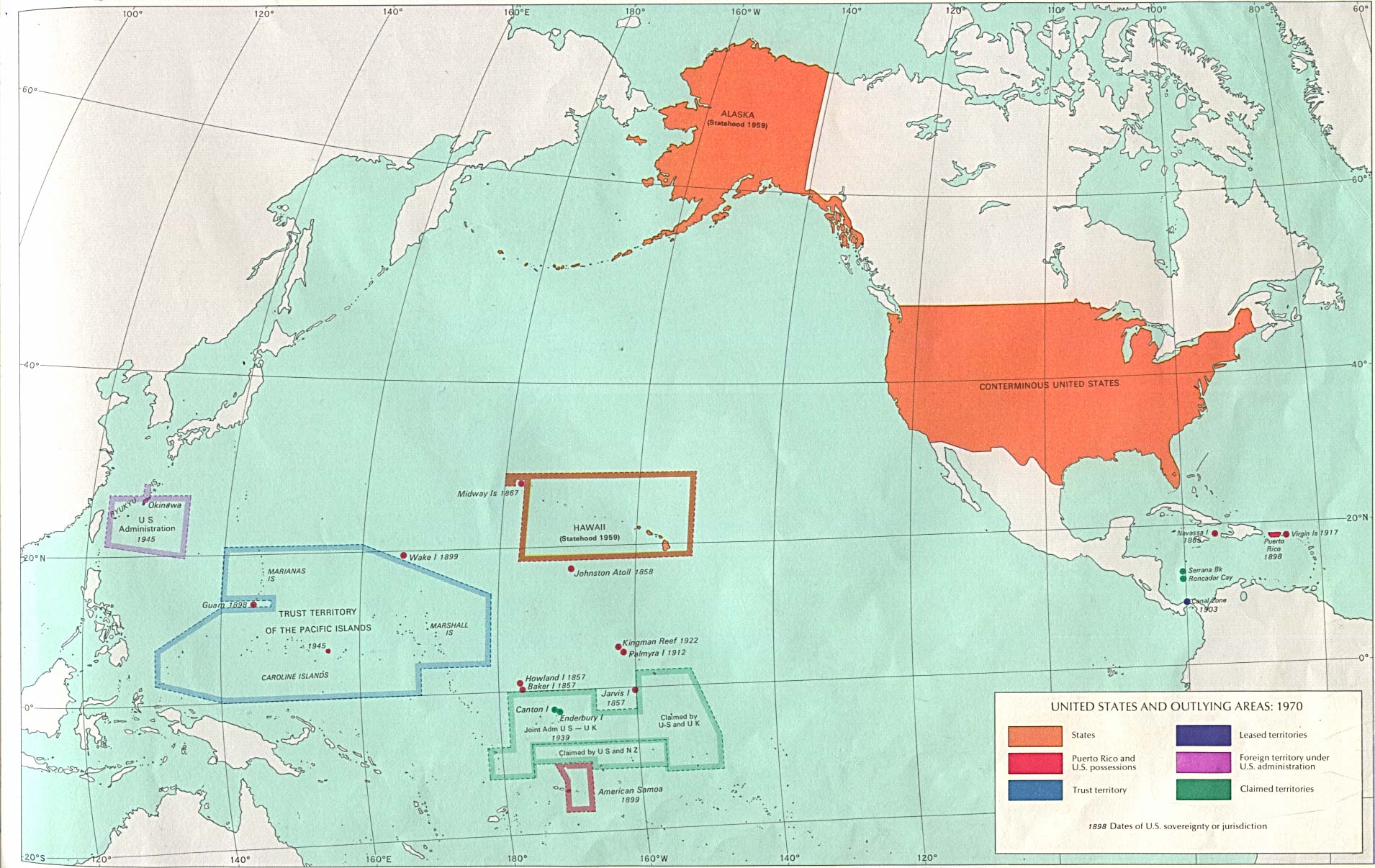
1. The Spanish-American War of 1898: the U.S. win sovereignty over
Cuba, Puerto Rico (in the Atlantic/the Caribbean Sea), Guam and the
Philippines (in the Pacific), and soon after that over the Panama
Canal (in 1903).

2. During the years of the World War 1 (U.S. entered the war in 1917):
U.S. administration of Haiti (1915), Dominican Republic (1916), Virgin
Islands (purchased from Denmark in 1917), and Rhineland/Germany
(1918).

3. During and after the World War 2: U.S. occupation of Iceland and Gr-
eenland (1941), parts of Austria and Germany, including West Berlin
(1945), Japan and South Korea (1945), Trieste/Italy (1947), and the ad-
ministration of the Trust Territory of the Pacific Islands/West Pacific
Micronesia (1947). [2]

On the other hand, the United States have a long lasting tradition of turning
its territories and possessions into states when imperatives of the times have
required them to do so. To begin with, most U.S. states, except the original
thirteen, were territories before they became states. The last U.S. statehood-
granted territories were: Oklahoma (in 1907), New Mexico and Arizona
(both in 1912), Hawaii and Alaska (both in 1959).

Currently, there are sixteen U.S. territories, five of which are permanently in-
habited: American Samoa (AS), Guam (GU), Northern Mariana Islands (MP),
Puerto Rico (PR), and U.S. Virgin Islands (VI). The rest of the eleven territo-
ries are small islands, atolls, and reefs spread across the Pacific Ocean and the
Caribbean Sea, with no permanent population. Also, there are certain constitu-
tional and administrative differences between these territories. Some territories
are or are not incorporated (as part of the United States proper), and do or do
not have an organizedgovernment (that is, through an organic act passed by the
U.S. Congress).

Thus, there were incorporated organized territories of the U.S. (such as Alaska
and Hawaii until 1959). Currently, there are only U.S. territories that are incor-
porated unorganized (Palmyra Atoll), unincorporated organized (Guam and U.S.
Virgin Islands), unincorporated unorganized (American Samoa and other islands,
atolls and reefs in the Pacific Ocean and the Caribbean Sea), and commonweal-
ths (Northern Mariana Islands and Puerto Rico). Other former U.S. territories
have become independent countries (such as: the Philippines, Micronesia, Mar-
shall Islands and Palau). It should be mentioned the fact that, with the excepti-
on of the Philippines, the other three former U.S. territories gained their inde-
pendence under the Compact of Free Association (COFA), which allows the
United States to have full authority over aid, defense, health care, and other go-
vernment services (such as federal communications and postal service), plus
the right to work in the U.S. and vice versa. [3]

In spite of the various local organizational differences among these entities,
the common denominator is that they all are (or, in case of few others, used
to be) U.S. territories and, for the obvious aforementioned strategic, military,
and economic reasons, there should start a serious and uninhibited approach
toward granting - at least for five of them: AS, GU, MP, PR, and VI – the U.S.
statehood. A step forward would be to attract the current COFA entities into
the new federal construction. An inspiring movement, which we call STATE-
HOOD FOR U.S. TERRITORIES, coming from the top executive level (the
 President), in conjunction with its top legislative counterpart (the Congress),
is expected in order to gather and channel the grassroots energies and resour-
ces toward this noble and visionary ideal. If properly implemented and accom-
plished, this country project or national plan is able to assure a perennial place
in history for its initiators. And, indeed, Statehood For U.S. Territories can
find its natural inception within the already popular trend of “making Ameri-
ca great(er) again”. Literally. [4]


[1]
[2]
[3]
[4]

------------------------------------------------------------------------------------------------

Tiberiu Dianu is a legal scholar, book author, graduate of the American  University Washington 
College of Law in Washington, DC, the University of Manchester Faculty of Law in Manchester, 
UK, and an exchange scholar of the Oxford University in Oxford, UK. He currently lives in Wa-
shington, DC and works for various government and private agencies. The opinions expressed in 
the preceding article do not necessarily reflect those of The Puerto Rico Monitor, its editors or 
advertisers.


Tuesday, March 15, 2016

Is Independence Imminent For Puerto Rico?


Commentary

Rosa Bravo


I am proud of my United States citizenship and I have long supported
the idea of statehood for Puerto Rico. But at this point, even I have to
admit that my home island becoming the 51st state seems like an in-
creasingly remote possibility. I'm not pessimistic about statehood be-
cause of the language difference, or the possibility of losing our "na-
tional" Olympic team, or because of Puerto Rican voters' long runn-
ing indecisiveness regarding the future of their island. I'm pessimis-
tic about statehood because the one entity that could grant such a thing,
the US Congress, will not let it happen. And with every day that passes,
Congress feels less and less willing to admit Puerto Rico as a state.

And who can blame them? Puerto Rico's financial woes have made
headlines regularly over the last several years. Holders of Puerto Rico
bonds are bracing themselves for the worst, will billions of dollars yet
to be lost. During the island's budget and debt debacles, some of Puerto
Rico's seemingly intractable institutional corruption has been brought to
light for the whole world to see. Puerto Ricans continue to leave the is-
land for the mainland in droves. Puerto Rico is still much poorer than the
poorest state in the union. Besides all of this, the US's incentives for hol-
ding on to this Caribbean territory have largely disappeared.

During the 20th century, Puerto Rico's location made it a key to protec-
ting the then US owned Panama Canal. After World War II, its strategic
value appreciated further, as Cuba went communist and the US needed to
pay close attention to the Caribbean and Central America. Puerto Rico was
also a hub for manufacturing, as tax incentives and cheap labor yielded bi-
llions in profits for American corporations. But those incentives are gone.
The Cold War is long over, and whatever geopolitical challenges the US
faces -- or expects to face in the near future -- are not present in the Ame-
ricas, but rather in the Middle East and Asia. American businesses found
labor cheaper than Puerto Rico's long ago, in Mexico, China, India...even
right next door in the Dominican Republic. Plus, Congress took away
many of the tax incentives.

The United States has taken plenty from Puerto Rico over the decades,
including scores of lives lost by Puerto Rican soldiers in American wars.
But now that they find they can't squeeze any more juice from their main
Caribbean possession, they are probably asking themselves what the point
is any longer. Sure, Puerto Ricans still pay plenty of taxes to Uncle Sam,
even if we don't pay Federal Income Tax (although many of us do have to 
pay). American businesses still make billions in the island. But the old re-
turn on investment is no longer there. Many a right-wing blowhard in DC
will think "Why do we keep sending billions in federal funds into a black
hole? Why do we even still have this island of latino freeloaders any lon-
ger?". They look at Puerto Rico's super-corrupt elites and increasingly poor
population and wonder whether it might not be time to cut their losses. Ne-
vermind that that same corrupt elite grew initially under US auspices (Puer-
to Rico had no self-rule at all until 1952, and even then it was severely li-
mited) and that the US-favored colonial status is largely responsible for
keeping Puerto Ricans trapped in poverty. Historical memories are short
in Washington.

Will Congress suddenly be afflicted with an attack of conscience, and
grant Puerto Rico statehood (provided a majority of us finally and with-
out reservation ask for it)? Will they consider America's decades-long ill
treatment and neglect of Puerto Rico and do the morally right thing, and
say yes to admitting millions of US citizens into the union as equals? I
wouldn't bet any money on it. While the statehood conversation would be
taken a lot more seriously if at least 75% of Puerto Rican voters said yes
to statehood (nope, 51% doesn't cut it and never will), it would still be a
battle. Congress looks at the Puerto Rico of today and see millions of poor,
Spanish-speaking welfare recipients. With Cuba opening, Puerto Rico is
no longer the business-friendly Caribbean lab of the mid-century; it is a
washed-up has-been, in their eyes. But they are beginning to acknowledge
that the current colonial situation is no longer tenable. So what options are
left? A sovereign, "associated republic", a la Marshall Islands or Palau.
And of course, full independence. Either one would be seen in Washing-
ton as cheaper and easier than maintaining the current status, or burdening
itself with a "beggar" 51st state.

Congress may soon have the excuse that it wants to get rid of Puerto Ri-
co. Independence may be coming sooner than any of us expect, whether
we ask for it or not. The colonial master is getting anxious and is feeling
increasingly eager to get rid of what it helped create. If you don't want to
see that happen, it's time to start making some real noise for statehood.
And not in  Puerto Rico, where it won't matter what you say or who hears
you. It is people and politicians in the mainland who need to hear our voi-
ces. And do you have family or friends in the mainland  US? Of course you
do. Tell them to speak up and to always VOTE, and to let  everyone know
that they vote. We also need an organization that can promote statehood
other than the New Progressive Party, which for decades has accomplished
less than nothing in convincing Congress to seriously consider decoloniza-
tion.

If we don't take the fight for statehood to another level, get ready to make
some room for that Puerto Rico passport in your wallet. Because we're
going to be on our own.


The opinions expressed in the preceding commentary do no  necessarily reflect those of 
The Puerto Rico Monitor.


Monday, January 18, 2016

Quick Explanation: Puerto Rico's Relationship With The U.S.

What is Puerto Rico's relationship with the United States?


For the couple of years after the invasion by the United States, Puerto
Rico was ruled militarily. In 1900, a civilian government was established
on the island through the Foraker Act. The upper house of the legislature
and the governor were appointed by the President of the United States.
Partly as a way for the U.S. military to gain new recruits to fight in
World War I, the Jones Act of 1917 gave all Puerto Ricans United States
citizenship, although the right to vote for the President was still not
granted. The island also had no voting representative in Congress, just
a "Resident Commissioner". This position was elective after 1917, but the
Resident Commissioner could still only vote in committee with no voting
privileges on the House floor.
In 1947, the US allowed Puerto Ricans to vote for their own governor,
with social democrat Luis Munoz Marin of the Popular Democratic Party
being elected the following year. In 1952, the Constitution of Puerto
Rico was approved by the island's government, then by the federal Congress
and the President. Thus was established the Commonwealth of Puerto 
Rico; the island would not be a U.S. state, but it would not be a sovereign
nation either. In Spanish, the Commonwealth option is known as "Estado
Libre Asociado" or "Free Associated State". Puerto Ricans still could not
vote for the President or have a voting representative in Congress, two
situations that continue to the present day.

Many Puerto Ricans migrated to the mainland United States throughout the decades -- and continue to do so -- mainly for economic reasons. It is estimated that over 5 million Puerto Ricans reside in the U.S., more than the number who live on the island. Puerto Ricans on the mainland have increasingly become an important voting bloc, especially in states like New York and Florida. While most Puerto Ricans who left the island in the middle of the 20th century were unskilled laborers, more recent immigration to the mainland (and abroad) has been largely composed of professionals and college graduates. Thousands of Puerto Rican veterans have served in the U.S. military, fighting in every major war since 1917 and largely serving with bravery and distinction.
Some U.S. Presidents (such as Ronald Reagan and Gerald Ford) expressed support for the idea of Puerto Rican statehood. Barack Obama has stated that he would follow the wishes of the Puerto Rican people regarding the island's status, but has so far been largely noncommittal. In the end, the future of the island's status is largely in the hands of the U.S. Congress, which has also been reluctant to deal with the issue.

Results of Puerto Rico Status Plebiscites

1967
1993
1998
2012
Commonwealth
60.4%
48.6%
0.06%
46% (1st round)
Statehood
39%
46.3%
46.49%
61.3%
Independence
0.6%
4.4%
2.54%
5.5%
Free Association
0.29%
33.2% (2nd round)
None of the above
50.3%
Puerto Rico's association with the U.S. has certainly brought some benefits: infrastructure was built, American companies brought some investment and Puerto Ricans could freely travel to and from the mainland United States. But the colonial status also brought some problems: FBI surveillance and harrassment of political activists, medical experimentation, the establishment of controversial military bases on Puerto Rican soil and the continued lack of representation as well as a lack of diplomatic and economic autonomy. Puerto Ricans have typically been split down the middle between supporters of the Commonwealth status quo and joining the U.S. as the 51st state, with a small minority supporting some type of independence. From the 1930s to the 1950s, a small but committed nationalist movement (led by Pedro Albizu Campos) carried out some violent actions, such as the uprising of 1950 (in which Nationalists took over several Puerto Rican towns, until defeated by the US military), the attempt on President Truman's life (also in 1950) and a shooting inside the US Capitol in 1954. In recent years, the statehood option has gradually been gaining more support.
As of spring 2015, no further status votes are planned in Puerto Rico, and action on moving forward with resolving the status issue seems to be at a standstill.


Wednesday, January 13, 2016

Puerto Rico News Digest For January 13, 2016


US SUPREME COURT TO MULL SOVEREIGNTY


From The San Juan Daily Star:

"The U.S. Supreme Court will hear on Wednesday an important case on Puerto
Rico’s constitutional status, according to SCOTUSblog. “[The court] told law-
yers involved on Friday that they should come prepared  to talk about the Jus-
tices’ power to decide the case,” said the blog. “The Court’s jurisdiction had
been challenged in an amicus brief filed  in the case of Puerto Rico v. Sanchez
Valle.” Last month, Solicitor  General Donald B. Verrilli Jr. fi led the amicus
brief stating that  Puerto Rico could only exercise sovereignty if were a state
or an independent country..."


PR ENERGY ISSUES DISCUSSED IN US HOUSE


From Caribbean Business:

"Several energy-related issues affecting Puerto Rico, as well as challenges
ahead in tackling some of these, were discussed at the latest congressional
hearing on the commonwealth’s affairs, held Tuesday by the U.S. House
Energy & Mineral Resources Subcommittee. Issues regarding the troubled
Puerto Rico Electric Power Authority (Prepa) were extensively discussed,
along with the high energy bills island residents and businesses face... And
although subcommittee Chairman Doug Lamborn  (R., Co.) stressed at the
beginning of Tuesday’s hearing that the Chapter 9 federal bankruptcy topic
— and the Puerto Rico government’s push to secure from Congress access
to the statute — was not going to be subject of the hearing, some participants
took the opportunity to bring it to the discussion..."


SAN JUAN PRESIDENTIAL STATUES VANDALIZED


From Fox News Latino:

"As the sun rose Tuesday on the statues of U.S. presidents outside Puerto
Rico's capitol building, four of them were seen to be painted with aerosol,
an act of vandalism coinciding with a congressional hearing in Washington
that could be key to the island's ability to declare bankruptcy. The suspects,
of whom three have been arrested, sprayed red paint on the faces of Harry
Truman, Theodore Roosevelt, Herbert Hoover and Franklin D. Roosevelt,
police said in a statement. Those taken into custody were identified as Fran-
cisco Negron Aleman, Luis Ramon Bonano and Elvin Rodriguez Perales.
On the cement walkway of Paseo de los Presidentes linear park, inaugura-
ted in 2010, the vandals spray-painted the word "Asesinos" (Killers)..."


GAMESTOP CLOSING ALL PR STORES


From Attack Of The Fanboy:

"El Nuevo Dia reported that Gamestop is shutting down forever in Puerto
Rico. The report said: “The director of public relations for the company, Joy
Mooring, said that the operations of over 40 shops set on the island will con-
tinue as usual until its closure in March.” Sadly, this means over 400 emplo-
yees will lose their jobs later this year. The reason Gamestop is closing in
Puerto Rico is due to “present business challenges and increasing govern-
ment restrictions...